


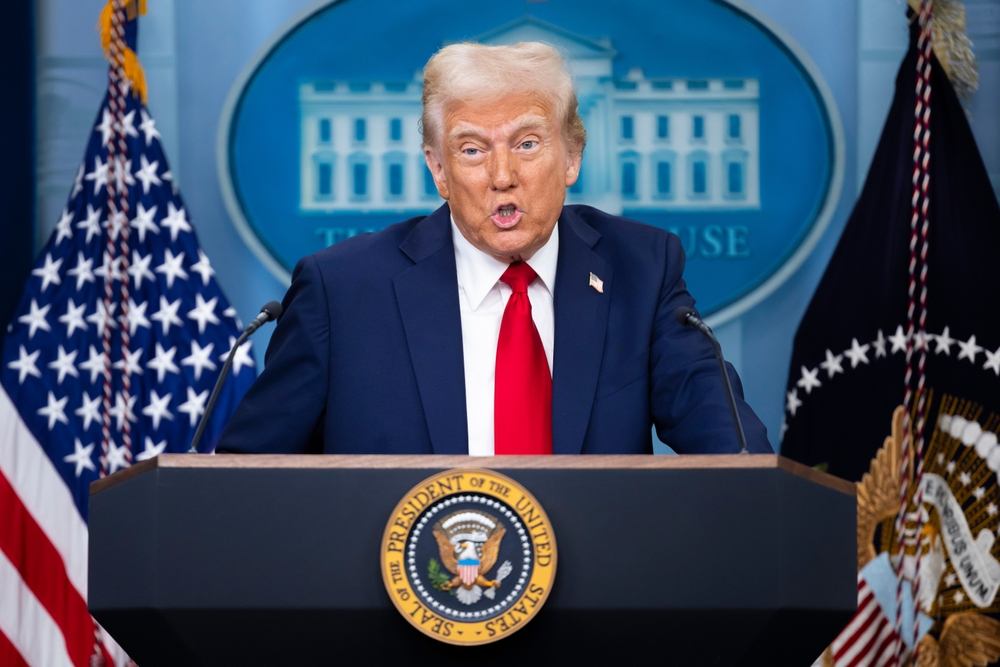
President Donald Trump delivered a combative 72-minute address at the World Economic Forum in Davos, Switzerland, demanding immediate negotiations for Greenland while explicitly rejecting the use of military force to acquire the Danish territory. The remarks came as European leaders anxiously gathered in the Swiss Alps to confront what many see as a fundamental challenge to transatlantic relations.
Trump’s Greenland Ultimatum
Trump opened the contentious portion of his speech by calling for immediate talks to acquire the Arctic territory, ridiculing Denmark for losing Greenland in six hours during World War II. Yet he simultaneously attempted to calm fears that have rattled NATO allies for weeks.
While the president acknowledged that America could prove unstoppable if it chose military action, he stated plainly that force was off the table. Trump framed the matter as a simple request, insisting that only the United States possesses the capacity to protect, develop and improve what he called a giant piece of land and ice.
The president emphasized American exceptionalism, declaring the United States a great power while dismissing Denmark as incapable of managing such a vast territory. His message to Danish leadership was blunt yet diplomatic: agree to negotiations and earn American appreciation, or decline and be remembered for that choice.
Davos Tensions Reach Breaking Point
Trump’s appearance dominated the Swiss forum long before his arrival, with financial markets reacting sharply to his threats of imposing tariffs on allies who refuse to cooperate on Greenland. Hours before the speech, investors began selling American assets, reflecting deep unease about the trajectory of international economic relations.
Treasury Secretary Scott Bessent dismissed reports of Europeans divesting from American holdings while urging nations not to retaliate against potential tariffs. The friction between American and European officials was impossible to ignore throughout the gathering, with European Central Bank chief Christine Lagarde reportedly walking out of a dinner during contentious remarks from Commerce Secretary Howard Lutnick the previous evening.
Sweeping Criticisms of Europe
Rather than extending an olive branch to anxious allies, Trump opened with sharp criticism of European nations. He claimed certain European areas have become unrecognizable and insisted the continent faces a crisis driven by unprecedented mass migration.
Trump revisited World War II, suggesting that without American intervention, Europeans would now be speaking German and Japanese. He portrayed America as the singular force keeping the world afloat, claiming most countries could not function without American support.
The president singled out Switzerland, the host nation, suggesting it benefits unfairly from American largesse. He recounted a conversation with French President Emmanuel Macron about prescription drugs, claiming he told Macron that France had been exploiting America for three decades.
Economic Claims and Energy Policy
Trump proclaimed that America is experiencing the fastest economic turnaround in its history, declaring that inflation has been defeated. He positioned the United States as the planetary economic engine, suggesting that when America prospers, the world follows, and when America struggles, global economies suffer alongside it.
Breaking from the climate-focused agenda typically embraced at Davos, Trump spoke extensively about fossil fuels and denounced what he called the green new scam. He boasted about dismantling wind energy projects, directly contradicting the environmental priorities of most forum participants.
Chaotic Scene at Packed Venue
When doors opened for the speech, well-dressed attendees rushed forward in a chaotic scramble to enter the venue. Most who waited in line found themselves blocked from the packed hall, revealing that while security remained tight, crowd management fell short.
Despite Trump’s polarizing relationship with the global elite typically drawn to Davos, his appearance proved to be the most sought-after event of the gathering. European leaders left the speech facing difficult questions about how to respond to an American president willing to publicly threaten allies while simultaneously demanding cooperation.
The Davos address crystallized a broader rupture in the postwar order, leaving allies to debate whether Trump’s approach represents temporary disruption or permanent transformation in how America engages with the world.
Source: Axios Media Inc
