


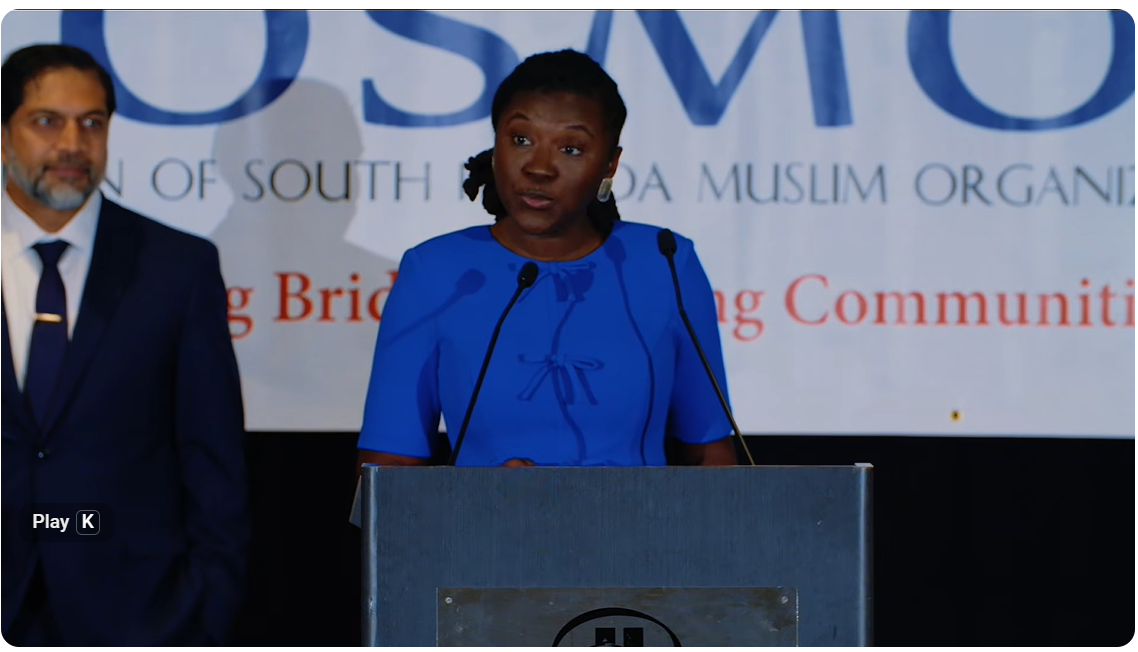
Nancy Metayer Bowen had buried her brother less than four months ago. She had just appeared on the campaign trail. She was days away, by some accounts, from formally announcing a run for Congress. On April 1, 2026, colleagues who could not reach her requested a wellness check. Police arrived at her Coral Springs home and found her dead.
Her husband, Stephen Bowen, now faces charges of first-degree premeditated murder and tampering with evidence.
What police found and what followed
Officers arrived at the home just after 10 a.m. after Metayer Bowen failed to appear for a scheduled meeting. Inside a second-floor bedroom, they found her body wrapped in blankets and garbage bags. A pillow with burn marks was recovered at the scene, along with three shotgun shells.
Bowen was located at an apartment complex in Plantation, where he was allegedly seen handing off a gun bag and ammunition. During interviews with investigators, he allegedly told police he had shot his wife three times the day before her body was discovered. He is currently being held without bond at the Broward County Jail.
The chief of police has said there are no other suspects in the case.
A trailblazer in Florida politics
Metayer Bowen made history as the first Black and Haitian American woman elected to the Coral Springs City Commission. She went on to serve as vice mayor and had become a prominent figure in the Florida Democratic Party, where she held the role of vice chair of Haitian outreach. She was also a trained environmental scientist and a board member of Friends of the Earth.
U.S. Rep. Jared Moskowitz, who represents Coral Springs, said he had seen her just days before her death. She had, he noted, recently buried her brother Joshua, 26, who died by suicide in December 2025. Joshua was a survivor of the February 14, 2018, mass shooting at Marjory Stoneman Douglas High School.
Moskowitz said Metayer Bowen had been preparing to announce a congressional bid. That announcement never came.
‘The world is less bright without her’
The response from elected officials across Florida was immediate. Florida Democratic Party Chair Nikki Fried described Metayer Bowen as a scientist, an environmentalist, and a barrier-breaker who believed that a more equitable future was possible. House Democratic Leader Fentrice Driskell said she had held Metayer Bowen in a hug at the party’s leadership summit just two weeks before her death.
U.S. Rep. Debbie Wasserman Schultz called her a visionary young leader and said she had served as her mentor. U.S. Rep. Maxwell Frost said Black women are disproportionately targeted by gun violence and that Metayer Bowen’s loss was a reflection of that crisis.
North Miami Rep. Dotie Joseph put a number to the broader pattern. Roughly 137 women and girls are killed by intimate partners or family members every day worldwide. In the United States alone, more than 70 women are shot and killed by an intimate partner each month.
Coral Springs City Manager Catherine Givens described Metayer Bowen as the light in every room she entered. Commissioner Joshua Simmons, her colleague on the city commission, said the body they serve now feels incomplete.
Her family’s words
Her sister, writing on behalf of the family on Metayer Bowen’s Facebook page, said that while many knew her as a leader and an advocate, the family knew her as a sister, a daughter, and a friend. They wrote that her warmth and laughter filled every room and that her legacy would live on in the policies she helped shape and in the lives she touched.
The family asked for privacy while they grieve.
A candlelight vigil was held in her honor at Coral Springs City Hall.
What her death reflects
Several officials framed Metayer Bowen’s killing not as an isolated tragedy but as part of a documented and growing pattern of domestic violence and gender-based violence. Republican committeewoman Angie Wong, writing publicly, said domestic violence is not a private matter. It is, she said, a public safety crisis.
David Hogg, the Marjory Stoneman Douglas survivor and gun control advocate, said he had been texting with Metayer Bowen about her political plans 48 hours before the news broke.
She was preparing for a future. The community she served is now preparing for a loss it did not see coming and is not sure how to absorb.
