


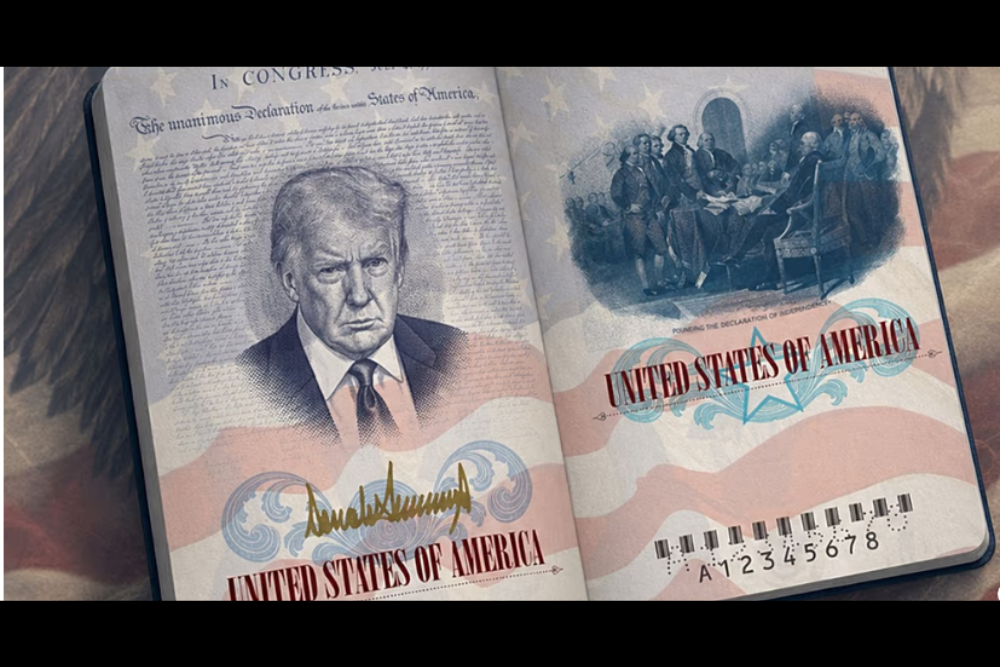
The State Department is moving forward with plans to print 25,000 limited edition U.S. passports featuring President Donald Trump’s face on the inside cover. The image, drawn from his second presidential portrait, will appear alongside a reproduction of the Declaration of Independence. A gold version of Trump’s signature will also be included in the design. According to a report by The Bulwark, the rollout is timed to coincide with the nation’s 250th anniversary celebration on July 4, 2026.
No sitting or former American president has ever had their likeness placed on a U.S. passport. Georgetown University professor Edward Kolla told reporters the move is without precedent not just in American history but across the world, describing it as something that falls well outside the norms of how heads of state typically appear on government travel documents.
What the Trump passport actually looks like
Fox News was among the first outlets to publish images of the new design. The inside cover features Trump’s portrait alongside the Declaration of Independence, and the back cover includes imagery of the Founding Fathers. Tommy Pigott, a State Department spokesperson, framed the limited edition as part of a broader effort to mark America’s semiquincentennial and celebrate the country’s history.
The passports are being produced under the America250 initiative, the umbrella branding the Trump administration has attached to its anniversary programming. That programming also includes a UFC fight on the White House South Lawn and a Grand Prix race scheduled in Washington, D.C.
How the Trump passport fits a larger pattern
The passport design is one piece of a broader effort by the Trump administration to attach the president’s personal identity to official government products and national events. His signature is also set to appear on U.S. currency for the first time, and the U.S. Mint has approved a commemorative gold coin bearing his likeness.
In 2025, Trump organized a military parade in Washington to mark the 250th anniversary of the founding of the U.S. Army, an event that fell on his birthday and drew protests in multiple cities. Earlier attempts to brand the Kennedy Center with his name led to a wave of cancellations from artists and performers who objected to the association.
An Interior Department spokesperson described the July 4 celebration as a once-in-a-lifetime event that captures the American spirit under Trump’s presidency. Critics read that framing differently, arguing that the through line connecting all of these initiatives is not national pride but personal branding.
How the public is reacting to the Trump passport
The announcement generated a fast and pointed response online. Much of the reaction centered on the practical reality of traveling internationally with a passport bearing Trump’s face, given how polarizing his image is in many parts of the world. Comedian Mike Drucker captured the sentiment that circulated widely, noting that carrying a photo of one of the most divisive figures on the planet would not make crossing borders any easier. The comment spread quickly because it named something a lot of people were already thinking.
What this moment says about Trump’s presidency
Putting a sitting president’s face on a travel document that Americans carry into other countries is a decision with real consequences beyond the symbolic. Passports are functional objects. People use them at checkpoints, in airports, and at border crossings in countries where opinions about Trump range from skeptical to openly hostile. The design choice prioritizes commemoration over practicality, and the 25,000 passports being printed will belong to people who may not have chosen that design if given the option.
The 250th anniversary of the United States arrives on July 4, 2026. The passport will outlast the celebration by years.
