


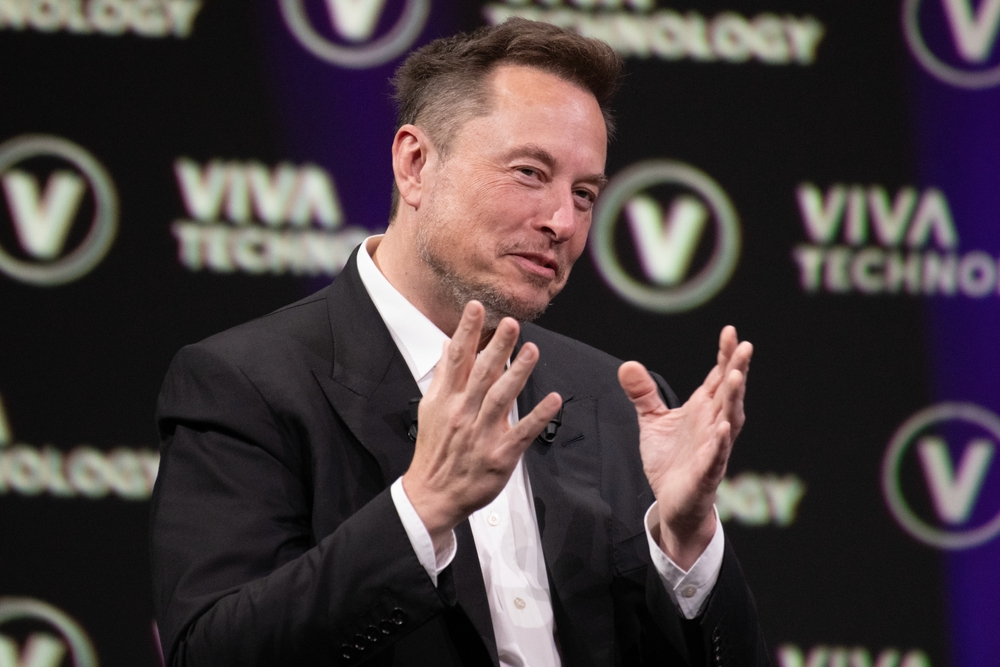
Tesla’s most recent quarterly earnings landed in mixed territory. Revenue came in below analyst expectations while earnings outperformed them, a result that would have dominated the coverage cycle a few years ago. What drew more attention this time was something Elon Musk said about where Tesla is headed next with Nvidia, and what it likely means for the company supplying much of the AI industry’s computing infrastructure.
Musk signaled that Tesla plans a substantial increase in capital expenditures going forward. The spending is aimed at scaling two projects that have become central to Tesla’s repositioning beyond electric vehicles: its Optimus humanoid robot and its robotaxi service, which runs on the company’s full self-driving software. Both require significant AI training capacity, and that is where Nvidia enters the picture.
Tesla’s dual-chip approach keeps Nvidia relevant
Tesla is not a passive buyer in the chip market. The company has been developing its own AI chips internally, and it uses them where cost efficiency makes that practical. But like several major technology companies, Tesla takes a dual approach, relying on its proprietary designs for certain workloads while purchasing Nvidia chips for AI model training at scale. Musk confirmed last year that Tesla was not planning to move away from Nvidia entirely, which means the company’s increased investment plans feed directly into Nvidia’s order book.
Nvidia CEO Jensen Huang has projected $1 trillion in purchase orders through 2027 for the company’s upcoming Vera Rubin and Blackwell AI chips. Tesla’s expanded spending is one tributary in what has become a broad and accelerating current of AI hardware demand.
Optimus and robotaxis represent Tesla’s largest bets
The Optimus robot is designed to perform everyday physical tasks and is built to learn from observing human behavior and video demonstrations. Tesla plans to ramp production this year. If the robot can be manufactured at scale and priced competitively, the potential labor market disruption is substantial. That is a large conditional, and the timeline has slipped before, but the strategic logic is clear enough that investors are watching production milestones closely.
The robotaxi service represents a separate but related bet. As Tesla’s FSD software matures, the company sees an autonomous ride-hailing network as a significant revenue opportunity. Both the robotaxi and Optimus projects require ongoing AI training, which sustains demand for the chips that make that training possible.
Tesla’s EV sales have been under pressure for roughly two years, with some recovery visible in the most recent quarter. Musk’s position is that the EV business becomes a secondary concern if the robotics and autonomous driving bets pay off over the next decade. That framing helps explain why the company is willing to absorb near-term margin pressure to fund longer-horizon projects.
What this means for Nvidia’s trajectory
Musk also noted that the trend toward higher capital expenditures is not unique to Tesla. Most major technology companies have been moving in the same direction. That broader pattern supports Nvidia’s medium-term outlook more than any single customer’s spending plans would on its own.
Analysts covering Nvidia carry an average price target of $269.17, representing upside of nearly 35% from current levels. The company already holds the largest market capitalization of any publicly traded company, which means the bar for continued outperformance is high. Valuation remains the most cited risk, alongside competition from other chipmakers investing heavily in AI hardware and the possibility of a broader pullback in AI spending if returns on that investment disappoint.
The risks are real and worth naming
Tesla’s shares trade at a forward earnings multiple that prices in substantial execution on the Optimus and robotaxi fronts. If either project encounters serious technical, regulatory or competitive obstacles, the valuation case weakens quickly. For investors comfortable with that profile, the long-term thesis is coherent. For those who are not, the risk-reward balance looks less attractive at current prices.
For Nvidia, the more immediate question is whether demand sustains at the levels Huang has projected. The company’s recent growth has been built on a wave of AI infrastructure spending that shows no sign of reversing, but waves do eventually crest. Musk’s comments suggest that wave has further to run, at least for now.
