


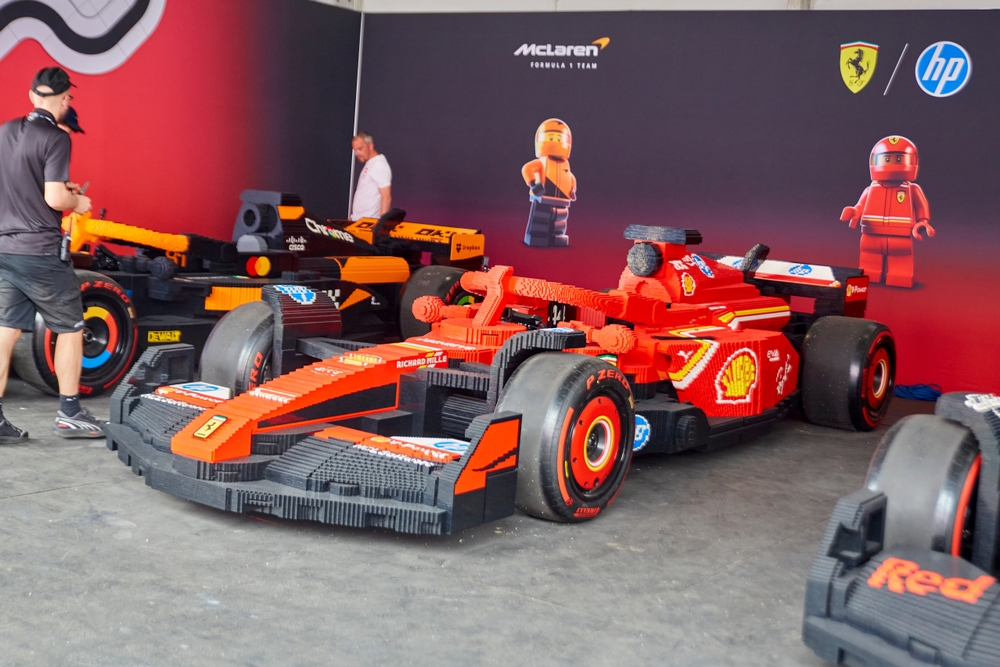
Lego is bringing 22 individually designed electric go-karts to the British Grand Prix driver parade at Silverstone on Sunday, upgrading its previous appearance at the Miami Grand Prix driver parade with smaller, faster, and structurally reinforced builds that give each driver their own vehicle for the first time.
Last year’s full-size cars, which seated two teammates side by side in a single shared build, gave way to individual minicars following feedback from both fans and a team of master builders who watched Miami’s driver parade dissolve into collisions, laughter, and a trail of scattered bricks. The lesson was simple and it informed every design decision that followed.
Built to survive what drivers will do to them
Each minicar has been constructed from more than 28,300 individual bricks by a team of 20 designers, engineers, and builders at Lego’s manufacturing facility in Kladno, Czech Republic. The construction of all 22 vehicles required approximately 6,400 combined working hours. Each completed kart weighs around 280 kilograms, of which 65 kilograms is Lego bricks mounted on a specially designed steel support structure.
The bricks on each car are arranged to reflect the livery and branding of the driver’s respective team, giving the parade a visual identity that ties the Lego builds directly to the competitive world of the sport they are celebrating. The individual designs cover all 11 teams currently competing in the championship.
Knowing what happened in Miami, the Lego designers made deliberate choices to make the vehicles more structurally resilient while keeping the playful spirit of the concept intact. Roll-hoops, fenders, and bumpers were added around the exterior, with the explicit acknowledgment that the drivers would hit each other’s cars and that the builds needed to survive a reasonable amount of contact without shedding too many pieces. Driver safety was also considered as part of the structural brief.
Faster than Miami and ready for Silverstone
The minicars are capable of reaching speeds approaching 18 miles per hour, a meaningful increase over the 13 miles per hour achieved by the larger builds at Miami. The combination of individual vehicles, higher top speed, and the competitive instincts of the world’s 22 best racing drivers creates conditions that Lego’s team appears to be welcoming rather than trying to prevent.
The driver parade is scheduled to begin at 1 p.m. local time at Silverstone and will be broadcast live on Formula 1’s YouTube channel, giving fans around the world access to what promises to be one of the more entertaining non-race moments of the British Grand Prix weekend.
Lego’s senior designer described the process of reviewing footage from Miami as a source of inspiration rather than concern, noting that the overwhelming reaction from drivers and fans had been positive and that the goal for Silverstone was to build on that experience rather than sanitize it. The smashed bricks, the uncontrollable laughter among drivers, and the fan response had all pointed to a concept that worked precisely because it was unpredictable.
An event that became part of the spectacle
The Miami driver parade’s Lego segment quickly became one of the most viewed and shared moments from that race weekend across social media, capturing the contrast between the technical precision of Formula 1 competition and the pure childlike enjoyment of 22 of the world’s most accomplished athletes trying to crash into each other in electric Lego go-karts.
Silverstone’s version arrives with considerably higher anticipation, a capacity crowd that the circuit expects to be the largest in Formula 1 history, and a record-breaking championship season to celebrate. The minicars add one more element to a weekend that already has plenty of reasons to watch.
