


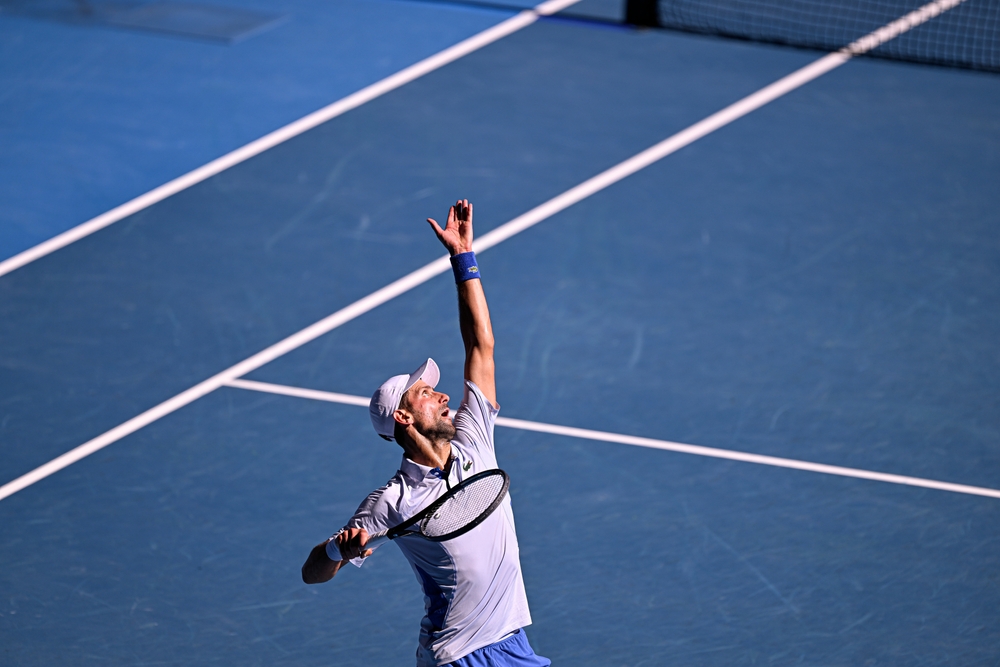
Novak Djokovic surpassed Roger Federer’s all-time men’s record for match victories at Wimbledon on Sunday, reaching the quarterfinals with his 106th career win at the All England Club after a grinding three-hour-and-26-minute battle against a qualifier that required him to change his tactical approach and manage some very public emotional outbursts along the way.
The seven-time Wimbledon champion was characteristically dismissive of the record itself, noting that he had not even been aware of it until after the match and describing it as essentially irrelevant to what he is actually trying to accomplish at the tournament. The record he is pursuing at Wimbledon is an eighth title and a 25th Grand Slam trophy overall, achievements that would be unprecedented in the history of the sport.
A match that tested him in unexpected ways
The fourth-round opponent, a 132nd-ranked qualifier, was the lowest-ranked player Djokovic has ever faced in a Grand Slam match, and the Serbian has never lost to either a qualifier or a player ranked that low in a major. Despite that, the match produced the most difficult ninety minutes of Djokovic’s Wimbledon first week, with the qualifier repeatedly outplaying him in baseline exchanges during extended rallies.
Djokovic trailed 5-2 in the opening set and had to save two set points before eventually winning the tiebreaker. He was broken early in the third set, which he subsequently lost, and was warned by officials for an apparent outburst of profanity in Serbian audible to those around him on Centre Court. He also drew disapproval from the crowd after hitting a ball away in frustration following that set.
In his on-court interview afterward, Djokovic apologized for what he described as multiple moments where he lost his composure during the match.
The tactical adjustment that won it
Recognizing that he was being beaten in the extended rallies that typically favor him, Djokovic made a conscious decision to move toward the net more frequently than usual, a departure from the baseline-dominant style that has defined his career. The adjustment worked. He opened the fourth set with a 3-0 lead and served out the match without dropping a game to advance.
The match was his longest at Wimbledon since the 2023 final, which went five sets. That it required this much effort against an opponent ranked well outside the top 100 reflects both the quality of this year’s draw and the position Djokovic occupies at 39, where moments of vulnerability that would once have been quickly contained now occasionally require sustained management before he rights the ship.
Records and context across the men’s draw
His 106th Wimbledon match win places him one ahead of Federer on the all-time men’s list for victories at a single major. His 17 Wimbledon quarterfinal appearances place him one behind Federer’s record there as well. He also extended his extraordinary streak of winning every Wimbledon match against players other than the two men currently at the top of the world rankings, a run stretching back to a retirement in 2017.
Djokovic will face a third-seeded Canadian in the quarterfinals, who advanced through a five-set match that produced one of the most astonishing individual points of the tournament, a sequence that had the crowd on its feet and the winner himself laughing in disbelief as it unfolded despite ultimately losing the point.
The defending champion advanced to his fifth Wimbledon quarterfinal, equaling the most by any man in his first six appearances at the tournament in the open era. He will face a German qualifier who reached the last eight for the first time in a major at age 36, becoming the oldest man to do so in the open era.
