


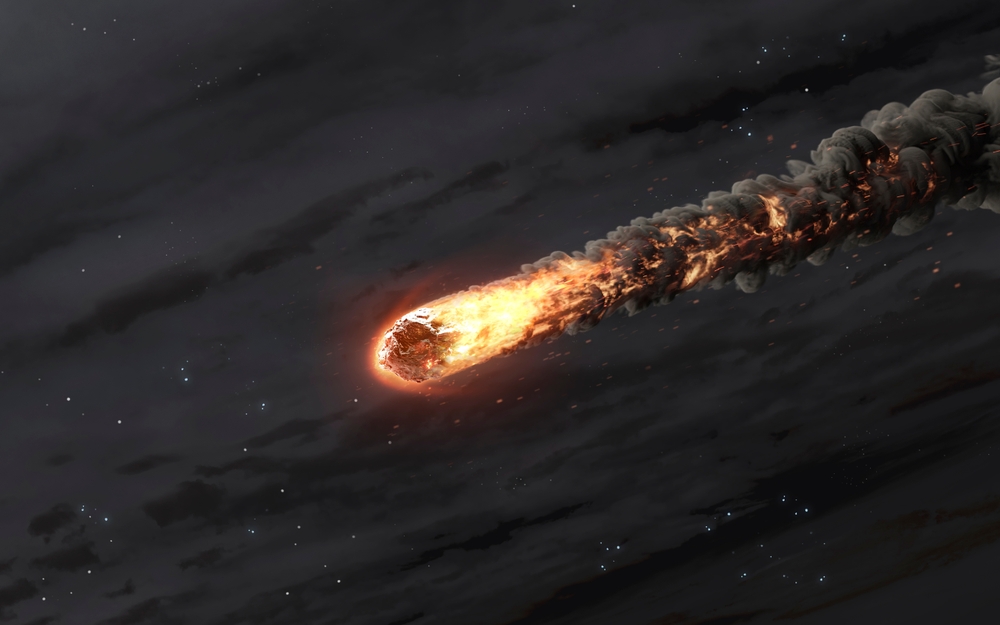
Shortly before 9 a.m. on Tuesday, residents across Northeast Ohio heard a sudden, rattling boom that shook windows, startled pets, and sent people rushing outside to find out what had happened. Some assumed it was a truck, a construction blast, or a minor earthquake. It was none of those things. A 7-ton asteroid had just broken apart roughly 30 miles above Valley City, Ohio, unleashing a pressure wave that rolled across a wide stretch of the region.
NASA confirmed the event and said the space rock entered the atmosphere traveling at 45,000 miles per hour. It was first detected about 50 miles above Lake Erie, near Lorain, Ohio, before moving southeast through the upper atmosphere over a span of 34 miles. The fragmentation happened over Valley City, and NASA said small pieces of the meteor likely scattered across Medina County, with some reaching the ground.
Witnesses from 10 states, Washington, D.C., and the Canadian province of Ontario reported seeing the bright fireball moments before 9 a.m. The National Weather Service office in Pittsburgh shared video of the meteor captured by an employee, showing it arcing visibly across the morning sky.
Why nobody got a warning
One of the most common questions that followed the event was straightforward: why was there no alert? The answer, according to experts, comes down to size. The asteroid measured roughly 6 feet in diameter, far too small to be tracked by telescopes monitoring near-Earth objects before atmospheric entry.
Ralph Harvey, a geological sciences professor at Case Western Reserve University, noted that NASA has only tracked a space object all the way to Earth three times in recorded history. A rock of this size offered no advance window for detection or warning, and by the time it became visible, it was already burning through the atmosphere at hypersonic speed.
Bill Cooke, who leads NASA’s Meteoroid Environments Office and monitors space objects large enough to track, confirmed the meteor was well below the threshold for pre-entry detection. Where the asteroid originated remains unclear. It may have drifted from the asteroid belt or broken away from a larger object, but there is no definitive answer yet.
The science behind the boom
The explosive sound residents heard was caused by the asteroid fragmenting under the stress of atmospheric entry, creating a pressure wave that traveled down to the surface. NASA calculated that the energy released in that moment was equivalent to 250 tons of TNT, the kind of force associated with a large military-grade detonation, occurring directly above a populated metropolitan area.
The National Weather Service in Cleveland identified the object using a geostationary lightning mapper, an instrument normally used to track lightning strikes by detecting rapid flashes of light in the atmosphere. Meteors produce a similar signature, and the instrument registered a green flash above Cleveland in the moments following the event.
The fragmentation was not visible to the naked eye in real time for most residents, but those who happened to be outdoors or near windows reported seeing a bright streak cross the sky before the sound arrived. Some described it as a daylight fireball, a term used for meteors bright enough to be seen against a sunlit sky, which requires an unusually powerful and luminous object.
Ohio has had a busy stretch of fireball sightings
Tuesday’s event was not an isolated occurrence. In mid-February, a separate meteor was caught on a doorbell camera over Ohio around 11:30 p.m. Another fireball was filmed on March 15, just two days before the Valley City event. While meteors enter the atmosphere daily, the combination of size, speed, and timing that makes one visible in daylight and audible across multiple states is considerably rarer.
NASA said no significant threat was posed at any point, and the fragments that reached Medina County would have been small. The agency continues to gather data from the event.
