


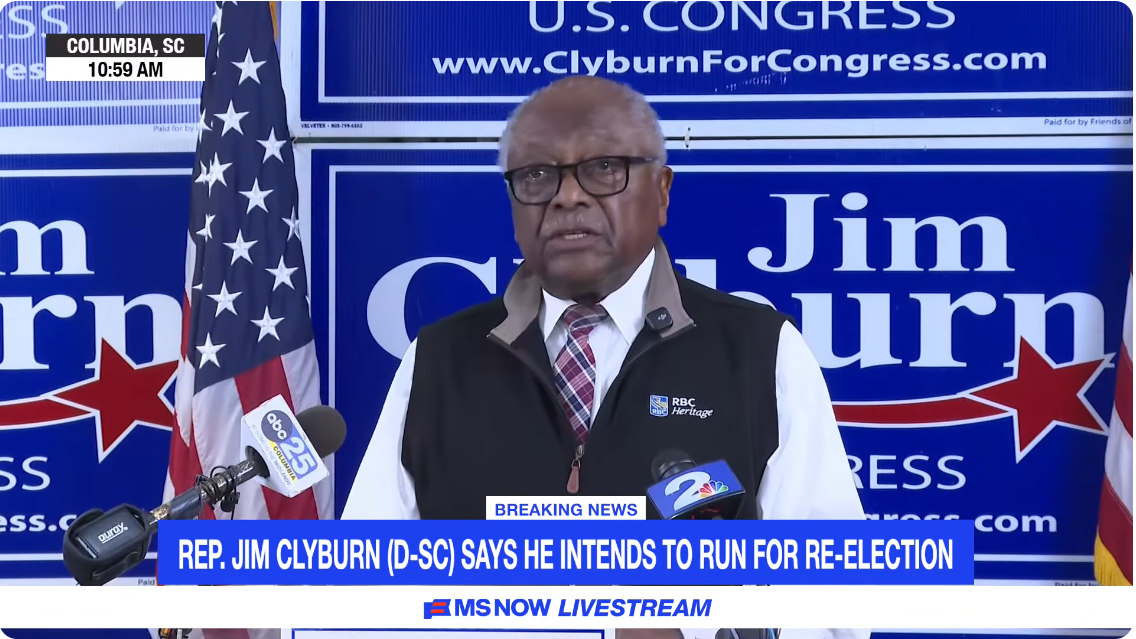
Rep. Jim Clyburn announced Today that he will run for reelection this November, pushing back against a wave of Democratic retirements and a growing chorus within the party calling for new blood in leadership. The 85-year-old South Carolina Democrat made the announcement at the state party headquarters in Columbia, telling a room of supporters he was physically capable and politically ready to serve another term.
Clyburn framed his decision around a sense of obligation rather than personal ambition. He pointed to the Constitution’s preamble as the foundation of his reasoning, describing the pursuit of a more perfect union as work that remains unfinished and worth continuing.
Clyburn breaks with a generation of Democratic leaders
The announcement separates Clyburn from the two colleagues who defined his political era. Reps. Nancy Pelosi of California and Steny Hoyer of Maryland, the other two members of a leadership triumvirate that guided House Democrats from 2007 to 2023, have both announced plans to retire. Their departures will leave Clyburn as the last of that trio still serving.
First elected in 1992, Clyburn has spent more than three decades in the House. He rose through the Congressional Black Caucus, where he served as chairman from 1999 to 2001, before ascending to the Democratic leadership ranks. After Democrats reclaimed the House in the 2006 midterms, he was elected majority whip, the No. 3 position in the caucus. He stepped down from that role in 2023 and later relinquished his position as assistant Democratic leader in 2024.
Clyburn became the first Black congressman to represent South Carolina in nearly a century and has since built a reputation as one of the most consequential Democratic power brokers in the country. He helped shepherd major legislation through the House, including the Affordable Care Act and the Inflation Reduction Act.
Jeffries called and asked him to stay
One factor in his decision was a phone call from House Minority Leader Hakeem Jeffries the day before the announcement. Jeffries, who has long discussed his goal of becoming the first Black speaker of the House, told Clyburn he wanted him involved in Democratic leadership if the party recaptured the majority. Clyburn said the conversation left him feeling that his presence was still valued and that his experience had a meaningful role to play in whatever came next.
Jeffries had not known what Clyburn’s decision would be before making the call, which Clyburn noted added weight to the outreach. The minority leader’s interest in keeping him close was enough to tip the balance toward running.
Clyburn also said he surveyed his staff, who showed him polling data indicating that constituents remained invested in his continued service. His family had been divided on the question heading into the announcement, though he ultimately concluded the support around him outweighed the hesitation.
A national debate playing out at home
His decision arrives at a complicated moment for the Democratic Party. Across the country, younger candidates are mounting primary challenges against longtime incumbents, centering their campaigns on the argument that older representatives should make way for the next generation.
Rep. Steve Cohen of Tennessee, 76, faces a serious primary challenge from state Rep. Justin Pearson, who is 31. Rep. Al Green of Texas, 78, is being challenged by Rep. Christian Menefee, 37. Sen. Edward Markey of Massachusetts, 79, faces a campaign from Rep. Seth Moulton, 47, who has made generational change the centerpiece of his message.
That debate traces back to 2024, when President Biden, then 81, stepped aside as the Democratic nominee in favor of Vice President Kamala Harris. The question of when older Democrats should pass the torch has not quieted since.
Clyburn, who turns 86 in July and would be 88 by the end of another term, is among the most prominent figures choosing to stay put. His 6th District is heavily Democratic, and he remains a commanding favorite in any general election matchup. Some South Carolina Republicans have attempted to target his seat through redistricting, though those efforts have not reshaped the district’s fundamental political composition.
His national influence, particularly around the early South Carolina presidential primary, also factored into the conversation. His 2020 endorsement of Biden is widely credited with rescuing what had been a struggling campaign and setting it on a path to the White House.
