


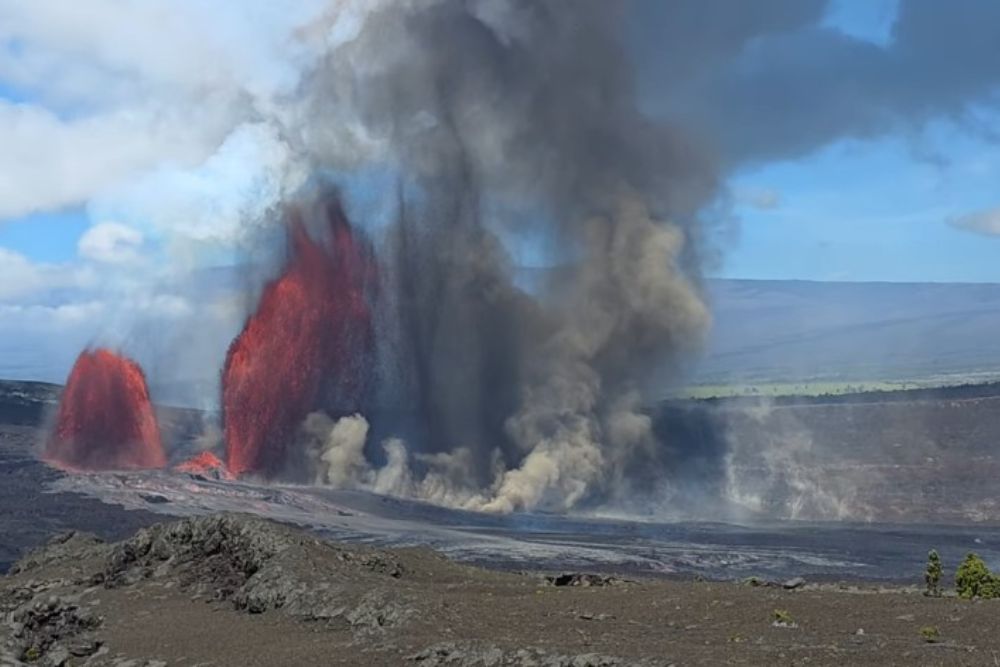
The ground on Hawaii’s Big Island has been restless for months, but what unfolded early Tuesday morning was nothing short of extraordinary. Kilauea, one of the most persistently active volcanoes on Earth, launched twin columns of bright-red lava soaring 1,000 feet into the air — marking its 43rd fountaining episode since eruptions began again in December 2024.
The fiery spectacle drew immediate attention from across the globe, even as local officials scrambled to manage its real-world consequences: road closures, ashfall warnings, and temporary shelter openings for displaced residents and tourists.
Kilauea’s Relentless Run of Fire
Since late 2024, Kilauea has settled into an unsettling rhythm of intermittent eruptions, each one reminding the island’s residents that life here is lived alongside one of nature’s most powerful forces. Tuesday’s episode was among the most visually dramatic, with two vivid lava fountains erupting simultaneously from the volcano’s summit crater, billowing thick plumes of smoke visible for miles.
The United States Geological Survey captured the event on livestream, giving the world a front-row seat to the raw, molten spectacle. Fountaining episodes like this one can range from a few intense hours to several sustained days — and predicting their duration remains an imprecise science.
Closures and Community Disruption
The eruption triggered swift action from local authorities. Hawaii Volcanoes National Park temporarily shuttered its gates, and portions of Highway 11 — a vital artery connecting communities across the Big Island — faced partial restrictions as falling volcanic fragments, known as tephra, rained down on surrounding areas.
Hawaii County officials moved quickly to open an emergency shelter at a local gymnasium, making space available for anyone displaced by road closures or affected by the ashfall. As of Tuesday, the shelter had yet to see any occupants, a sign that most residents had either sheltered in place or found alternative arrangements.
The Hidden Health Danger in the Ash
Beyond the spectacle lies a serious public health concern. The National Weather Service issued an ashfall advisory, warning that volcanic tephra poses real risks to the eyes, skin, and respiratory system. For residents relying on water catchment systems — a common setup across many parts of the Big Island — the ash contamination can be particularly disruptive, compromising water supplies and requiring extensive cleanup.
In past eruption episodes, ashfall was severe enough that Hawaii County civil defense teams were deployed to help clear debris from homes and properties. Officials urged residents to take precautions seriously and monitor conditions closely.
Why Kilauea Never Really Stops
Kilauea’s activity is not an anomaly — it is the norm. Sitting atop one of the most geologically dynamic hotspots on the planet, the volcano has been erupting in various forms for decades. Scientists at the USGS continue to monitor seismic activity, ground deformation, and gas emissions around the clock, feeding data into early warning systems designed to give communities as much lead time as possible before conditions escalate.
The ongoing eruption cycle is a stark reminder that Hawaii’s breathtaking landscape is not static — it is being actively built and reshaped beneath the feet of everyone who calls it home.
Staying Safe During an Active Eruption
For residents and visitors hoping to witness Kilauea‘s power firsthand, preparation is everything. Authorities stress the importance of checking real-time updates from the USGS and Hawaii Emergency Management Agency before venturing near eruption zones. Face masks or respirators are strongly recommended in ashfall areas, and anyone with respiratory conditions should take extra precautions.
The volcano‘s lava currently remains contained within its summit crater, posing no direct threat to residential areas — but volcanic environments are unpredictable, and conditions can shift rapidly.
Kilauea is not just a geological wonder. It is a living, breathing force that continues to shape the Big Island in real time — one fountain of fire at a time.
