


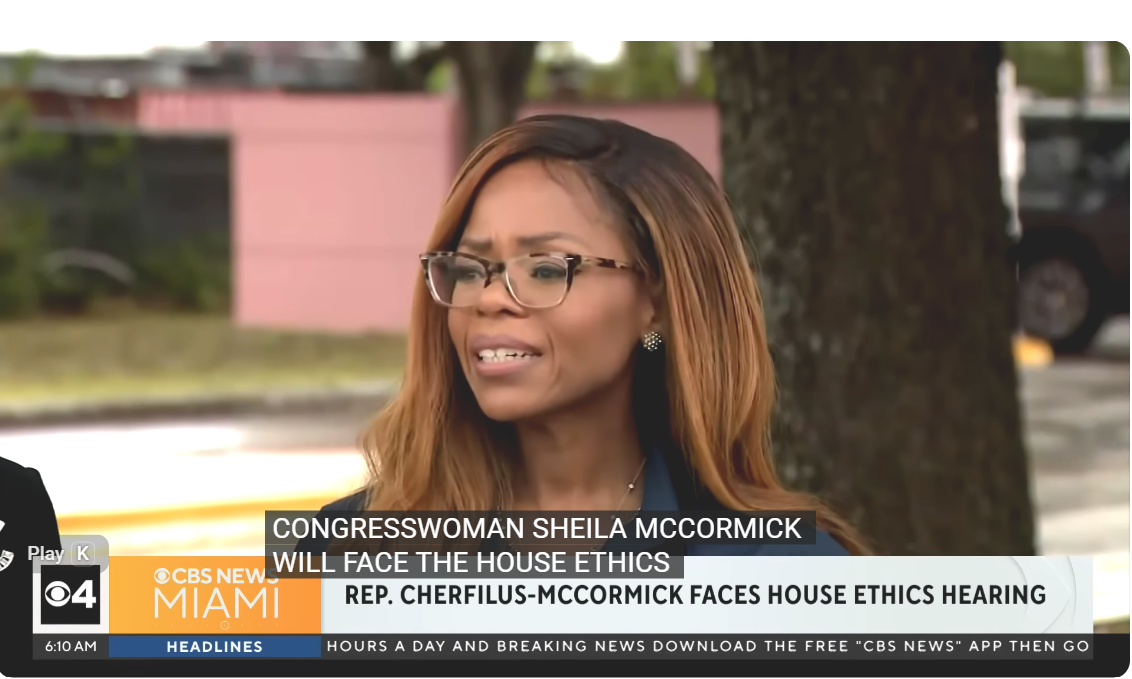
The House Ethics Committee’s adjudicatory subcommittee announced Today that it had proven 25 of 27 counts of ethics violations against Rep. Sheila Cherfilus-McCormick, a Florida Democrat. The finding came after a rare public hearing Thursday that stretched well past midnight, during which a bipartisan panel reviewed evidence compiled over a two-year investigation that included more than 33,000 documents and 28 witness interviews.
The subcommittee found that counts 1 through 15 and 17 through 26 of the Statement of Alleged Violations had been proven. The violations center on allegations that Cherfilus-McCormick improperly used millions of dollars in federal disaster relief funds to finance her 2021 special election campaign.
The allegations at the center of the case
Federal prosecutors allege that Cherfilus-McCormick funneled money from Trinity Healthcare Services, her family’s company, into her congressional campaign. Trinity had received overpayments from FEMA, and investigators presented flow charts during Thursday’s hearing showing how those funds allegedly moved from the Florida Department of Emergency Management through the company and into her campaign. A separate chart illustrated alleged transfers from the Haitian government to her campaign vendors.
The subcommittee alleged she committed violations including improper receipt of funds and the commingling of personal and campaign finances. She was indicted in November on charges of stealing $5 million in disaster relief funds and has pleaded not guilty.
Her lawyer’s argument and where it fell short
Cherfilus-McCormick’s attorney, William Barzee, spent much of Thursday’s hearing arguing that his client was entitled to the money she received from Trinity under a profit-sharing agreement. When pressed by committee members to produce that agreement, Barzee presented a document that turned out to be unsigned.
Rep. Nathaniel Moran, a Texas Republican, called it offensive to suggest that an unsigned document qualified as a binding profit-sharing agreement, noting that Cherfilus-McCormick had two years to produce a signed version and never did.
Barzee also moved repeatedly to delay the hearing or move it behind closed doors, telling the panel he had been on the case for fewer than three weeks and needed more time to prepare. He argued that a public proceeding could compromise her potential jury pool ahead of a criminal trial expected to begin in April. The panel denied the request.
Rep. Mark DeSaulnier, the committee’s top-ranking Democrat, addressed the broader stakes of the proceeding directly, saying that at a moment when public confidence in Congress is low, the committee’s role in upholding the integrity of the House could not be more important.
What comes next for Cherfilus-McCormick
In April, the committee will recommend a punishment to the full House, which could range from censure to removal from committees to expulsion. Expulsion requires a two-thirds vote from the chamber.
Some Republicans have already signaled they will push for expulsion. At least one Democrat, Rep. Marie Gluesenkamp Perez of Washington, has said publicly that Cherfilus-McCormick should resign or be removed.
The last House member to be expelled was Rep. George Santos, a New York Republican, in 2023. Santos was later sentenced on charges of wire fraud and identity theft before President Trump commuted his prison sentence.
Cherfilus-McCormick’s position
Cherfilus-McCormick has denied wrongdoing throughout the investigation and the hearing. In a statement Friday morning, she said she looks forward to proving her innocence and described her focus as remaining on the constituents of Florida’s 20th District who sent her to Washington.
Her criminal trial is expected in April, though Barzee told the committee it could slip to the summer or fall. Committee counsel noted there was no guarantee it would take place this year at all.
