


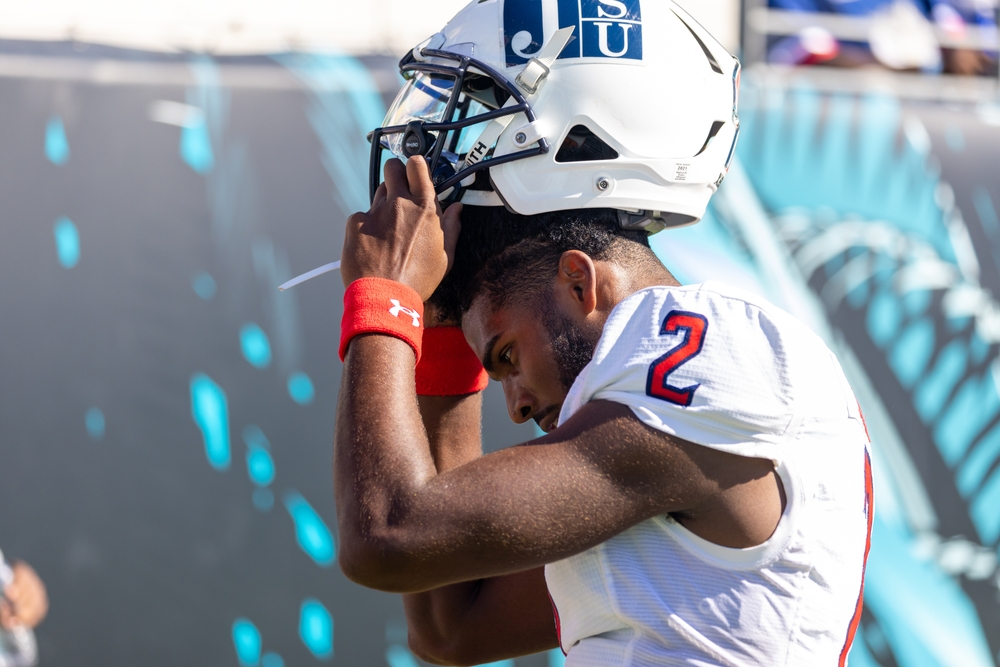
Shedeur Sanders did not take the easy road. When the son of Pro Football Hall of Famer Deion Sanders chose Jackson State University — a historically Black college in Mississippi — over Power Five programs like Alabama and Oregon, the football world raised an eyebrow. Four years later, that decision looks less like a gamble and more like a blueprint.
Sanders is now a Cleveland Browns quarterback carrying the weight of a generation on his shoulders. But before the bright lights of the NFL, there was the SWAC, the Celebration Bowl, and a program that he helped transform into a national conversation. His story begins — and will always be rooted — at an HBCU.
Sanders Chose Jackson State When It Mattered
In January 2021, Sanders enrolled at Jackson State as the highest-rated recruit in the school’s history. He had offers from some of the most prestigious programs in college football but chose to follow his father, who had just been named head coach of the Tigers. That decision was met with skepticism. It would not stay that way for long.
As a freshman, Sanders threw for 3,231 yards and 30 touchdowns, leading Jackson State to an undefeated regular season in the SWAC. He won the Jerry Rice Award — given to the top freshman in FCS football — becoming the first player from an HBCU to ever claim the honor. It was a signal to the rest of the country that talent does not have a zip code.
His sophomore year was even more dominant. Sanders completed over 70% of his passes for 3,732 yards and 40 touchdowns, breaking multiple school records. Jackson State finished 12-1, won the SWAC Championship, and returned to the Celebration Bowl — the game widely known as the HBCU National Championship. Sanders earned the Deacon Jones Trophy, honoring him as the nation’s top HBCU player.
What Sanders Built at an HBCU Was Real
The numbers Sanders posted at Jackson State were not inflated by weak competition. In two seasons, he accumulated 6,983 passing yards, completed 616 of 901 attempts, and threw 70 touchdowns against just 14 interceptions. He went undefeated in SWAC play throughout his entire tenure with the Tigers — a streak he has spoken about with pride.
Beyond statistics, he helped elevate the visibility of HBCU football in ways that extended far past the field. He signed name, image and likeness deals with Gatorade, Beats by Dre, and Nike — becoming the first college football player to ink a deal with the latter. Cameras that had never pointed at Jackson, Mississippi were suddenly locked in on Jackson State.
His impact was cultural. His footprint was national.
The Transfer and the Next Chapter
After the 2022 Celebration Bowl, he entered the transfer portal and followed his father to the University of Colorado. In his first game as a Buffalo, he threw for a school-record 510 yards and four touchdowns in a stunning upset of then-ranked TCU. The HBCU kid had arrived on the biggest stage in college football — and he did not blink.
By the end of his college career, Sanders had completed 70.1% of his passes for 14,353 yards and 134 touchdowns across four seasons. He threw a touchdown pass in 49 consecutive games — the longest streak in NCAA Division I history.
Still, the NFL Draft brought unexpected turbulence. Despite being projected as a potential first-round pick, Sanders slid all the way to the fifth round, where the Cleveland Browns selected him with the 144th overall pick. The slight was felt. The response was loud.
Sanders Rises in Cleveland
The NFL debut was fitting. During his first preseason game, Sanders crossed paths on the field with a referee who had officiated his very first college game at Jackson State — a full-circle moment that captured just how far his journey had come.
When fellow rookie quarterback Dillon Gabriel went down with a concussion midseason, he got his shot. He did not waste it. He was named the starter for the remainder of the 2025 season and finished as the Browns’ QB1 — earning a Pro Bowl nod, a rare honor for a rookie who spent most of the year on the bench.
His rookie season was not perfect. He dealt with a weak offensive line, took 23 sacks across eight starts, and posted a 7-10 touchdown-to-interception ratio. The Browns finished 5-12. But flashes of brilliance — sharp reads, clutch completions, poise under pressure — gave the franchise and its fans a reason to believe.
Sanders’ HBCU Legacy Is the Foundation
Now, with the 2026 season approaching and Cleveland actively rebuilding its offensive line, Sanders heads into a defining year. The starting job is not guaranteed — the Browns have made that clear. But neither is failure for a quarterback who has spent his entire life proving people wrong.
What makes Sanders’ story resonate beyond football is what it represents for HBCU institutions and the communities they serve. He chose Jackson State not because he had to, but because he wanted to. He said it himself at the Shrine Bowl ahead of the draft — HBCUs are his foundation.
That foundation produced a Jerry Rice Award winner, a two-time SWAC champion, a Deacon Jones Trophy recipient, a school-record setter at a Power Five program, and now a professional quarterback in the NFL. He is living proof that the HBCU path is not a detour. For those paying attention, it never was.
