


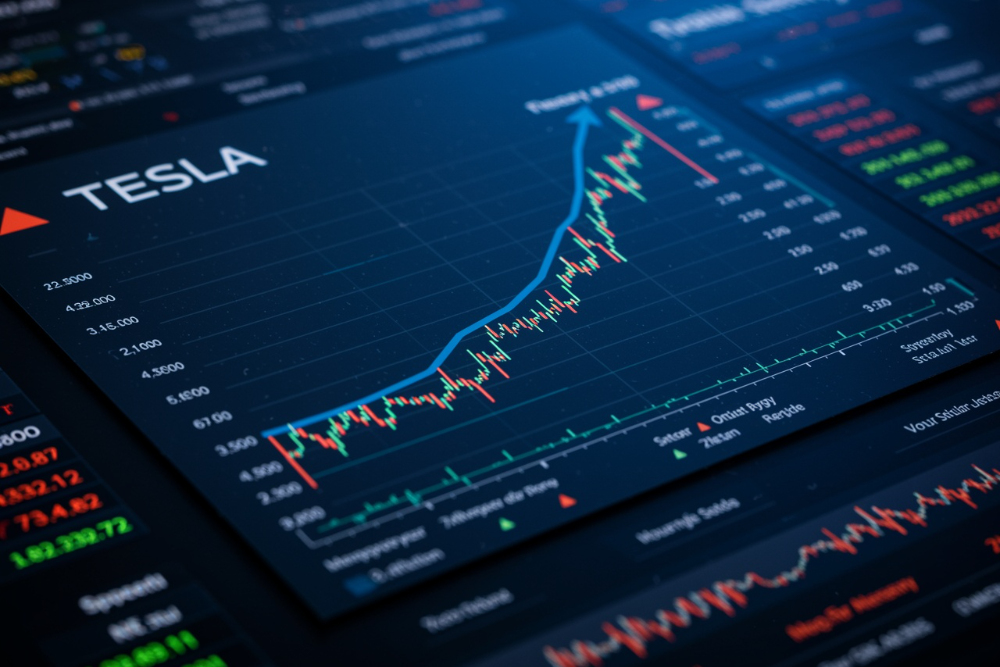
An artificial intelligence forecasting system recently analyzed Tesla’s technical patterns to project price movement through early April 2026. The findings challenge the prevailing Wall Street narrative, suggesting more subdued momentum than the chorus of analysts currently championing the stock. While mainstream sentiment remains overwhelmingly positive, the AI-driven assessment paints a markedly different picture for short-term traders.
The predictive model focused exclusively on recent price behavior and technical momentum indicators specific to Tesla’s trading patterns. When the analysis ran, shares hovered around $444. The system calculated a base-case average price near $456 through mid-April, representing modest appreciation from current levels. This projection reflects the kind of incremental upward drift that occurs during periods of market indecision, when neither bulls nor bears command decisive control.
Technical indicators including MACD and RSI both tilted positive during the assessment, confirming slight upward momentum bias. Yet the model refrained from signaling strong conviction in either direction. For a company that has become synonymous with the broader artificial intelligence investment thesis, this measured outlook stands in stark contrast to the excitement surrounding similar technology stocks. The restraint embedded in these projections deserves attention from anyone trading Tesla on shorter timeframes.
Why Short-Term Forecasts Deserve Healthy Skepticism
Context matters enormously when evaluating any 60-day price projection. These forecasts essentially represent sophisticated pattern recognition extrapolated forward under current conditions. A single quarterly earnings release can obliterate the assumptions underpinning such models. An unexpected regulatory development or executive announcement can trigger volatility that renders technical projections meaningless overnight.
The same AI framework suggested Tesla could potentially reach $1,000 by 2030, illustrating the dramatic difference between near-term pattern analysis and longer-range fundamental evaluation. The model essentially sees consolidation or modest gains in coming weeks while preserving bullish optionality over multiple years. This dual perspective makes logical sense if Tesla’s core business thesis remains fundamentally sound despite near-term trading uncertainty.
Markets rarely climb in straight lines regardless of underlying strength. Consolidation phases interrupt upward trends. Pullbacks shake out weak holders. News catalysts generate initial enthusiasm that fades into disappointment. The modest 60-day outlook doesn’t invalidate longer-term bullish cases. It simply suggests the stock may not immediately surge from current price levels, requiring patience from investors expecting rapid appreciation.
Tesla Faces Complicated Fundamental Crossroads
Tesla has evolved from hypergrowth disruptor into execution-focused incumbent, fundamentally altering how investors must evaluate the business. The days of exponential expansion have concluded. Growth now centers on sustainable volume increases rather than revolutionary market share conquest. This transition feels less thrilling but potentially offers more stability for shareholders concerned about valuation sustainability.
Electric vehicle demand has normalized following years of extraordinary growth across developed markets. Global adoption curves are flattening in mature regions like Western Europe and California while accelerating in emerging markets including Southeast Asia and Latin America. This represents healthy market maturation but eliminates the narrative of unlimited expansion that previously justified premium valuations. Investors must now scrutinize actual profitability metrics rather than simply tallying units sold.
Margin pressure has emerged as the critical near-term challenge. Vehicle pricing adjustments and shifting product mix directly impact profitability while input costs continue rising. Regulatory credit sales have historically provided episodic revenue boosts but remain inherently unreliable for modeling purposes. Sustainable margins must derive from factory efficiency improvements and supply chain optimization rather than accounting maneuvers. This operational focus lacks the drama of market domination stories but determines actual shareholder value creation.
Autonomous Technology Creates Genuine Upside Optionality
Full Self-Driving capabilities and robotics development represent the explosive narrative maintaining investor enthusiasm despite manufacturing headwinds. If Tesla successfully develops autonomous vehicle technology and deploys functioning robotaxi networks at scale, valuation assumptions change entirely. The Optimus robotics platform could theoretically become a trillion-dollar business opportunity completely separate from automotive sales. This possibility remains simultaneously realistic and highly speculative.
The data accumulation advantage carries genuine strategic importance. Tesla continues collecting more real-world driving information than any competitor, an advantage that compounds exponentially for machine learning training purposes. Substantial supercomputing investments demonstrate serious commitment to maintaining this technological edge. Whether regulatory agencies ultimately approve fully autonomous operation remains an entirely different question with massive commercial implications.
What Actually Drives Tesla Price Movement
Delivery trends dictate immediate market sentiment more than any other factor. Quarterly results trigger multiweek price swings as analysts dissect regional breakdowns and inventory levels. China execution matters critically because it balances intensifying domestic competition against export momentum into developing markets. Cybertruck production ramp updates clarify manufacturing scalability questions. Model Y refresh cycles test demand elasticity at various price points. These tangible quarterly catalysts influence trading far more substantially than 60-day technical projections.
Most Wall Street analysts maintain Strong Buy ratings with 12-month price targets clustering between the mid-$500s and $550s. Aggressive analysts project upside into the high $600s assuming Tesla maintains dominant competitive positioning across key markets. Even median analyst targets imply meaningful appreciation from current levels. This professional consensus remains firmly intact despite the AI model’s cautious 60-day forecast.
The short-term forecast serves as a useful temperature check rather than definitive guidance. It suggests consolidation or grinding gains rather than explosive appreciation. Meanwhile the longer-term investment thesis remains fundamentally unchanged. Tesla‘s strategic optionality around autonomous vehicles and robotics justifies maintaining positions for patient investors. Near-term traders might wait for clearer technical setups. Long-term believers probably continue holding through volatility.
