


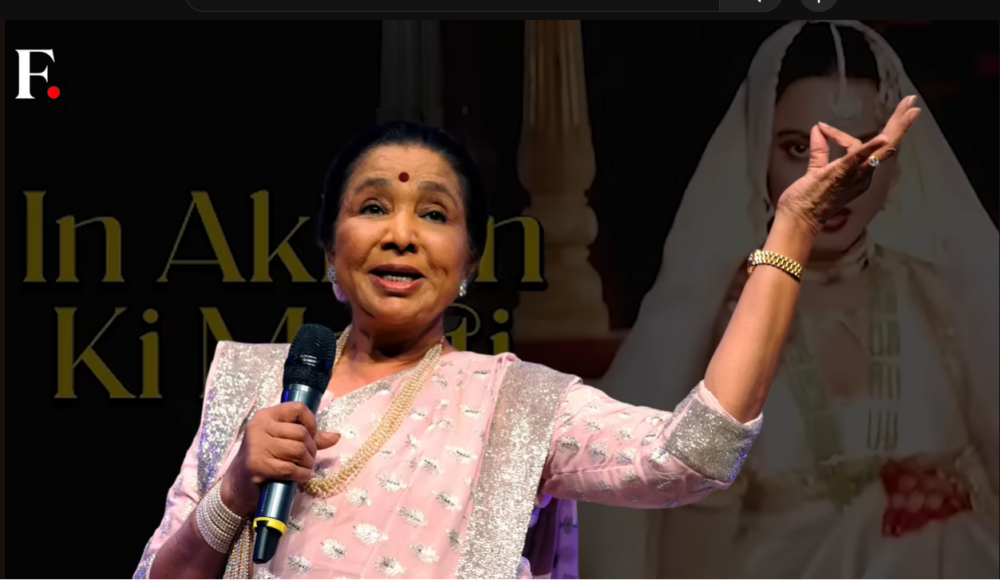
Asha Bhosle, the Indian playback singer whose voice became one of the most recognized and beloved sounds in Bollywood history, died Sunday at the age of 92 in Mumbai. Her passing drew an immediate outpouring of grief from across India’s arts and entertainment world, as well as from admirers far beyond its borders.
Her granddaughter Zanai Bhosle had confirmed earlier that the singer had been moved to a private hospital in Mumbai on Saturday evening after experiencing a chest infection and exhaustion. Her son Anand Bhosle confirmed her death to ANI news agency and announced that her funeral would be held in Mumbai on Monday.
Eight decades, countless songs
Bhosle’s career was, by nearly any measure, one of the longest and most prolific in the history of recorded music. She sang in numerous Indian languages, including Hindi and Marathi, lending her voice to an enormous catalog of Bollywood films spanning multiple generations of actors, directors and audiences. Her range was genuinely exceptional she moved with ease between soulful ballads, playful dance numbers and everything in between, giving each song a texture and personality entirely her own.
Over the course of that career, she received 2 Grammy nominations, a recognition rarely extended to artists working primarily outside the Western music industry. She also received India’s Dadasaheb Phalke Award, the country’s highest honor in the arts, as well as the Padma Vibhushan, India’s second highest civilian distinction. The breadth of those honors reflects just how thoroughly she permeated Indian cultural life.
A global reach
While Bhosle was a household name across India for much of her life, she reached a wider international audience through her collaborative work with British musician Boy George, introducing her voice to listeners who may never have encountered Bollywood music. That crossover spoke to the universal quality of her artistry something in her delivery transcended language and geography.
She was also the younger sister of Lata Mangeshkar, herself one of India’s most revered singers, making the two women perhaps the most celebrated pair of siblings in the country’s musical history.
Tributes pour in
The reaction to her passing was swift and deeply felt. Indian Prime Minister Narendra Modi praised her musical journey as one that had enriched the country’s cultural heritage and touched hearts around the world. He noted that her career, which stretched across eight decades, had left an indelible mark on Indian music.
Bollywood star Shah Rukh Khan took to social media to describe her voice as one of the foundational pillars of Indian cinema, adding that her talent would outlive many. Actor Hema Malini echoed that sentiment, mourning the loss of the vivacity and character Bhosle brought to every song she performed.
An irreplaceable presence
What made Bhosle’s legacy so durable was not simply the volume of her output though it was staggering but the consistency of her artistry across wildly different eras of Indian popular culture. She was recording and performing at a time when the industry looked nothing like it did when she began, yet she adapted, evolved and remained relevant in a way that very few artists anywhere in the world have managed to do.
Her death marks the end of a chapter in Indian music that will not be repeated. The singers, composers and filmmakers who came after her were shaped, directly or indirectly, by the standard she set a standard defined not just by technical brilliance, but by warmth, versatility and an unmistakable sense of joy in performance.
She is survived by her son Anand Bhosle and her granddaughter Zanai Bhosle, among other family members. Funeral arrangements are set for Monday in Mumbai.
