


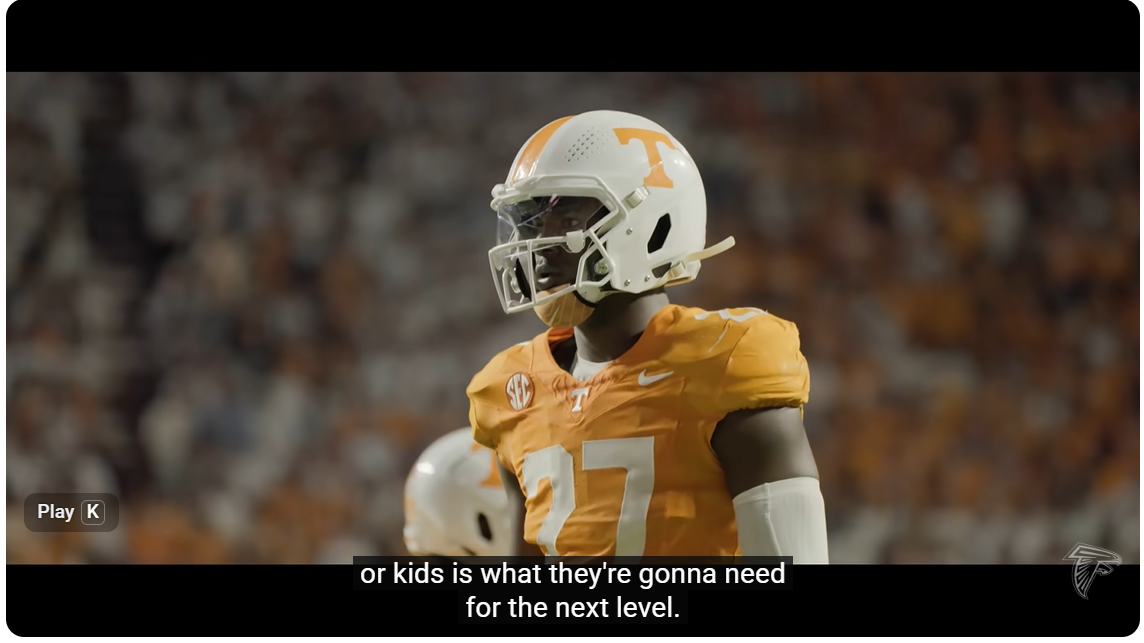
Atlanta Falcons edge rusher James Pearce Jr. will not face trial on three felony counts and one misdemeanor charge, after Miami-Dade prosecutors agreed Thursday to place him in a pretrial diversion program. The agreement, if Pearce completes all requirements over the next six months, will result in a full dismissal of every charge against him.
The charges stemmed from a February 7 incident in Doral, Florida, in which Pearce allegedly drove his Lamborghini into a car belonging to WNBA player Rickea Jackson, his former girlfriend, as she fled toward a local police station for protection. Officers who attempted to stop him reported that he defied their commands, struck a police officer’s knee with his vehicle and eventually crashed before being apprehended on foot following a physical struggle.
He spent one night in jail and was released on a $20,500 bond.
Prosecutors had charged Pearce with aggravated battery with a deadly weapon, fleeing police, resisting arrest with violence and misdemeanor stalking. He was 22 years old at the time.
Pearce’s conditions and what comes next
As part of the agreement, Pearce must undergo therapy and maintain complete distance from Jackson. He is barred from contacting her, approaching within 500 feet of her home or workplace or coming within 100 feet of her vehicle. A permanent injunction hearing is scheduled for May 21, and Pearce is due in Miami-Dade County court on May 7 to formalize the arrangement. Florida law gives both the responding officers and Jackson the right to be consulted before the deal is finalized, and prosecutors confirmed Thursday that both groups had already approved the program.
His attorney told reporters that the diversion agreement does not constitute an admission of guilt, framing it instead as an opportunity extended by prosecutors after reviewing the strength of their case. He added that the outcome should allow Pearce to play during the upcoming NFL season.
The Falcons declined to comment, citing the pending legal matter.
What Jackson said
Jackson, now 24, filed a petition for a protective order on February 9. In that filing, she described a sustained pattern of behavior that she said left her fearing for her life long before the February 7 incident. She wrote that Pearce had threatened to kill her, threatened to place a bag over her head and had physically and verbally abused her on multiple occasions.
She described the end of their relationship as difficult precisely because of what she characterized as his obsessive and violent behavior. She said he attempted to give her $75,000 to visit him and $200,000 to remain in a relationship with him as the dynamic deteriorated. Jackson and Pearce began dating when both were students at the University of Tennessee.
On the night of the arrest, she wrote that she recognized she was in danger and deliberately drove toward the Doral Police Department. Pearce, she alleged, struck her car repeatedly before she reached it.
Officers in Doral and Davie, Florida, had responded to at least eight separate 911 calls involving Pearce between November 2025 and his arrest, seven in Doral and one in Davie, where Jackson alleged he pulled her hair, took her phone and scratched her hand during an Uber ride after accusing her of infidelity.
The court granted Jackson’s initial protection request. She told the court in February she was prepared to testify. Jackson, who was recently traded from the Los Angeles Sparks to the Chicago Sky, has not publicly commented on Today’s development.
The NFL’s decision is still ahead
The league told ESPN it has been closely monitoring the case, which remains under review of its personal conduct policy. Pearce, selected 26th overall in the 2025 NFL Draft, recorded 10.5 sacks and 45 quarterback pressures during his rookie season, both franchise records for a first-year player. He finished third in NFL defensive rookie of the year voting.
A diversion program does not shield him from league discipline. Given the severity and public nature of the charges, a mandatory minimum suspension of six games is widely expected under the NFL’s personal conduct policy, with the commissioner retaining authority to increase that figure.
Whether Pearce uses this agreement as a genuine turning point or simply as a legal exit remains, for now, an open question.
