


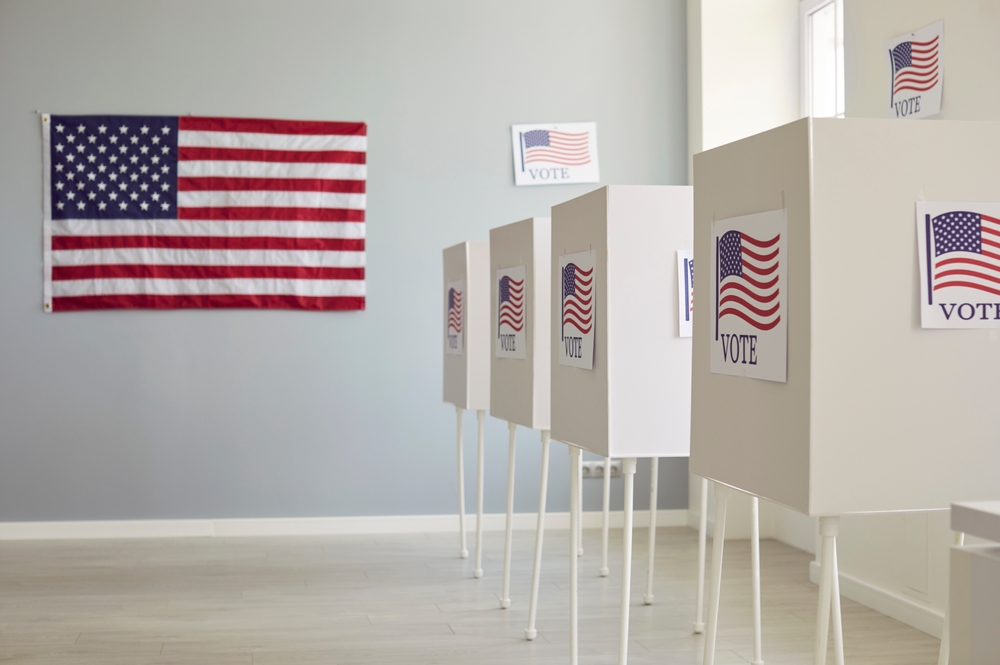
Presidential elections command national attention, wall-to-wall coverage, and record turnout cycles. Local elections, which determine who controls school budgets, who sets community policy, and who decides which candidates even appear on future ballots, routinely draw about 20% of eligible voters. The gap between those two numbers tells a story that civic advocates have been trying to correct for years.
The consequences of that gap are not abstract. They show up in classroom sizes, in school closures, in the direction a political party takes heading into a state race. The decisions made by locally elected officials land closer to daily life than most federal policy ever will, yet the elections that produce those officials remain largely invisible to the majority of voters.
Voter fatigue and information gaps drive the low numbers
Dr. Alana Hackshaw, a clinical professor at the University of Maryland’s School of Public Policy, points to two overlapping problems. The first is voter fatigue, the exhaustion that comes from being asked to engage in elections at every level of government with some regularity. The second is a shortage of accessible information about who is actually running and what they stand for.
Presidential races generate enormous media coverage that essentially does voter research on behalf of the public. Local races receive far less of that attention, which means staying informed requires a level of active engagement that many voters simply do not have the time or resources to sustain.
School boards and central committees hold more authority than most people realize
Two bodies that consistently fly under the radar are school boards and central committees. School boards control budgets, set curriculum, hire and fire district leadership, and make the operational decisions that shape a student’s daily experience. Recent debates over cell phone restrictions and school consolidations have drawn some public attention, but board meetings still go largely unattended.
Central committees operate within political parties and carry a different kind of influence. They recruit candidates, organize campaign infrastructure, and raise funds, which means they have a direct hand in determining whose name ever appears on a ballot. Their work happens mostly out of public view, but its effects reach every level of party politics.
Young voters are starting to pay attention earlier
Nadia Robinson, a senior at Baltimore Polytechnic Institute and intern with Baltimore Votes, a nonprofit focused on increasing voter participation, is preparing to cast her first ballot. Her time working as a poll worker has given her a practical familiarity with the voting process that most first-time voters do not have.
Her argument for early engagement is straightforward. Starting young makes participation a habit rather than a decision that has to be made fresh each election cycle. Baltimore Votes is built around that logic, working to bring younger residents into civic life before disengagement has a chance to take hold.
Budget cuts in Baltimore classrooms illustrate what is actually at stake
Jocelyn Providence, a mathematics teacher in Baltimore City Public Schools, has attended school board meetings for more than a decade. Over that time, she has watched budget decisions translate directly into classroom conditions. Cuts have produced larger class sizes and reduced staffing, changes that affect both what teachers can do and what students can access.
Providence’s position is that community members who pay taxes into the school system have both the standing and the responsibility to weigh in on how those funds are used. School board elections are where that input is formalized, and low turnout weakens the signal.
The argument for showing up is simple
Javey Adams, civics program coordinator for No Boundaries Coalition, frames the issue without much decoration. A vote in a local election is direct participation in the decisions that govern a neighborhood. The lower the turnout, the smaller the group making those decisions on everyone else’s behalf.
Local elections will not draw the same energy as a presidential race. The mechanics of civic attention do not work that way. But for the people who show up, the return on participation is immediate and measurable in ways that national elections rarely are.
