


The Edmund Pettus Bridge in Selma, Alabama, once again became a gathering point for voting rights advocates on May 16, 2026, more than six decades after the marches that helped secure those protections for Black Americans. Activists and organizers returned to the bridge to push back against redistricting efforts led by Republican controlled state legislatures across the South.
The demonstration, organized under the banner All Roads Lead to the South, responds directly to the U.S. Supreme Court’s April 2026 ruling in Louisiana v. Callais. Essence reported that the decision threatens majority Black voting districts throughout the region by weakening protections for minority representation. Organizers billed the gathering as a National Day of Action and described it as the launch of a broader summer long campaign built around four pillars, mobilization, civic education, legal advocacy and direct action, all aimed at protecting voting access ahead of upcoming elections.
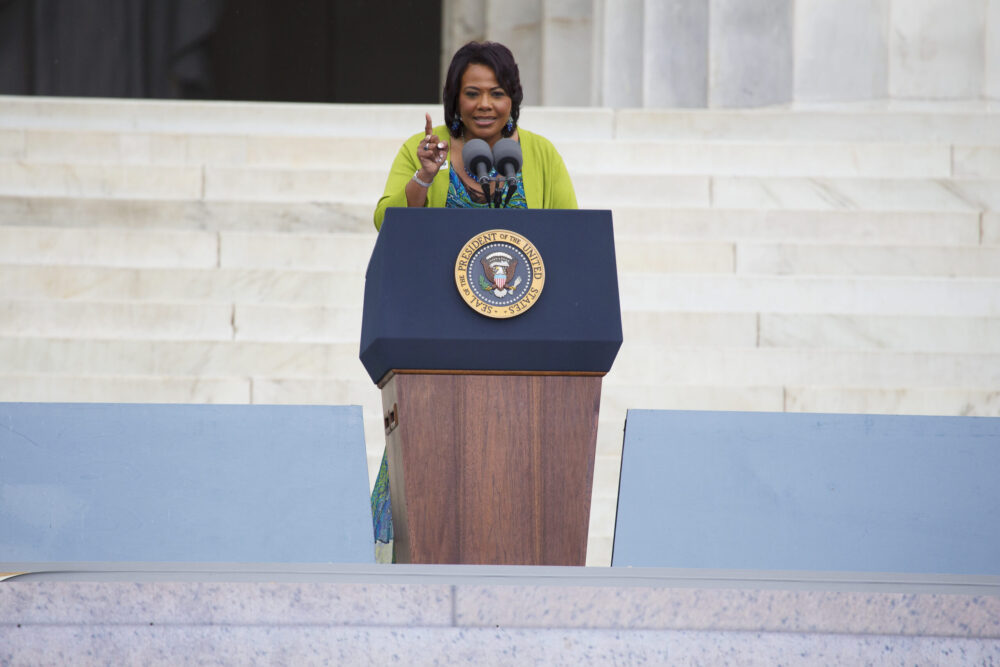
Among those who returned to the historic site was Rev. Dr. Bernice A. King, 63, CEO of The King Center and the daughter of Dr. Martin Luther King Jr. and Coretta Scott King. Essence sat down with King to discuss the symbolism of returning to Selma and Montgomery, Alabama, the same ground where her parents helped lead the civil rights movement decades earlier.
A familiar fight, fought from a different position
King told Essence that revisiting the same battlegrounds her parents once organized on carries a complicated weight. While the threats facing Black voters today echo the barriers her parents fought, including discriminatory practices once used to block registration, she noted that today’s organizers hold far more political power than earlier generations did, even as that strength faces renewed attempts at erosion. King pointed to her mother’s longstanding belief that freedom must be defended in every generation rather than treated as a permanent victory.
She says she finds encouragement in watching younger organizers step into leadership with determination, and said her focus now is ensuring the current mobilization builds lasting infrastructure rather than fading once attention moves elsewhere.
Why King says the stakes are higher than they appear
King described the current threat to voting rights as serious, warning that inaction could embolden further rollbacks. She drew a comparison to exposing wrongdoing to light, noting that vigilance plays a critical role in this moment.
King also pointed to recent economic and policy setbacks affecting Black communities, including widespread job losses among Black women in corporate America, changes to SNAP benefits and rollbacks tied to diversity, equity and inclusion programs. She told Essence that despite these pressures, Black communities have historically found resilience and strength in the face of opposition.
She warned that apathy at the ballot box could allow current setbacks to multiply, potentially reversing decades of progress made since the Jim Crow era. King emphasized that the act of redrawing voting districts in the middle of a primary cycle signals exactly how much electoral power is at stake, and she urged people to vote, encourage others to vote and stay informed about the candidates and issues on the ballot.
Sustaining a movement built for the long haul
Asked how organizers can maintain momentum in a culture prone to short attention spans, King, a Christian minister, said movements need a clear and compelling vision that people can connect to their own lives. She said that vision alone is not enough. Effective organizing requires structure, with specific roles and responsibilities for every participant, not just visible spokespeople.
King pointed to the Montgomery bus boycott as an example, noting that grassroots organizing, particularly efforts by women in the community to distribute information, made that movement possible. She said today’s organizing efforts need that same combination of a bigger picture goal paired with concrete, ongoing action steps.
Where King finds hope
Despite the challenges, King says she remains hopeful, pointing to consistent turnout from people across generations as a source of encouragement. She also drew inspiration from Harriet Tubman, who led others to freedom without modern tools or maps, relying instead on deep conviction and faith.
King added that she has also found hope in seeing more white Americans speak out in support of Black communities in recent months, including on social media, calling it a meaningful shift even if some had stayed silent in years past.
