


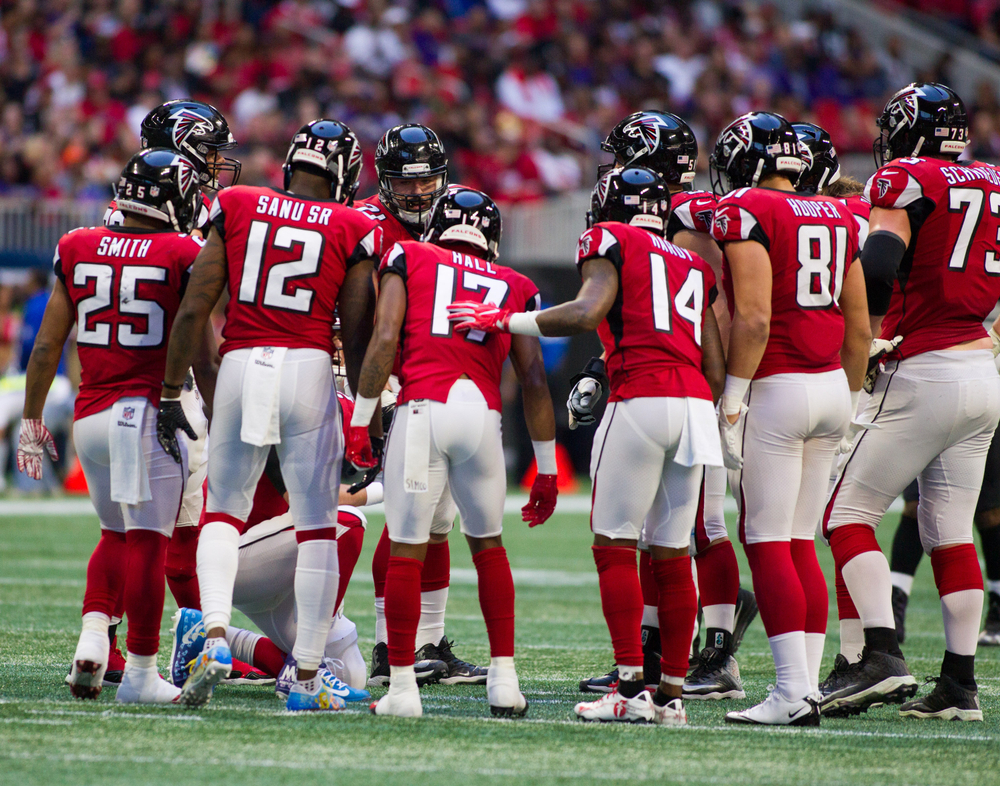
Two of the NFL’s most explosive running backs sat out the opening day of training camp Wednesday as they push for new long-term contracts, creating simultaneous holdout situations on opposite ends of the country that could reshape the running back market.
Bijan Robinson of the Atlanta Falcons and Jahmyr Gibbs of the Detroit Lions were both absent from their teams’ first practice sessions of the preseason. Both players have been engaged in contract discussions with their respective organizations this offseason, and both are widely expected to set a new market standard for running backs when deals are eventually finalized.
The current benchmark for the position is held by Saquon Barkley of the Philadelphia Eagles, whose contract carries an average annual value of $20.6 million. Robinson and Gibbs are each positioned to push that number higher, and the football world is watching to see which deal comes first and what it means for the other.
Robinson’s case
Robinson has built one of the most impressive three-year starts a running back has produced in recent memory. Selected eighth overall by Atlanta in the 2023 draft, he has accumulated 5,648 all-purpose yards and 34 total touchdowns across his first three seasons. Robinson earned Pro Bowl honors in each of the past two years, and last season he was named a first-team All-Pro after leading the entire NFL in rushing yards with 1,478 and setting a Falcons franchise record with 2,298 scrimmage yards.
The Falcons exercised the fifth-year option on Robinson’s rookie contract this offseason, keeping him under team control through the 2027 season. That move provides Atlanta with leverage in negotiations but also signals that the organization views Robinson as a cornerstone of what they are building and intends to eventually give him the deal his production demands.
Gibbs’ case
Gibbs was also picked in the top 12 of the 2023 draft, the Lions taking him 12th overall, and he has rewarded that investment with three consecutive Pro Bowl selections, the only player in this class of running backs to match Robinson’s distinction in that regard. In three seasons, he has compiled 5,029 yards from scrimmage and an extraordinary 49 total touchdowns, a pace that makes him one of the most prolific scorers at the position the league has seen in years.
Gibbs’s dual-threat ability has given Detroit a weapon that can hurt defenses in the run game and through the air, making him extraordinarily difficult to account for regardless of down and distance. The Lions also exercised their fifth-year option, keeping him under contract through 2027.
When asked Wednesday whether there was an update on a potential extension, Lions coach Dan Campbell offered a measured response, saying both sides were working through the process and that the situation would unfold in its own time. The deliberate framing suggested no imminent resolution but also no breakdown.
What is at stake for the position
The broader context of these negotiations matters beyond just the two players involved. Running back has historically been one of the most underpaid positions in the NFL relative to its impact on games, and the recent Barkley deal represented a meaningful shift in how teams are willing to compensate elite players at the position.
Robinson and Gibbs are both 23 years old, both represented the same draft class, and both have produced at levels that exceed what even the most optimistic projections would have forecast. If either or both receive deals that clear $22 or $23 million per year in average annual value, it would represent a significant recalibration of what the market pays for the premium running back.
The fact that both situations are unresolved simultaneously creates a complicated negotiating dynamic. Teams prefer to set the market rather than match it, and neither Atlanta nor Detroit wants to overpay relative to what the other team ultimately agrees to. The players, meanwhile, have every incentive to hold out until the numbers reflect what their performances have earned.
Training camp practice time matters, and every day spent away is a day of preparation lost. But for players at this level seeking deals of this magnitude, the cost-benefit calculation often favors patience.
