


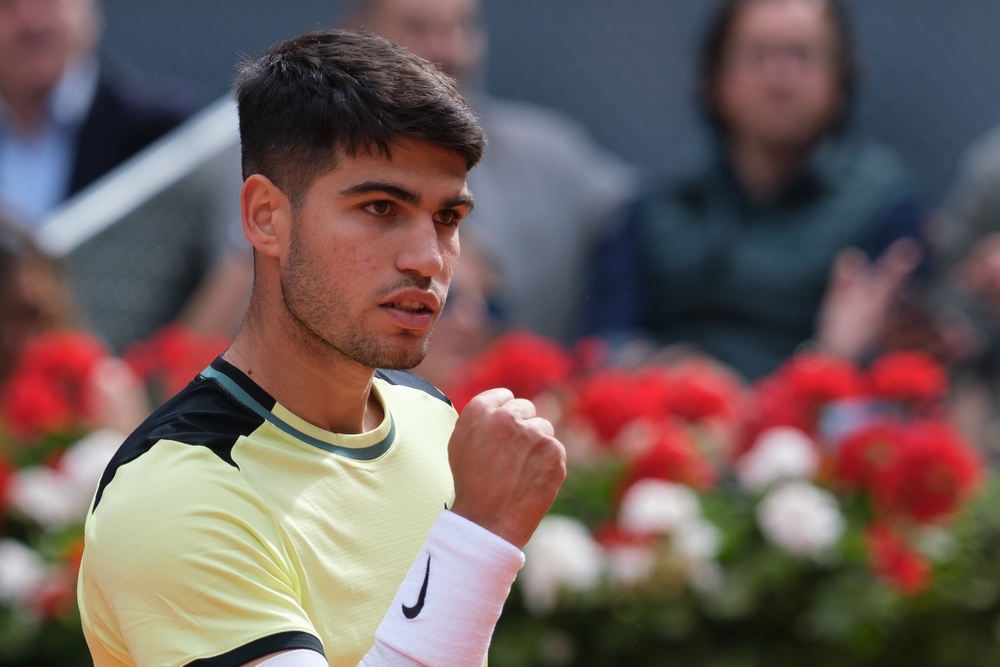
Carlos Alcaraz reached his first final since returning from a four and a half month injury layoff, beating qualifier Jaume Munar 5 to 7, 6 to 3, 6 to 1 in the Japan Open semifinals on Monday.
What happened in the first set?
A collapse he could not explain. Having broken midway through to take control, he lost 14 consecutive points to hand the set over, ending it with back to back double faults. The run extended to 16 straight points into the second set. He said afterwards that he did not know what happened and that he seems to be struggling in first sets generally, while noting he has recovered each time.
How did he turn it?
Immediately. He broke in the opening game of the second set and won 11 of the next 13 games across the remainder of the match. That is a wide swing against an opponent who had already beaten the 12th ranked player in the opening round, and it is the part of his game that has not been affected by the layoff.
What is the injury situation?
A right wrist problem that cost him four and a half months. Carlos Alcaraz returned in late August and reached the US Open quarterfinals, losing to Ben Shelton in a match finishing at 3:33 in the morning. He has worn a compression sleeve on the right arm throughout his comeback, which is visible and has not been described as a concern by him.
How long since his last final?
April, when he lost to Jannik Sinner at Monte Carlo. Reaching a final roughly six weeks after returning from an injury of that length is a reasonable trajectory, and he is defending the title he won in Tokyo last year.
Who does he face?
Jiri Lehecka, ranked 19th, who beat Valentin Vacherot in straight sets. Lehecka arrives on a six match winning streak that includes both his singles wins in Prague, where he led the Czech Republic past the United States to qualify for the Davis Cup Final 8.
Does that make it difficult?
More than the rankings suggest. A player on a run of that length has rhythm, which is precisely what someone returning from months out does not. The ranking gap favours Carlos Alcaraz. The form comparison does not.
Should the first set pattern worry him?
Worth watching rather than worrying about. Slow starts are common for players rebuilding match sharpness, and recovering from them repeatedly indicates the problem is rhythm rather than capability. It becomes a concern if an opponent good enough to hold a lead gets one.
What is at stake?
A title defence and a marker. Winning in Tokyo would confirm the comeback is complete rather than ongoing, which matters with the season’s closing stretch ahead.
