


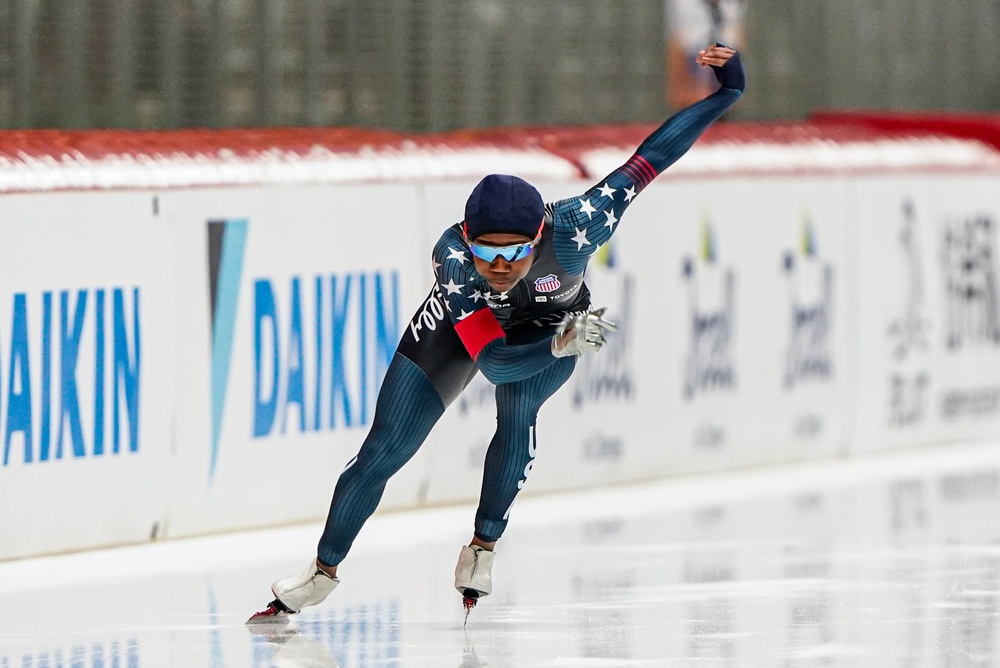
There are athletes who compete, and then there are athletes who transform an entire sport. Erin Jackson belongs firmly in the second category. The 33-year-old Team USA speed skater arrived at the Milano Cortina 2026 Winter Olympics not just as a defending champion but as a symbol — a living, breathing reminder of what it looks like when barriers shatter at 37 miles per hour on ice.
Jackson made history at the 2022 Beijing Winter Olympics when she became the first Black woman to win an individual gold medal at a Winter Games, claiming the top spot in the women’s 500m race. That single moment shifted the culture of winter sports in America, inspiring a generation of young athletes who had never seen themselves reflected on the Olympic podium. Now, she is back in Italy for her third Olympic appearance, and Jackson is leaning fully into the pressure that comes with defending that crown.
She was also chosen by her fellow Team USA athletes to serve as a flag bearer at the San Siro Opening Ceremony — making her the first Black woman to carry the United States flag at a Winter Olympics opening ceremony. The honor was earned, not given.
Fueled by Pressure, Not Broken by It
What separates Jackson from most elite competitors is her relationship with pressure. Where others shrink, she expands. She has described herself as a naturally calm and laid-back competitor — someone who needs the high stakes of an Olympic stage to ignite the kind of fire that wins gold medals. The crowd noise, the expectations, the defending champion label — all of it feeds her rather than rattles her.
That mindset carried her through a grueling few years. Between Beijing 2022 and Milano Cortina 2026, Jackson battled a series of injuries and health setbacks that would have ended lesser careers. She pushed through, trained meticulously, and returned to Italy ready to compete in not one but two events — the 500m and the 1000m, the latter being her Olympic debut at that distance.
A Fifth-Place Finish That Still Speaks Volumes
The 500m result at these Games did not go the way Jackson had hoped. She finished fifth on Feb. 15 with a time of 37.32 seconds, just five hundredths of a second off the bronze medal. Dutch skaters Femke Kok and Jutta Leerdam claimed gold and silver, with Japan’s Miho Takagi securing bronze. It was a narrow miss for Jackson, who had posted the second-best 100m start in the field before the race slipped away in the final stretch.
Still, a fifth-place finish at the Olympic level, while battling years of injury recovery, is a testament to Jackson’s resilience. The sport of speed skating is merciless in its margins — hundredths of seconds determine legacies. Jackson knows this better than anyone.
Jackson’s Legacy Goes Beyond the Podium
The impact of Erin Jackson on American winter sports cannot be measured by medals alone. Her 2022 gold inspired conversations about access, representation, and diversity in sports that have historically been dominated by white athletes from cold-weather countries. She has spoken openly about hoping her success opens doors for more minorities to explore winter sports in the United States.
That hope is already becoming reality. At these same Milano Cortina Games, a new wave of Black athletes is making history alongside Jackson — from bobsled to skeleton to ice hockey — a direct result of the cultural shift her 2022 victory helped accelerate. Jackson planted a seed in Beijing. In Milan, the garden is blooming.
What Comes Next for Erin Jackson
With speed skating competition running through Feb. 21, Jackson still has more ice time ahead. Her first Olympic 1000m appearance earlier in the Games, where she placed sixth, showed she remains a force at multiple distances. Regardless of where she finishes, Jackson’s presence at these Games — as flag bearer, as trailblazer, as competitor — reinforces a message that the sport of speed skating is richer and more powerful because of her.
She came to Milan not just to defend a gold medal. She came to defend the idea that Jackson belongs at the top of the world stage — and nothing about her story says otherwise.
