


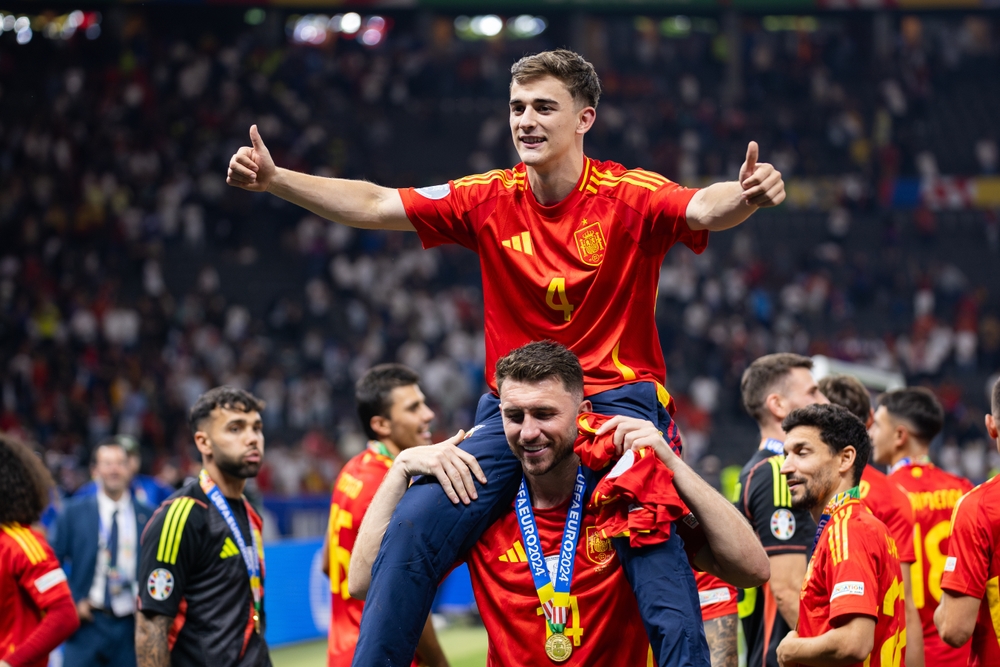
Gavi had every reason to want justice. He was shoved to the ground by Leandro Paredes in the chaotic scenes that followed Spain’s World Cup final victory on Sunday. But when the Spain midfielder was asked this week whether he believed the Argentina players involved in the post-match fracas should face sanctions, his answer was surprisingly forgiving.
The Barcelona midfielder said he did not think suspensions were the appropriate response, even after video showed multiple Argentina players and at least one member of the coaching staff making physical contact with Spanish players in the moments after the final whistle at MetLife Stadium. Gavi, who had entered the scene after Paredes grabbed Spain defender Eric García by the throat, was then knocked to the ground by the same Argentina midfielder. Despite that, he told reporters on Tuesday that he regarded the incidents as an unfortunate but inherent part of football at the highest level.
Gavi maintained that this is a side of football that has always existed, one driven by the emotions of a championship match where the stakes are as high as they can be. He acknowledged that the scenes did not set a good example for young fans. Gavi said the most appropriate response in the moment would have been a dismissal during the game, and that treating the incidents as anything more than that was overstating them.
What the footage showed
FIFA opened a formal investigation into the post-match conduct after footage circulated widely showing a series of incidents involving Argentina players and staff. Paredes and Nahuel Molina were seen making contact with García and Rodri. Argentina assistant coach Roberto Ayala appeared in video making contact with Dani Olmo, the Spain player who later addressed the wider question of values and conduct in the aftermath.
Enzo Fernández had already been dismissed during the match itself, receiving a second yellow card in second-half stoppage time before Argentina played out the remainder of regulation and extra time with 10 players. Ferran Torres scored in the 106th minute to give Spain the title.
The post-match behavior drew sharp criticism from analysts and commentators, who pointed to Argentina’s aggressive approach throughout the match and the lack of sportsmanship that followed the final whistle as evidence of a team that handled defeat poorly in the most public setting imaginable.
A ceremony that made things worse
Beyond the physical altercations, a separate moment added to the perception of Argentina’s conduct. As the two teams gathered on the pitch for the trophy presentation, Spain formed a guard of honor for Argentina as their opponents approached the podium to collect their runner-up medals. Argentina did not extend the same courtesy when Spain lifted the World Cup. Several Argentina players turned their backs as the Spanish celebrations began, a gesture noticed widely around the world.
Olmo responded to that image directly, framing it not as a minor slight but as a question of the values that elite athletes are expected to model for the generations watching them. He described Spain and Argentina as organizations that carry responsibility to set an example, and said that turning away in that moment reflected poorly on what those values should look like.
Gavi and the player’s perspective
Gavi’s willingness to defend players who shoved him is notable. It reflects a perspective that experienced footballers often share privately, that the intensity of these matches generates emotion that spills over in ways those inside the sport understand differently than those watching from outside.
Gavi’s perspective does not erase what the footage shows. FIFA has appointed an investigator and the process will run its course. But within the game itself, Gavi, one of the players most directly on the receiving end of Argentina’s behavior, has said he does not want his opponents sanctioned.
Whether FIFA arrives at the same conclusion as Gavi is another matter. The governing body operates independently of player opinion, and precedent for post-match disciplinary action exists in international football. The investigation will determine whether the governing body believes the events warrant consequences that go beyond what the referee was able to apply during the match.
