


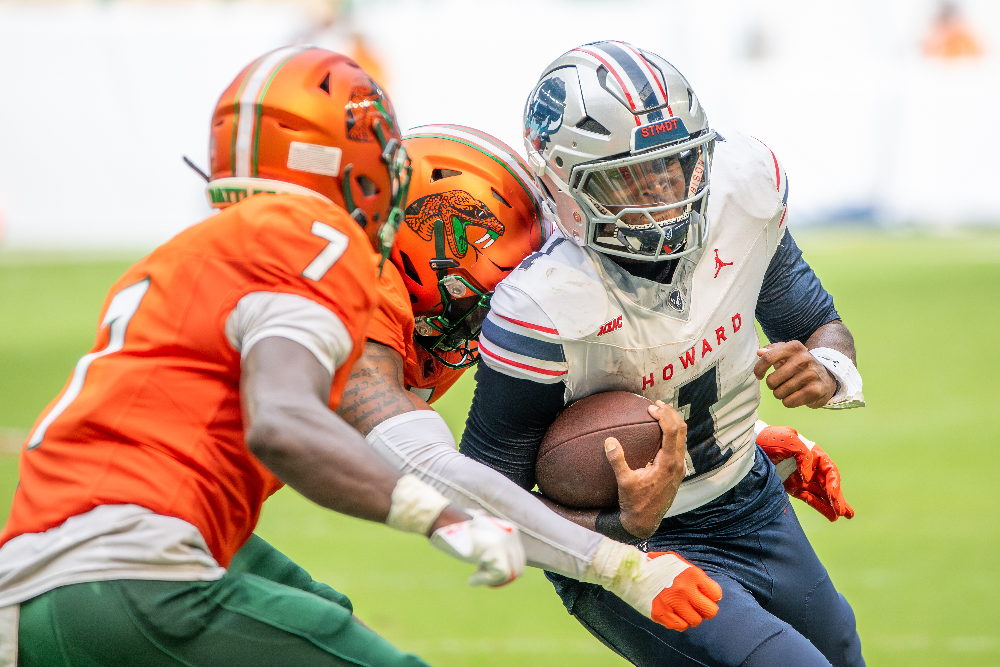
The HBCU Legacy Bowl is no longer just a celebration — it’s a legitimate pipeline to the NFL Draft, and this year’s edition made that clearer than ever. A wave of standout performers from Historically Black Colleges and Universities captured serious attention from pro scouts and front office personnel during the fifth annual showcase held last Saturday, with several players drawing interest from double-digit NFL franchises.
Peters and Harris Put QB Talent on Full Display
Prairie View A&M quarterback Cameron Peters emerged as one of the most talked-about prospects of the week, earning meetings with both the Green Bay Packers and Kansas City Chiefs. Evaluators took notice of his poise under pressure and sharp accuracy throughout the week of practices and in-game action — qualities that tend to matter most to teams searching for developmental signal-callers with upside.
The Packers cast a wide net at quarterback, also sitting down with North Carolina Central’s Walker Harris, the MEAC Offensive Player of the Year. Harris had a remarkable 2025 campaign, throwing for 3,214 yards with a 24-to-9 touchdown-to-interception ratio, while chipping in 77 rushing yards and five scores on the ground. That kind of dual-threat production in a conference-leading role is exactly what NFL teams want to see from HBCU quarterbacks competing on the national stage.
Mosley Commands the Longest Interview List of the Week
If there was one player who dominated the conversation among NFL personnel departments, it was North Carolina Central running back Chris Mosley. Fresh off a 2025 season in which he racked up 1,017 rushing yards and eight touchdowns, Mosley walked into the Legacy Bowl with momentum — and left with one of the most impressive meeting lists of any prospect at the event.
The Giants, Ravens, Buccaneers, Lions, Titans, Jets, Commanders, Vikings, and Jaguars all requested time with Mosley, a nine-team haul that speaks volumes about the level of legitimate interest surrounding him. For a running back out of an HBCU program, that kind of widespread NFL attention is both rare and well-earned.
West Proves Division II Talent Can’t Be Overlooked
Clark Atlanta wide receiver Ronnie West made a compelling case that Division II players deserve a seat at the table when it comes to NFL evaluation. One of the few non-Division I athletes in the game, West held conversations with the Packers, Titans, Dolphins, Jaguars, Colts, and Lions — six franchises that clearly weren’t deterred by the level of competition he faced in college.
West’s presence at the Legacy Bowl and the attention he received is a reminder that talent doesn’t come with a conference label.
Stewart Earns Praise on the Defensive Front
Tennessee State defensive lineman James Stewart made his mark on the other side of the ball, drawing meetings with the Lions, Titans, Ravens, and Jets. Scouts highlighted his burst off the line of scrimmage and disciplined hand technique as standout traits — the kind of technical foundation that translates quickly at the pro level and makes him an intriguing developmental piece for teams needing depth up front.
The Legacy Bowl Keeps Delivering for HBCU Prospects
Now in its fifth year, the HBCU Legacy Bowl has cemented itself as far more than a post-season exhibition. It is a genuine scouting event, one that puts top talent from historically Black programs directly in front of the decision-makers who determine draft board placements and free agency targets. The exposure alone is invaluable — but the meetings, the evaluations, and the buzz generated this year show that NFL teams are taking HBCU talent more seriously than ever.
As the 2026 NFL Draft draws closer, Peters, Harris, Mosley, West, and Stewart will have a chance to build on the momentum earned in New Orleans. If this year’s Legacy Bowl is any indication, the pipeline from HBCUs to the pros isn’t slowing down anytime soon.
Source: HBCU Sports
