


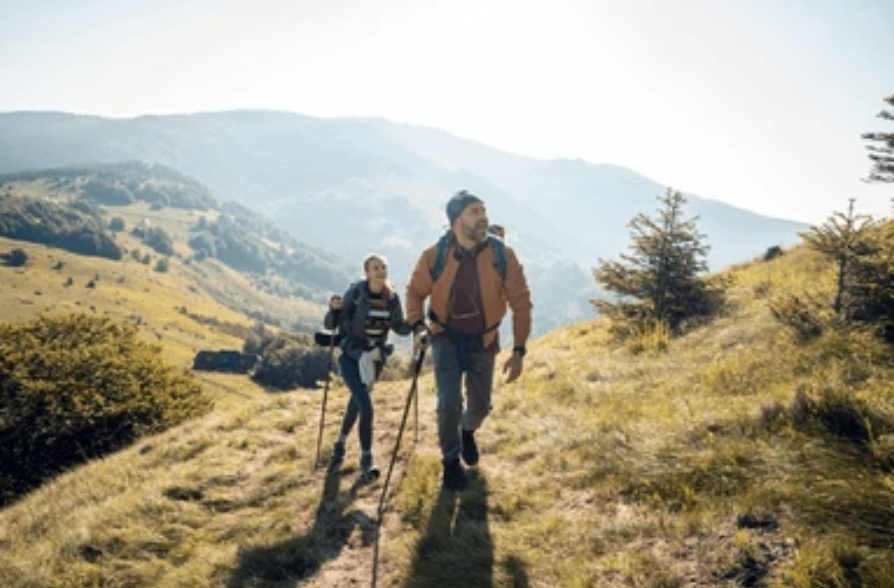
Hiking is the exercise that people who hate exercise will actually do. It does not feel like a workout in the way that a spin class or a weight room session announces itself as one. You are just walking, but on an incline, on uneven ground, through something that looks considerably better than a parking garage, with a view that occasionally justifies the entire experience. The gym has never offered a view that justified anything.
Research published in early 2026 examining the physiological and psychological outcomes of regular hiking compared to matched indoor exercise is making a case that the informality of hiking has always obscured its clinical value. Five specific health benefits produced by hiking involve mechanisms that indoor workouts cannot replicate regardless of equipment sophistication, and they are getting serious scientific attention in early 2026.
Hiking and proprioceptive development that prevents falls
The variable, unpredictable terrain of hiking creates a continuous proprioceptive challenge that flat-surface exercise, including treadmill walking and gym-based training, eliminates by design. Every uneven step, root navigation, and slope adjustment activates the ankle stabilizers, hip stabilizers, and deep core musculature in coordination patterns that smooth-surface exercise never demands.
Research published in early 2026 examining balance and fall prevention outcomes in older adults found that regular hikers showed significantly better postural stability, ankle proprioception, and reactive balance scores than matched adults who performed equivalent volumes of flat-surface walking and gym-based exercise. The terrain variability of hiking is not a difficulty to be managed. It is the mechanism of one of its most clinically valuable benefits.
Hiking and cortisol reduction through nature exposure
The stress-reducing effects of natural environments, studied under the framework of attention restoration theory and stress recovery theory, are distinct from the stress reduction produced by exercise alone. Research published in early 2026 comparing cortisol responses to hiking in natural environments versus equivalent intensity exercise on treadmills found significantly greater cortisol reduction in the hiking group, with the differential attributable to the restorative cognitive effects of natural environment exposure rather than the exercise itself.
The practical implication is that hiking produces stress reduction through two additive pathways simultaneously, which is the physiological stress reduction of exercise combined with the psychological restoration of natural environment exposure, making it more effective for cortisol management than either pathway alone can achieve.
Hiking and cardiovascular adaptation through varied intensity
The natural interval structure of hiking, in which flat sections alternate with ascents and descents that dramatically alter cardiovascular demand, produces a training stimulus that researchers describe as naturally periodized cardiovascular exercise. Research in early 2026 found that adults who hiked regularly showed cardiovascular adaptation profiles similar to those of adults who performed structured interval training, without any deliberate intensity manipulation. The terrain does the programming automatically.
Hiking and vitamin D synthesis supporting immune and bone health
Outdoor hiking provides ultraviolet B light exposure that triggers vitamin D synthesis in the skin, addressing one of the most prevalent nutritional deficiencies documented in 2026 health data. Adults who hiked outdoors for two or more hours per week showed significantly better vitamin D status than matched adults who exercised exclusively indoors, with the vitamin D difference producing downstream improvements in immune function markers and bone mineral density assessment.
Hiking and mental health outcomes through awe experience
Awe, which is the emotional response to experiences that exceed existing mental frameworks through vastness or complexity, is consistently produced by natural landscapes in ways that urban and indoor environments rarely replicate. Research published in early 2026 examining awe experience and mental health outcomes found that adults who regularly experienced awe through hiking and outdoor activity showed lower rates of rumination, higher life meaning scores, and better emotional regulation capacity than matched adults without regular awe exposure. Your gym has never made you feel small in the specifically useful way that a mountain view does.
