


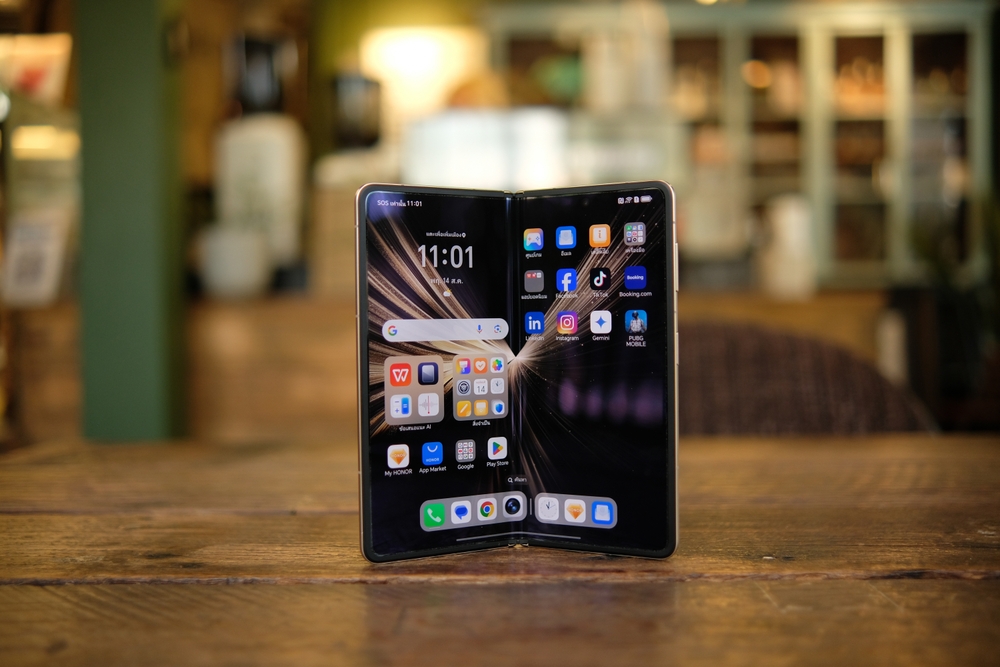
Foldable phones have been promising the future for years. Honor just delivered it. At Mobile World Congress in Barcelona, the Chinese tech brand unveiled the Magic V6 — its thinnest, most powerful foldable to date, and one that makes a compelling case for being the most complete foldable smartphone on the market right now.
From its record-breaking battery to its Apple device compatibility, the Honor Magic V6 is not just an incremental upgrade. It is a statement.
Honor Magic V6 Pushes Foldable Design to Its Limits
Honor has made thinness a signature obsession, and the Magic V6 represents the brand’s most refined execution of that vision yet. The device measures just 4mm thick when unfolded and 8.75mm when folded — shaving fractions of a millimeter off last year’s already razor-thin Magic V5. The numbers may seem small, but in the competitive foldable market, every millimeter matters.
The display setup is equally impressive. The Magic V6 features a 7.95-inch main AMOLED screen with a resolution of 2352 x 2172 pixels, paired with a 6.52-inch cover display running at 2420 x 1080 pixels. Both panels support LTPO 2.0 technology, enabling variable refresh rates between 1Hz and 120Hz — adapting dynamically to whatever is on screen for sharper visuals and smarter power management.
The external screen also benefits from a new anti-reflective coating with a reflectivity rating of just 1.5%, making it significantly easier to read in bright outdoor conditions.
The Honor Magic V6 Battery Is in a Class of Its Own
If there is one feature that sets the Magic V6 apart from every other foldable on the market, it is the battery. The device packs a 6,600 mAh cell — a dramatic jump from the 5,820 mAh found in last year’s model — making it the largest battery ever fitted into a device this thin.
Honor’s SuperCharge technology supports 80W wired charging and 66W wireless charging, meaning the battery refills nearly as fast as it depletes. But Honor is not stopping there. The company also previewed a next-generation silicon-carbon battery technology with 32% silicon density that could push future foldable batteries beyond the 7,000 mAh threshold — a figure that would have seemed impossible just two years ago.
Honor Magic V6 Specs and Camera System
Under the hood, the Magic V6 runs on Qualcomm’s Snapdragon 8 Elite Gen 5 processor, paired with 16GB of RAM and 512GB of internal storage — a configuration built for power users who demand performance without compromise.
The camera system is equally well-equipped. Three rear sensors handle photography duties — a 50-megapixel main camera with an f/1.6 aperture, a 64-megapixel telephoto with f/2.5, and a 50-megapixel ultrawide at f/2.2. On the front, dual 20-megapixel cameras with f/2.2 apertures cover both the cover and inner displays for video calls and selfies.
The new Super Steel Hinge rounds out the hardware story. Built with a tensile strength of 2,800 MPa, it is engineered for long-term durability. Honor also reduced the display crease depth by 44% compared to previous generations, making the main screen look and feel closer to a traditional flat display than any foldable the company has produced before.
Honor Magic V6 Bridges the Android and Apple Divide
Perhaps the most unexpected feature of the Magic V6 is its deep compatibility with Apple’s ecosystem — a rare move for an Android foldable manufacturer. The device supports two-way notification sync with iPhones, meaning alerts appear seamlessly across both devices. It can also display notifications directly on an Apple Watch, share files with Mac computers in a single tap, and function as an extended display for Mac users.
For anyone operating across both Android and Apple devices — a growing reality for many professionals and creatives — the Magic V6 removes friction in a way that no foldable has attempted before.
Honor has not confirmed pricing for the Magic V6, with the company saying only that it will launch in select international markets in the second half of 2026. Given everything packed into this device, the anticipation is already building.
Source: Tech Crunch
