


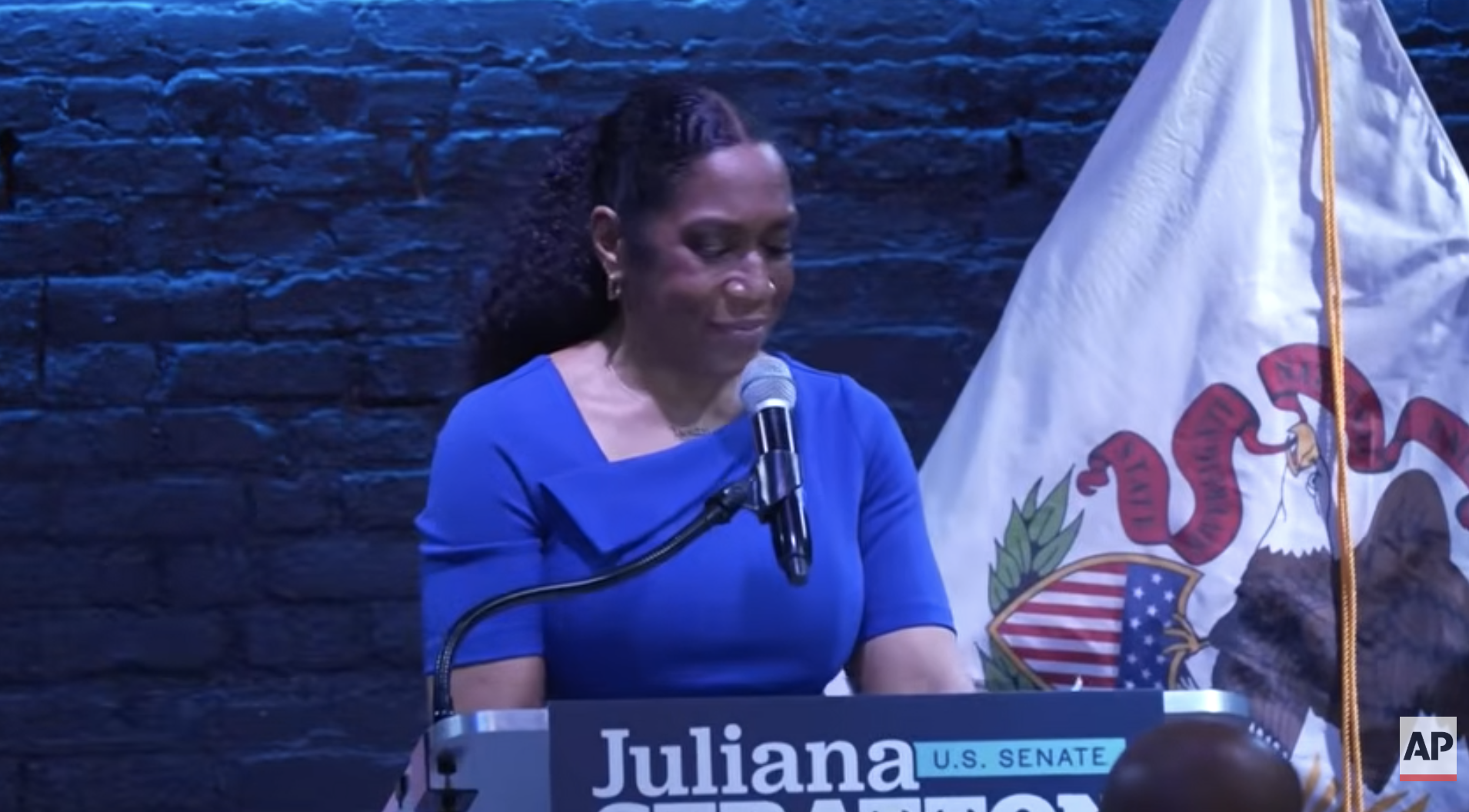
Illinois Democrats made a clear choice on Tuesday night, and it was not the safe one. In a three-way primary race to fill the Senate seat being vacated by retiring Sen. Dick Durbin, Lt. Gov. Juliana Stratton defeated two sitting members of Congress, driven by a dominant showing in Chicago and a stronger-than-expected performance in the surrounding suburbs. The victory was striking not just for who won but for what her campaign represented.
Stratton ran a candidacy that leaned into confrontation rather than away from it, including campaign advertising that left little doubt about where she stood on the current political climate. She defeated Rep. Raja Krishnamoorthi, who entered the race with a significant financial advantage, and Rep. Robin Kelly. In a party still arguing about how loud to be and which direction to face, Stratton’s margin sent a message.
Pritzker emerges as the primary’s biggest winner
The person who may have gained the most from Tuesday’s results was not on the ballot in any competitive sense. Gov. JB Pritzker ran unopposed in his own primary as he pursues a third term, but his fingerprints were all over Stratton’s victory. Pritzker invested millions to elevate her candidacy, and the returns on that investment were substantial.
For a governor widely regarded as a serious contender for the 2026 presidential nomination, engineering a Senate outcome in his home state while simultaneously positioning himself as one of the party’s most combative voices against the current administration was a significant double play. His election night remarks were pointed and energetic, framing the moment as part of a larger national fight. Whether that energy translates into a presidential campaign remains to be seen, but Tuesday did nothing to diminish the possibility.
An Illinois Senate race with historic stakes
If Stratton wins in November, she would become the fifth Black woman ever elected to the United States Senate. In a state that leans heavily Democratic at the statewide level, she enters the general election as the clear favorite against Republican nominee Don Tracy, the former chair of the Illinois Republican Party.
At 60, Stratton would also represent a generational shift from Durbin, who at 81 has been the second-ranking Democrat in the Senate for years. She has already signaled that her approach to Senate leadership will differ from the current direction, stating she would not back Senate Minority Leader Chuck Schumer to lead the Democratic caucus. That position alone suggests her arrival in Washington, should it happen, will not be a quiet one.
The party’s divisions on full display
Beyond the Senate race, Illinois hosted four open House primaries on Tuesday, all in districts expected to remain in Democratic hands come November. Those contests became a testing ground for some of the party’s sharpest internal disagreements, including debates over policy positions on Israel and the influence of outside money from groups aligned with pro-Israel and pro-cryptocurrency interests.
The results were mixed in ways that reflected the party’s unresolved tensions rather than resolving them. Some candidates backed by those outside groups won. Others lost. A progressive running on generational change fell short in one Chicago-area district, though the winner of that contest was also not the preferred choice of major establishment-aligned organizations. One former member of Congress mounted a successful comeback while another conceded.
Taken together, the Illinois primary did not settle the Democratic Party’s internal arguments. If anything, it illustrated how much ground those arguments still cover and how far the party remains from reaching anything resembling consensus on its direction, its tone and the kind of candidates it wants representing it in Washington.
What Tuesday did confirm is that Illinois remains one of the more instructive states for reading where the Democratic Party is headed. The results produced no clean ideology winner, no single template for how to run and win in 2026. What they produced instead was a set of outcomes that each faction of the party can point to as partial validation, which may be the most honest summary of where things stand right now.
