


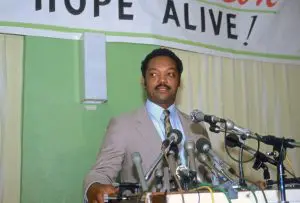
Jesse Jackson, the charismatic civil rights champion who became one of America’s most influential voices for the voiceless and marginalized, died Tuesday at age 84. His family released a statement describing him as a servant leader dedicated not only to his family but to the oppressed and overlooked around the world. Jackson’s decades-long career made him impossible to ignore, even when America tried.
Born in 1941 in Greenville, South Carolina during the Jim Crow era, Jackson grew up surrounded by racist laws designed to subjugate Black Americans. He transferred from the University of Illinois to a historically Black college after experiencing discrimination, then began civil rights activism while in college. He was arrested for trying to enter a “whites-only” library in South Carolina. That defiance would define his entire life.
Jackson became a close lieutenant to Martin Luther King Jr., traveling with him and becoming deeply involved in the movement’s most critical moments. When King was assassinated at the Lorraine Motel in Memphis, Jackson was present, a detail that would become controversial when he claimed to have cradled the dying King in his arms—an account other King associates disputed. Regardless, Jackson’s connection to King cemented his place in civil rights history.
The preacher who ran for president twice
Jackson pursued the Democratic presidential nomination in 1984 and 1988, mounting unexpectedly strong campaigns despite facing significant obstacles. In 1984, he won 3.3 million votes and finished third. His candidacy lost momentum after it became public that he had privately called Jewish people derogatory names, a controversy that revealed the complexity of his legacy.
By 1988, Jackson ran a more polished campaign, finishing second in the Democratic race. He won 11 state primaries and caucuses, including several in the South, and captured 6.8 million votes—29 percent of those cast. He electrified the Democratic convention with a speech about his journey and America’s diversity. That speech remains iconic among those who remember his charismatic oratory and ability to inspire audiences. It wasn’t until Barack Obama’s election in 2008 that another Black candidate came as close to securing a major party presidential nomination.
Building infrastructure for Black economic power
Jackson never held elective office, but he built something arguably more powerful: institutions dedicated to Black economic empowerment and social justice. He founded Operation PUSH and later the National Rainbow Coalition, organizations focused on creating economic opportunities and advancing civil rights beyond just race, including women’s rights and gay rights. The two organizations merged in 1996, and Jackson led the merged entity for nearly three decades.
Jackson became known for personal diplomacy that transcended traditional activism. He secured the 1984 release of a U.S. naval aviator from Syria, earning President Ronald Reagan’s gratitude. He met with Saddam Hussein in 1990 to secure the release of Americans and others after Iraq’s invasion of Kuwait. He negotiated the release of Cuban and American prisoners from Cuban jails and American airmen held in Serbia. These diplomatic efforts demonstrated that Jackson’s influence extended far beyond domestic civil rights.
The complicated legacy of a complicated figure
Jackson’s life wasn’t without scandal. His son Jesse Jackson Jr. served time on fraud charges. Jackson had a daughter out of wedlock in 1999 with a woman who worked at his civil rights organizations, a revelation that became a public scandal. He weathered these controversies and remained America’s preeminent civil rights figure for decades, though his influence gradually diminished as he aged.
In 2017, Jackson announced he had been diagnosed with Parkinson’s disease after experiencing symptoms for three years. The diagnosis marked a visible shift in his ability to maintain the activist schedule that had defined his life. Despite this, Jackson continued speaking out about racial justice, condemning police killings of Black Americans including George Floyd in 2020.
A life that spanned the civil rights era to modern activism
Jackson’s career bridged the classical civil rights movement of the 1960s and contemporary activism. He hosted a CNN show from 1992 to 2000, pressed corporations for Black economic empowerment, and received the Presidential Medal of Freedom from President Bill Clinton in 2000. He served as Clinton’s special envoy to Africa, bringing international attention to African issues.
Jackson’s death comes during an administration that has targeted civil rights progress, removing slavery exhibits from museums and restoring Confederate statues. His passing marks the end of an era when one person’s moral authority and oratory could command national attention on issues of justice and equality.
