


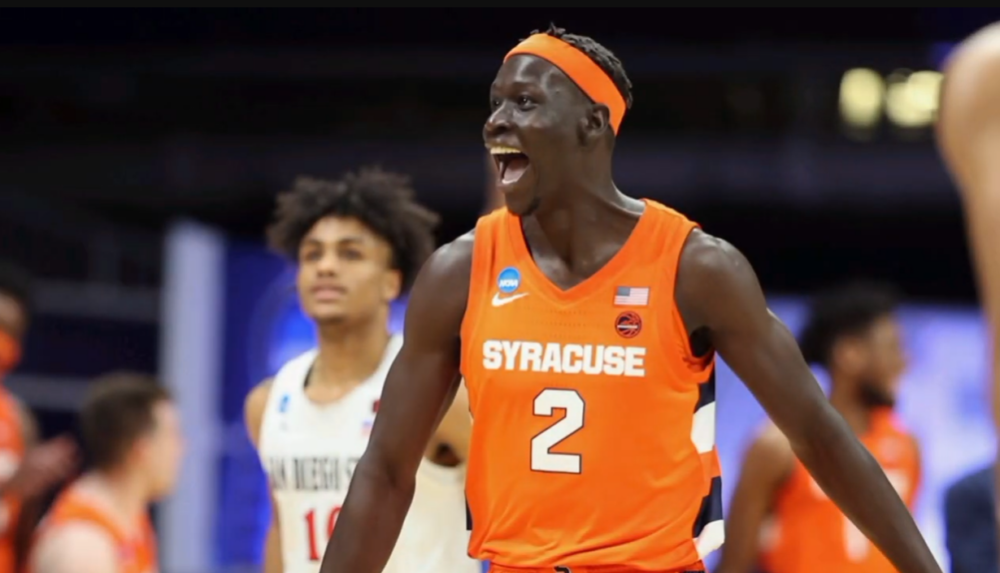
John Bol Ajak’s path to the United States was never an easy one. Born in Sudan, he fled to Kenya before eventually arriving in America in 2014 at just 14 years old. In those earliest days, he had no place to sleep and no guaranteed future only ambition and the hope that education and athletics might open doors that hardship had closed.
A host family eventually took him in, and Ajak found his footing at the Church Farm School in Exton, Pennsylvania. From there, his basketball ability and academic drive carried him to Syracuse University, where he spent three seasons playing for the Orangemen and built a life deeply connected to the city’s African community. For a young man who had survived displacement and homelessness, Syracuse felt like home.
That chapter of his life is now over.
How the legal troubles began
After graduating from Syracuse, Ajak’s F-1 student visa expired in 2023. He had hoped to continue his education by enrolling in a master’s program at the university’s Newhouse School of Public Communications, a plan that would have kept him on a legitimate path toward extending his stay. That plan never materialized into the legal protections he needed.
In the months that followed, Ajak’s situation deteriorated rapidly. His first arrest came on Dec. 17, 2025, near the JMA Dome, where he faced charges of resisting arrest and disorderly conduct. Just over a month later, he was arrested again at the Newhouse School on similar charges. Additional arrests for third-degree criminal trespassing followed, each one compounding an already fragile immigration status.
On Feb. 18, 2026, moments after being released from jail following his most recent arrest, Ajak was taken into custody by U.S. Immigration and Customs Enforcement. He was transferred to the Moshannon Valley Processing Center in Pennsylvania, where he remained detained while his case moved through immigration court.
The hearing that sealed his fate
On April 2, 2026, Ajak appeared before Immigration Judge Adam G. Panopoulos in a virtual court hearing, representing himself without legal counsel. The U.S. Department of Homeland Security had already established that he overstayed his visa, and the legal ground beneath him had all but disappeared.
Ajak chose voluntary departure over a formal deportation order a distinction that carries some legal weight but changes little about the practical reality of what comes next. During the hearing, he made clear that his feelings about the outcome were raw and unresolved, expressing a deep sense of betrayal about how his years in the United States were ending.
The judge acknowledged the circumstances of his case but ruled in favor of the government. Ajak is now set to return to Sudan, a country he left more than a decade ago as a teenager searching for a better life.
What his story leaves behind
Within the Syracuse community, the reaction to Ajak’s deportation has been one of grief and reflection. His case has reignited conversations about the vulnerabilities international students face, particularly those from African nations, when navigating a U.S. immigration system that offers little flexibility once a visa has lapsed and legal trouble begins.
Ajak’s story is not simply about a visa overstay. It is about a young man who arrived in this country with almost nothing, built something real, and then watched it unravel through a combination of legal missteps and a system with limited room for second chances. The community that embraced him the African community in Syracuse he once described as central to why he chose to stay is now left to reckon with his absence.
What comes next
As Ajak prepares to return to Sudan, the specifics of what awaits him there remain unclear. He left as a child. He returns as an adult with an American college degree, a complicated legal record, and a future that must now be built somewhere else entirely.
His case will likely continue to echo in discussions around immigration policy, the treatment of international student athletes, and the gap between the opportunities America promises and the protections it sometimes fails to provide. For the many young people who arrive in the United States chasing the same dreams Ajak once held, his story is a difficult and necessary one to understand.
