


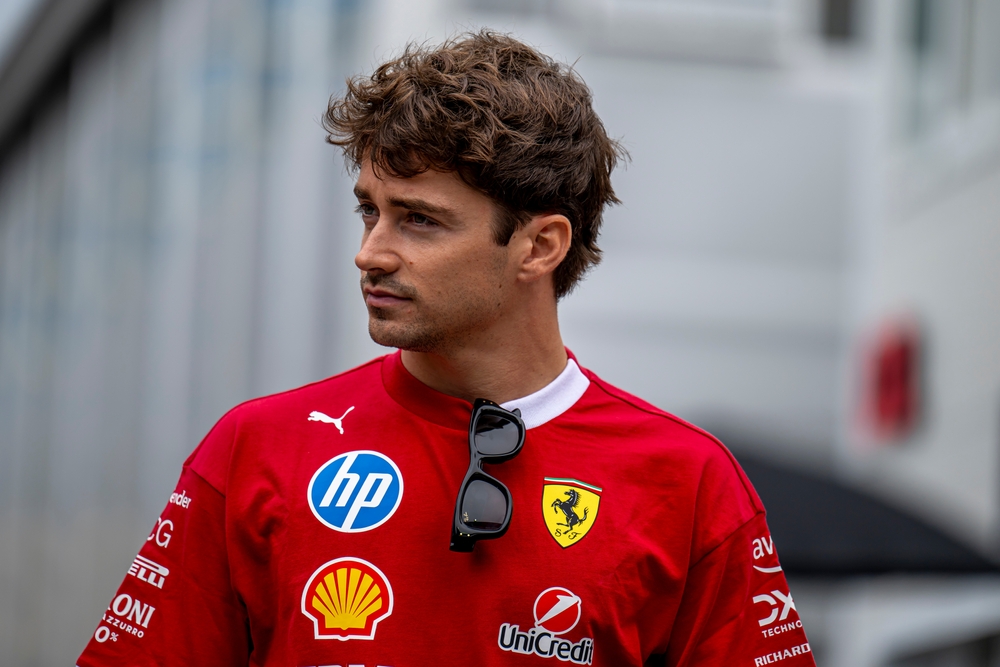
Charles Leclerc ended a victory drought stretching back to the 2024 United States Grand Prix with his first career British Grand Prix win at Silverstone, revealing afterward that he had deliberately limited his exposure to online media and social commentary during a difficult stretch of the season in order to protect his focus and maintain an accurate sense of his own capabilities.
The win also saw Leclerc finish ahead of Ferrari teammate Lewis Hamilton in a grand prix for the first time since March, a development that carried additional significance given the questions that had circulated around his pace relative to his seven-time world champion teammate throughout the earlier part of the year.
A slump that required active management
Leclerc did not downplay the difficulty of the period he had been navigating before Silverstone. He described an environment characterized by significant negativity, with narratives forming around his performance that he found neither accurate nor constructive to engage with. The response he settled on was deliberate avoidance, reducing his attention to online commentary and focusing exclusively on what he and his team could identify and address within the car and his driving.
His reasoning for the approach reflected an understanding of how quickly public perception shifts in Formula 1, where a driver can move from celebrated to questioned within days of a performance change. He said the volatility of external commentary made it a poor guide for how to actually interpret a difficult situation, and that his best path through the slump was to trust his own judgment and his team’s data rather than absorb a version of events shaped by observers working with far less information.
He was clear that he did not believe he had stopped being a competitive driver. The problem, in his account, was a question of finding the right feeling with a car that is unlike any he has driven before under 2026’s new technical regulations, and that process took longer than he had hoped.
The car and what changed
Leclerc was strong in the opening phase of the 2026 season before losing confidence in how the car responded to his inputs. Several setup changes were made over subsequent rounds, but reestablishing the connection between his driving style and the car’s behavior required more time than the team had anticipated. Silverstone provided the conditions, a circuit where driver confidence plays a particularly significant role in lap time, in which that connection felt restored.
He was careful to present the win as a starting point rather than a resolution. He noted that Silverstone suits a particular style and that he will need to demonstrate the same level of performance across different circuit layouts before he can consider his relationship with the 2026 car reliably rebuilt. One race, in his framing, does not end the battle.
What the Silverstone result means
The British Grand Prix victory is significant in multiple dimensions. It ends a drought that had lasted through the final portion of 2024 and all of the 2025 season. It demonstrates that Ferrari’s recent development work has produced genuine performance at a circuit where Lewis Hamilton has historically been at his most dominant. And it reestablishes Leclerc as a factor in the championship conversation heading into the second half of the season.
He acknowledged the emotional weight of the result, describing the effort required to keep working hard and maintain trust in the team’s direction during a stretch when outside commentary was uniformly discouraging. The satisfaction of producing the win on the other side of that experience, he said, reflected the work of everyone around him as much as his own performance.
