


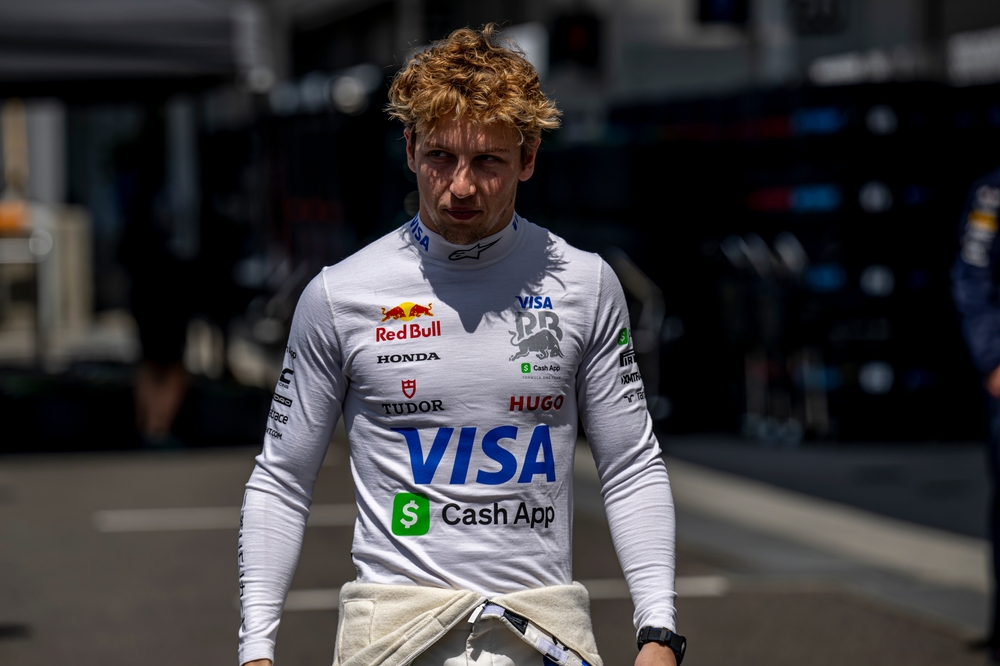
Liam Lawson has directly challenged the version of events Red Bull presented when they demoted him after just two races at the start of last season, saying the team built a false narrative around his exit that he finds deeply at odds with what he actually experienced during that period.
Lawson had replaced Sergio Perez heading into 2025 and was seen as one of Formula 1’s most promising young talents. After a difficult opening weekend in Australia and an even harder weekend in China, he was moved back down to the junior team Racing Bulls, with Yuki Tsunoda taking his seat. The team suggested at the time that the move was made to relieve pressure on a driver who appeared to be struggling. Lawson rejects that framing entirely.
What actually happened in China
The central revelation in Lawson’s account concerns a decision made during the Shanghai race weekend that he says was a collective team initiative rather than a reflection of his individual failings. At that point in the season, the Red Bull car was not performing well, and frustration with the machinery was shared across the team including by Max Verstappen.
On Saturday evening during the Chinese Grand Prix weekend, a meeting took place in which a radical setup change was proposed and agreed upon. The change was far more extreme than anything a team would normally attempt during a race weekend, described by Lawson as an experiment on a scale that bore no resemblance to standard adjustments. The logic was that since Lawson would be starting from the back of the grid anyway, the weekend could serve as a testing opportunity to gather data that might help the team and the driver find a better direction going forward.
Lawson said he was fully aware that the chances of the radical change producing a competitive result were extremely low and agreed to the plan with that understanding, on the basis that the data gathered would be valuable regardless of the race outcome. The experiment did not produce the improvement hoped for, and his demotion was confirmed before the following round in Japan.
A narrative Lawson refuses to accept
What troubles Lawson is not the demotion itself but the explanation that accompanied it publicly. The suggestion that the move was made to protect him from the mental burden of competing at that level was, in his telling, the opposite of the truth. He described the manufactured framing as something he finds impossible to reconcile with the experience as he lived it.
His response has been to mentally detach from the entire episode, describing a deliberate act of psychological compartmentalization in which he chooses to treat those two races as if they never occurred. Given how the situation unfolded, with inadequate preparation, a compromised car, and a post-race narrative he did not recognize as his own, the decision to move on without dwelling on the experience appears to have served him well.
Support from Verstappen and a return to form
One aspect of the Red Bull period that Lawson described positively was the behavior of his teammate throughout the entire saga. Verstappen, operating from a position of unrivaled success within the team, was supportive of Lawson in ways that Lawson said he valued but did not wish to detail publicly. The contrast between how the institution handled the situation and how the team’s star driver treated him as an individual was, in Lawson’s account, considerable.
Since returning to Racing Bulls, Lawson has found his footing. He has scored points in five of the first seven races of the current season and contributed the majority of the junior team’s constructors’ points. The form suggests a driver who processed a damaging experience without allowing it to define him, which is precisely the approach he described choosing to take.
