


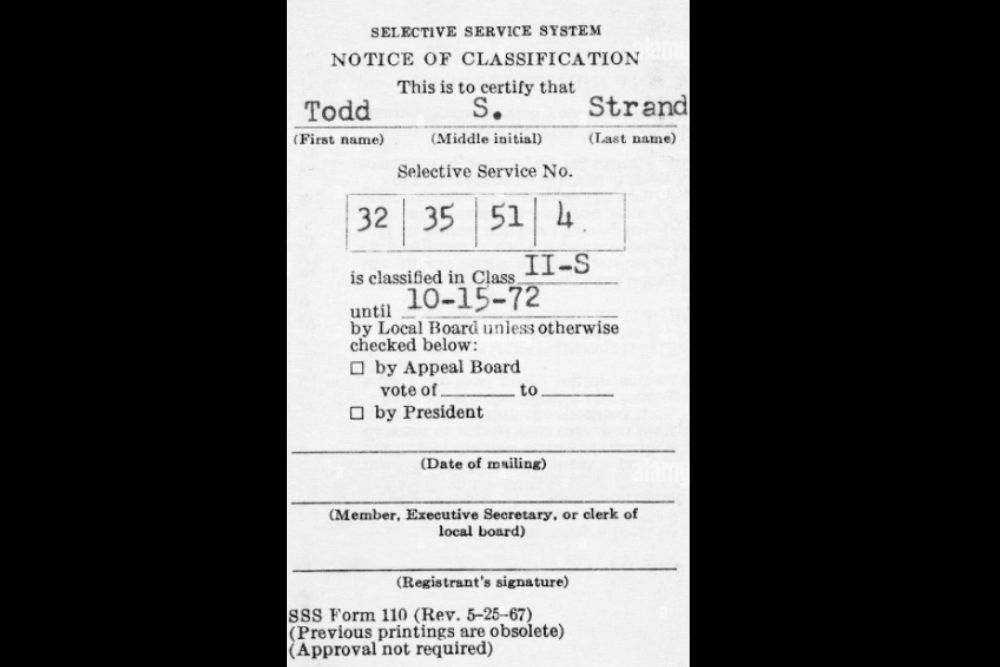
Starting in December 2026, young men in the United States will no longer need to register themselves with the Selective Service System. The government will do it for them. The change, tucked into the Fiscal Year 2026 National Defense Authorization Act signed into law in December 2025, shifts the registration burden from individuals to federal agencies, which will pull data from existing government sources to enroll eligible men automatically as they turn 18.
The Selective Service System submitted its proposal for automatic registration on March 30, 2023, according to reporting from The Hill. The policy has been in the pipeline for years. Now it’s law.
What registration actually means
Automatic enrollment in the Selective Service does not mean a draft is coming. The two are distinct. Registration simply places eligible men into a database that would be activated only in the event of a national emergency declared by Congress. If a draft were triggered, individuals would be selected through a randomized lottery and then evaluated for physical, mental, and moral fitness before being inducted.
The United States has not used a mandatory draft since the Vietnam War era. The country shifted to an all-volunteer military in 1973. President Jimmy Carter brought the Selective Service back online in 1980 amid Cold War tensions, and it has remained in place ever since. Under current rules, men are required to register within 30 days of turning 18. Failure to register can result in the loss of access to federal student loans, job training programs, and other government benefits.
Automatic registration eliminates that individual responsibility, and for some, that’s the concern.
The draft’s history and Black men
The policy change is arriving with historical context that many in the Black community find difficult to set aside. During the Vietnam War, Black men were drafted at rates that did not reflect their share of the population. In 1967, Black men accounted for 16.3% of all draftees while making up roughly 11% of the U.S. population at the time. A Defense Department initiative known as Project 100,000, which ran from 1965 to 1973, further increased the number of Black men inducted by lowering qualification standards in ways that critics argued exposed more vulnerable and lower-income men to military service.
The numbers today reflect a continuation of that pattern in voluntary form. As of late 2024 and into 2025, Black soldiers made up between 20.3% and 21.4% of active-duty Army personnel, totaling somewhere between 91,000 and 95,000 service members. That representation is notably higher than the Black share of the overall U.S. population, which sits around 13%.
What officials are saying about the draft
White House press secretary Karoline Leavitt said in a March 2026 interview that activating the draft is not part of any current plan. That statement offers some reassurance, but it doesn’t settle the broader conversation. Political conditions shift. Leadership changes. And the automatic registration policy, by design, ensures that the infrastructure for a draft is always current and ready.
The concern being raised is not that a draft is imminent. It’s that if one were ever triggered, the demographic patterns from the Vietnam era could reassert themselves, and a community that already serves at disproportionate rates could again bear more than its share of the burden.
For young Black men and their families, that history is not abstract. It shapes how a procedural policy change reads, even when officials are careful to describe it as nothing more than administrative modernization.
