


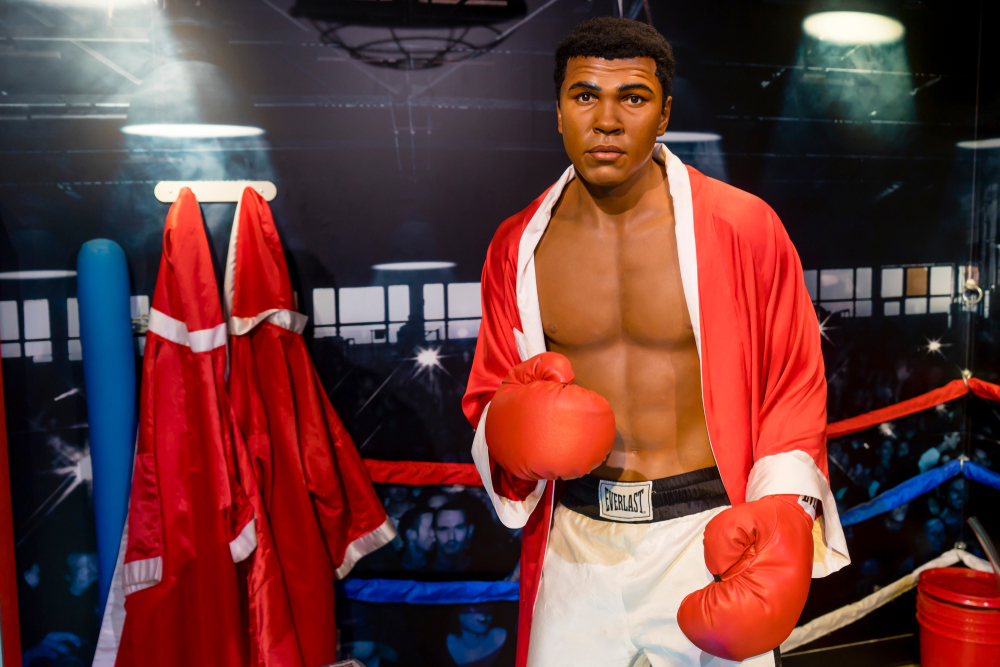
The image of Muhammad Ali in fighting stance tells only half the story. Topless, gloves raised, muscles taut with purpose—this was a man who understood that his fists were never just weapons in a ring. They were tools of defiance against a power structure that demanded Black athletes entertain without opinion, perform without protest, exist without politics.
Ali did not comply.
Between 1964 and 1967, Ali transformed from Cassius Clay into something the establishment could not tolerate—a Black man who refused to be controlled. His conversion to Islam, his friendship with Malcolm X, his thunderous rejection of the Vietnam War—each act represented a fundamental threat to the social order that preferred its Black champions grateful and silent.
The punishment was swift and devastating. In 1967, authorities stripped Ali of his heavyweight title and banned him from boxing for three years during his athletic prime. No criminal conviction. No due process. Just raw, institutional power wielded against a Black man who dared to say the system itself was the opponent.
When Excellence Becomes Dangerous
Ali’s dominance in the ring was undeniable. His speed, strategy, and showmanship redefined what a heavyweight could be. But excellence alone was never the problem. The issue was that Ali understood his platform and refused to waste it on shallow gratitude.
His most famous declaration remains a masterclass in resistance— I ain’t got no quarrel with them Viet Cong. No Viet Cong ever called me nigger. With 17 words, Ali connected American racism to American imperialism, exposed the hypocrisy of asking Black men to fight for freedoms they did not possess at home, and positioned himself as more than an athlete—he became a political force.
The power structure responded the only way it knew how— elimination. If they could not silence Ali through persuasion or intimidation, they would erase him from the sport entirely. The message was clear to every Black athlete watching— stay in your lane or lose everything.
The Modern Parallels Are Unmistakable
Fast forward to 2026, and the script remains familiar. Black athletes who speak on police brutality, voting rights, or systemic inequality face immediate backlash. Sponsors withdraw. Media pundits demand they stick to sports. Politicians call them ungrateful. The methods have evolved, but the goal is identical— enforce silence as the price of success.
Colin Kaepernick knelt during the national anthem and was blackballed from the NFL. LeBron James faced relentless criticism for addressing social issues despite being one of basketball’s greatest players. Naomi Osaka prioritized her mental health and was fined, then vilified. The pattern repeats because the power structure still cannot tolerate Black excellence paired with independent thought.
Ali proved that dominance in your field means nothing if the system decides you have become too dangerous. His three-year exile was not about boxing ability—it was about setting an example. Punish one loudly enough, and others will self-censor out of fear.
Why Silence Is Never Neutral
The demand that Black athletes avoid politics is itself a political position. It protects the status quo by removing influential voices from important conversations. When Ali refused the draft, he was not injecting politics into sports—he was refusing to let sports be used as a distraction from the political reality of Black oppression.
Today’s athletes face the same trap. Staying silent on issues that directly affect their communities is framed as professionalism, while speaking up is deemed divisive. But Ali understood what his critics never could— neutrality in the face of injustice is complicity.
His willingness to sacrifice wealth, fame, and career during his prime years demonstrated that some principles matter more than comfort. That lesson terrifies a power structure built on the assumption that everyone has a price.
The Cost of Defiance Remains High
Ali eventually returned to boxing and reclaimed his title, but those stolen years can never be recovered. He paid an enormous price for his convictions, and the system ensured that price was visible to discourage others from following his path.
Yet his legacy endures precisely because he refused to submit. Generations of Black athletes and activists draw strength from his example, understanding that true power lies not in how hard you punch, but in what you refuse to accept.
The wax figure in Orlando captures Ali’s physical form—the stance, the muscles, the readiness for battle. But it cannot capture what made him truly dangerous to the establishment— his absolute refusal to let anyone else define his worth or dictate his purpose.
Muhammad Ali proved that Black excellence paired with vocal resistance represents the ultimate threat to systems designed to exploit Black talent while suppressing Black autonomy. That truth remains as relevant in 2026 as it was in 1967, and the ongoing attempts to silence outspoken Black athletes confirm that the power structure learned nothing from trying—and failing—to break the Greatest of All Time.
