


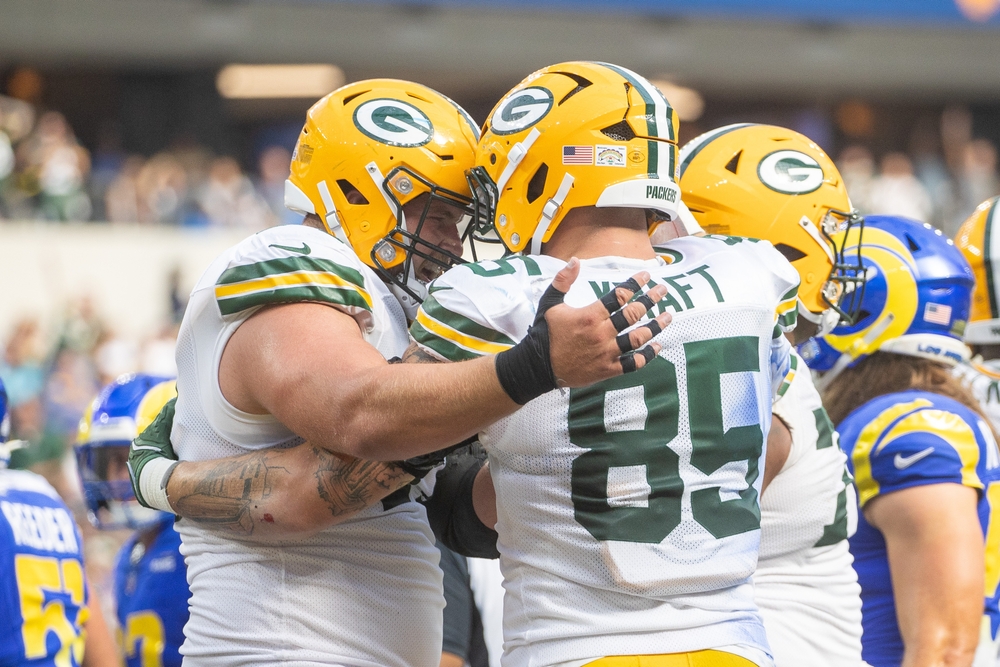
Tucker Kraft took a significant step toward his return on Friday, coming off the physically unable to perform list less than nine months after surgery to repair a torn ACL in his right knee, putting him on track to be ready for the Packers’ season opener.
He sustained the injury in early November and underwent surgery roughly 10 days later. His activation from the PUP list, while a necessary procedural step, does not mean he will immediately be participating in full-team drills. The Packers are expected to reintegrate him gradually, beginning with individual work and walk-through periods as the team brings him back into football activity without rushing the recovery timeline.
The coaching staff will not allow him to participate in 11-on-11 team drills for at least another one to two weeks, with the nine-month threshold the organization uses as a guideline for ACL returns not expected to be reached for a short while longer. That marks his pace as slightly ahead of the initial expectations Kraft himself had set, as he said last month that he intended to be at practice at some point during camp and ready for the season opener against the Minnesota Vikings on Sept. 13 without limitations.
What the Packers are watching
The organization’s general manager spoke earlier in the week about where Kraft stands physically, describing the tight end as visually impressive when seen on the field but noting that the science behind ACL recovery justifies patience even when a player appears ready. He compared the situation to a similar return by receiver Christian Watson the prior year, in which the player looked ahead of schedule but the team maintained its cautious approach regardless.
Matt LaFleur, the Packers’ head coach, described the reintegration plan as one focused on familiarity first, allowing him to hear plays called, line up in formations and work through the installation in a controlled environment before anything more demanding is asked of him. The walk-through periods the team holds in the evenings are considered a useful setting for those early steps, giving him practice at absorbing the game plan without the physical demands of a full session.
What Kraft was before the injury
The return matters to the Packers because of how good he had been through the portion of the season he played. At the time of the injury he had caught 32 passes for 489 yards and six touchdowns. He was the only tight end in the NFL through nine weeks with at least 30 receptions, 475 receiving yards, six or more receiving touchdowns and an average of at least 15 yards per catch. The combination of volume and efficiency at the position was rare, and the Packers need that version of Kraft back for what they are trying to do offensively.
He enters this season in the final year of his rookie contract, which means the negotiation questions surrounding his future are already in the air alongside the recovery conversation. Both he and the organization have said they want to get a deal done sooner rather than later, and neither side has expressed interest in letting the season play out without an agreement in place. As of Friday, those talks were described as still in their early stages.
The bigger picture for Green Bay
The Packers have invested significantly in building a tight end group capable of affecting games in multiple ways. Kraft’s production before the injury reflected the kind of all-around threat the position demands in today’s NFL, and his return at full capability would give the offense a dimension that no replacement was able to replicate during the months he was out.
The Sept. 13 opener in Minnesota gives the team a built-in target to calibrate everything around. Whether Kraft meets that deadline without restrictions will depend on how the next few weeks of gradual reintegration go and how his knee responds to increasing loads of football activity.
For now, Kraft is back in the building and back in the process, which is the first step toward being back in the game.
