


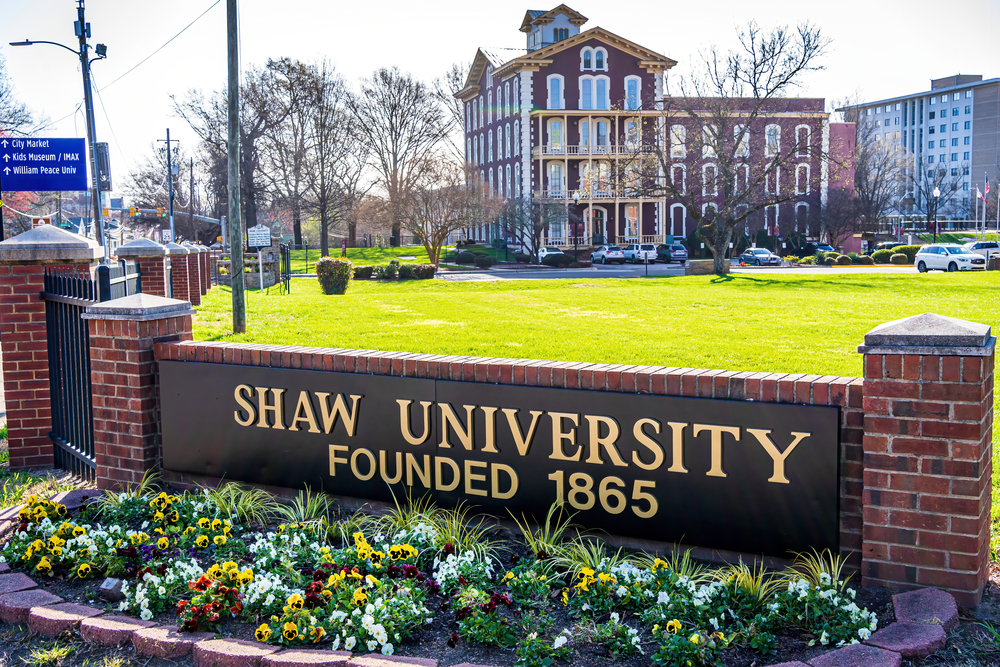
There are old schools, and then there is Shaw University. Sitting in the heart of downtown Raleigh, North Carolina, behind a gold-lettered sign that reads Founded 1865, Shaw carries a weight that most institutions could not begin to comprehend. It was born in the same year slavery was abolished in America — not as a coincidence, but as a declaration. Shaw University did not just open its doors. It swung them wide open for an entire people who had been told, by law, that education was not for them.
That story, 160 years in the making, is one of the most remarkable in American higher education. And it is still being written.
Shaw University and the birth of Black education in the South
Shaw was originally established as the Raleigh Theological Institute by the American Baptist Home Missionary Society in 1865, making it the first HBCU in the American South. Its founder, Henry Martin Tupper, was a Union Army veteran and Massachusetts-born educator who arrived in Raleigh with a singular mission — to teach formerly enslaved people to read. In its first four years alone, Shaw taught nearly 1,000 former slaves to read. That number is staggering. That number is legacy.
The institution grew rapidly from that single theology class, incorporating formally as Shaw University in 1875. What followed was a string of firsts that reads less like a school’s history and more like a mission statement for an entire movement.
A record of firsts no other HBCU can match
Shaw did not just survive — it pioneered. Shaw was the first university to offer a four-year medical school, the first to offer a school of pharmacy, and the first to offer a law school for freed people in the United States. Each of these programs was created at a time when Black Americans were systematically excluded from every professional pathway in this country. Shaw built the door and held it open.
In 1873, Shaw opened Estey Hall, the nation’s first college building featuring dormitories and classrooms open to Black women. Estey Hall still stands on campus today — a brick-and-mortar testament to the audacity of what Shaw dared to build. By 1900, Shaw University had trained more than 30,000 Black teachers, sending them out across the South to carry the work forward.
Shaw and the Civil Rights Movement
Shaw’s legacy does not stop at academics. In April 1960, Ella Baker organized a student meeting at Shaw University that gave rise to the Student Nonviolent Coordinating Committee, better known as SNCC — one of the most powerful organizations of the American Civil Rights Movement. From Shaw’s campus, young people coordinated sit-ins, voter registration drives, and Freedom Rides that helped reshape the legal and social landscape of an entire nation.
Former Vice President Kamala Harris, speaking at Shaw in 2020, captured this legacy in a few words — people born into bondage stood on Shaw’s ground as graduates and as scholars, and it was there that Ella Baker and fellow students helped establish SNCC. That is the kind of institution Shaw is. Its campus is not just a place of learning — it is sacred ground.
Shaw University in 2026
Today, nearly 1,100 students attend Shaw University, where they can prepare for careers in emerging fields including digital technology and cybersecurity. Shaw’s Innovation and Entrepreneurship Center supports both students and community members in building businesses, while its collaboration with the Research Triangle Foundation of North Carolina is opening new doors for corporate partnerships and career development in the innovation sector.
Shaw University has also extended its reach beyond traditional classrooms, offering educational pathways to adult learners and even incarcerated individuals seeking a second chance. That instinct — to open doors for people others have shut out — has been Shaw’s DNA since 1865.
Why Shaw’s story still matters
A university founded to teach freed people how to read is now producing doctors, lawyers, technologists, and leaders. That arc — from a theology class in a Raleigh hotel room to a 160-year institution anchored in one of the South’s fastest-growing cities — is not just history. It is proof of what becomes possible when education is treated as liberation.
Shaw University is still here. Still standing. Still founding. And that brick wall with the gold letters out front? It is not just a sign. It is a monument.
