


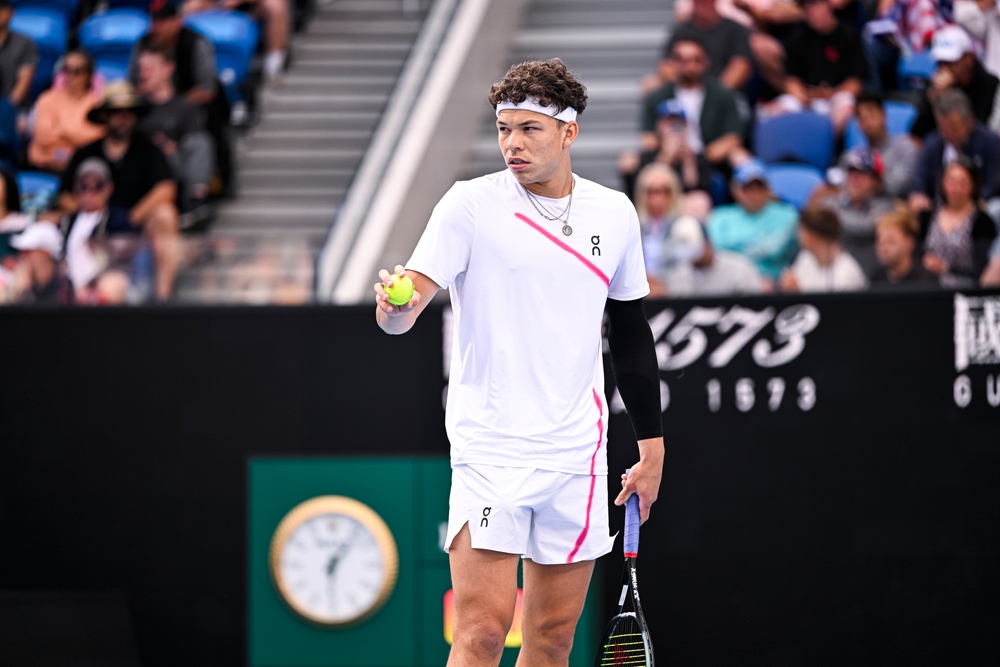
Ben Shelton joined Karen Khachanov in criticizing the second-serve bouncing routine of US Open champion Alexander Zverev after Sunday’s final, saying the practice creates an unfair burden on opponents and should be subject to some form of rule change.
The current rules include a 25-second serve clock for first serves but contain no time limit for second serves, requiring only that the serve be delivered without delay. There is also no limit on ball bounces before a serve.
Shelton lost 6-3, 7-6 (2), 5-7, 6-2. He said the chair umpire told him during the match that he needed to get to the baseline earlier when Zverev began his routine. Shelton pushed back, telling her that Zverev can start his routine whenever he wants and that he guaranteed Zverev would never serve and find him unready. But he said he should not have to simply stand there for 20 to 25 ball bounces.
Shelton said as long as a receiver is ready when the server puts his hands together and begins bouncing, that should be what matters. He called the existing rule stupid. He said he wants a rule limiting time on the second serve, though he was not certain how one would be constructed. He said unlimited time is not good for the sport or for fans.
Khachanov said the same thing
Khachanov raised the issue after his semifinal loss to Zverev on Friday. He said the bouncing annoys not only him but many players because it takes so much time. He said the difficulty is that a receiver gets ready, and then there are another 12 bounces, forcing another split step, and that every single point is like that.
Khachanov added that he did not think much could be done because it is within the rules.
Zverev’s response
Zverev acknowledged a statistic circulating during the tournament that he had recorded more than 12,000 pre-serve bounces in his first five matches. He said he was not doing it on purpose, found it quite funny, and was not counting in his head or aiming for a specific number.
The rule question
The gap in the rulebook is specific. The serve clock applies to first serves only. For second serves, the standard of without delay is vague and has not historically been enforced against players who have elaborate pre-serve routines.
He said he thought first-serve time should remain generous and that players should be able to use the full 25 seconds. But he said a time limit of some kind on second serves should be introduced. Shelton added that he expects tournaments to look at the issue at some point because the delay in play is significant in some matches.
Whether the ATP or Grand Slam committee takes up the question during the off-season will determine if the champion faces any change in the environment he plays in next year.
