


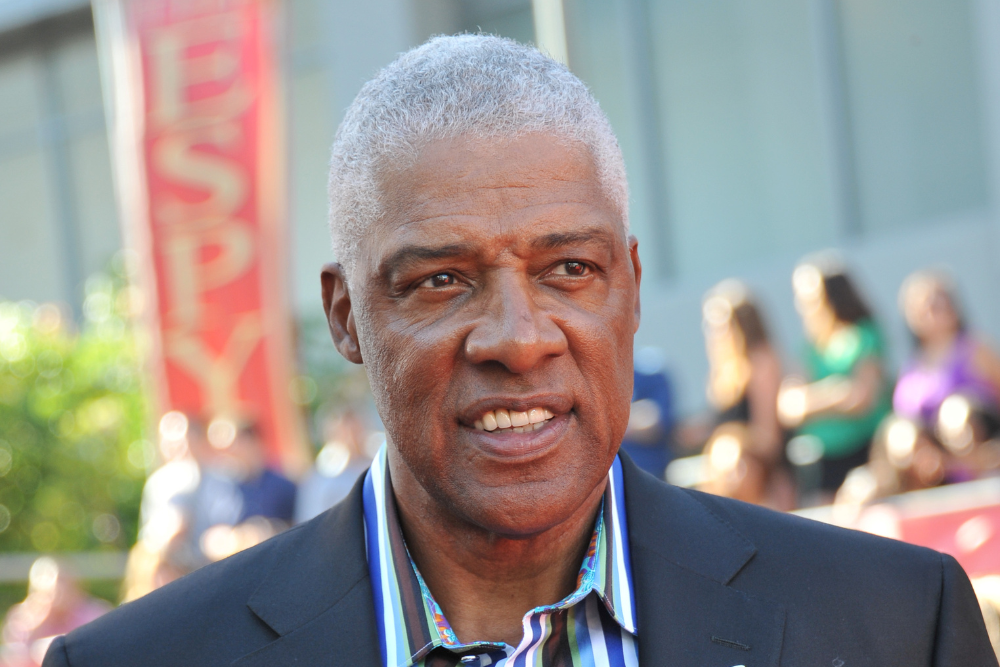
Julius Dr. J Erving has never been someone who stays in one lane for long. At 74, the basketball Hall of Famer is proving that point once again with a new brand partnership that blends sports nostalgia, modern technology and sharp business instincts in equal measure.
Erving has signed with footwear company Rockport as part of a campaign that uses artificial intelligence to digitally recreate a younger version of himself giving fans a rare visual bridge between the gravity defying athlete he once was and the accomplished entrepreneur he has become.
A campaign that turns back the clock
The partnership comes to life through a promotional video shared on Erving’s social media platforms, and it is unlike most athlete endorsements. In it, a younger Dr. J appears on a basketball court in full uniform, executing the kind of moves that made him one of the most electrifying players of his generation. The footage then shifts through time, showing Erving’s transition from the hardwood to the boardroom, eventually landing on a present-day version of him dressed in a suit Rockport shoes completing the look.
It is a campaign that leans heavily on legacy while feeling distinctly current, and for Erving, that balance seems intentional. He has long described himself as someone driven by a need to push forward, whether in sport or in life, and the Rockport deal reflects that same restless energy.
The man who started it all for athletes and sneakers
What makes this partnership especially resonant is its historical backdrop. In 1976, Erving became the first professional basketball player to sign a sneaker deal an agreement with Converse that quietly rewrote the rules for how athletes and brands could work together. That deal planted a seed that would eventually grow into one of the most lucrative corners of the sports industry. The template he established helped pave the way for the deals that would later define the careers of players like Michael Jordan and Kobe Bryant, whose footwear partnerships became cultural phenomena in their own right.
That Erving is now entering a second chapter of his sneaker story, nearly five decades later, adds a layer of symmetry that is hard to ignore.
A basketball career that still resonates
For those too young to have watched him play, Erving’s résumé tells the story clearly. He came up in the American Basketball Association, suiting up for the Virginia Squires and later the New Jersey Nets before the ABA and NBA merged and he was traded to the Philadelphia 76ers. What followed was one of the most celebrated careers the sport has ever seen. He led Philadelphia to an NBA championship in 1983, was named to the All NBA Team seven times and took home the NBA Most Valuable Player Award in 1981. Across 11 seasons in the NBA and six in the ABA, he built a statistical and cultural legacy that the 76ers organization still points to with pride he remains the franchise’s all time leader in blocked shots.
His style of play, characterized by an almost balletic athleticism and a creativity that felt entirely his own, helped popularize the above the rim game that now defines how basketball is played and watched at every level.
Keeping the legacy alive on screen
The Rockport deal is not the only way Erving has been making his presence felt recently. He was also featured in Soul Power: The Legend of the American Basketball Association, a docuseries now streaming on Prime Video that examines the history and cultural impact of the ABA. His participation in the project underscores how central he remains to any honest telling of professional basketball’s evolution not just as a player, but as someone who helped give the sport much of its modern identity.
At 74, Julius Erving is not coasting on what he built. He is still building.
