


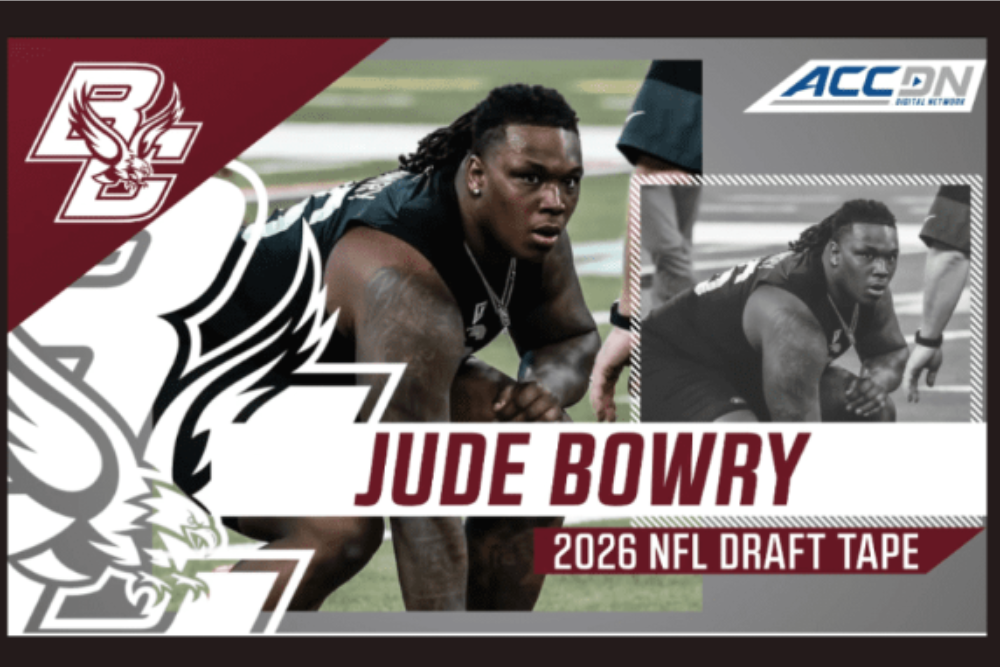
The Buffalo Bills opened Day 3 of the 2026 NFL Draft with a trade that cost them almost nothing and netted them a player who had slid further than most analysts expected. Before the fourth round began, general manager Brandon Beane swapped pick No. 101 with the Las Vegas Raiders for No. 102 and a 2027 seventh-round selection. The Raiders used that slot to take cornerback Jermod McCoy out of Tennessee, a player whose draft stock had dropped due to a knee injury. The Bills had already taken a cornerback in the third round, selecting Ohio State’s Davison Igbinosun, so passing on McCoy fit the board. With pick No. 102, Buffalo took Jude Bowry, an offensive tackle out of Boston College.
Who Jude Bowry is
Bowry is 6 feet 5 and 315 pounds. He was a two-year starter at Boston College with 23 career starts dating to 2022, logging 1,285 snaps at left tackle and 97 at right tackle. Over 31 games, he allowed just two sacks and was flagged for eight penalties, a clean record for a player working against Power conference pass rushers across multiple seasons.
His athletic profile is what drew the Bills in. Bowry has the foot speed to match edge rushers on the outside, the length to disrupt pass rush timing, and enough core strength to move defenders as a drive blocker. The inconsistencies in his game, particularly in hand placement and punch timing against bull rushers, are why he was available at 102 rather than somewhere in the second round. Those are coachable problems. The raw tools underneath them are not something a coaching staff can install from scratch.
The Buffalo Bills and the guard debate that followed the pick
Every snap Bowry took in college came at tackle, but his likely home in the NFL may be on the interior. The Athletic’s Dane Brugler noted that while Bowry is raw against skilled pass rushers at the tackle position, his athleticism, length, and core strength make him a candidate to develop at guard. That projection landed differently in Buffalo than it might have elsewhere.
Left guard David Edwards left in free agency, and the Bills are currently working through a competition between veteran Austin Corbett and backup Alec Anderson for that starting role. Corbett carries an injury history that makes depth at left guard a real need rather than a cosmetic one. Bowry enters that mix as a developmental option who could push for snaps earlier than a typical Day 3 selection would.
A pick aimed at the next two seasons, not this one
Bowry is not a projected starter in 2026. Draft analysts said so immediately, and the Bills would likely agree. Buffalo had a visible defensive depth need heading into Day 3, and taking an offensive lineman with a position question attached raised some eyebrows. The counterpoint from Beane’s perspective is straightforward. When a player with Bowry’s athletic profile slides to the 102nd pick, the value is there regardless of how clean the fit looks on paper.
The Bills had already addressed the edge rusher position in the second round, selecting Clemson’s T.J. Parker. The third round brought a cornerback. The fourth round is where Buffalo bet on ceiling, and they did it without surrendering the 101st pick outright. The 2027 seventh-rounder they picked up in the trade only sweetens the math.
Whether Bowry grows into a starting guard or settles into a swing role, the Bills got him at a price that accounts for the uncertainty. For a franchise that drafts with a two-to-three year horizon in mind, this one may read differently by the time training camp opens in 2027.
VideoCredit:Youtube:ACC Digital Network
