


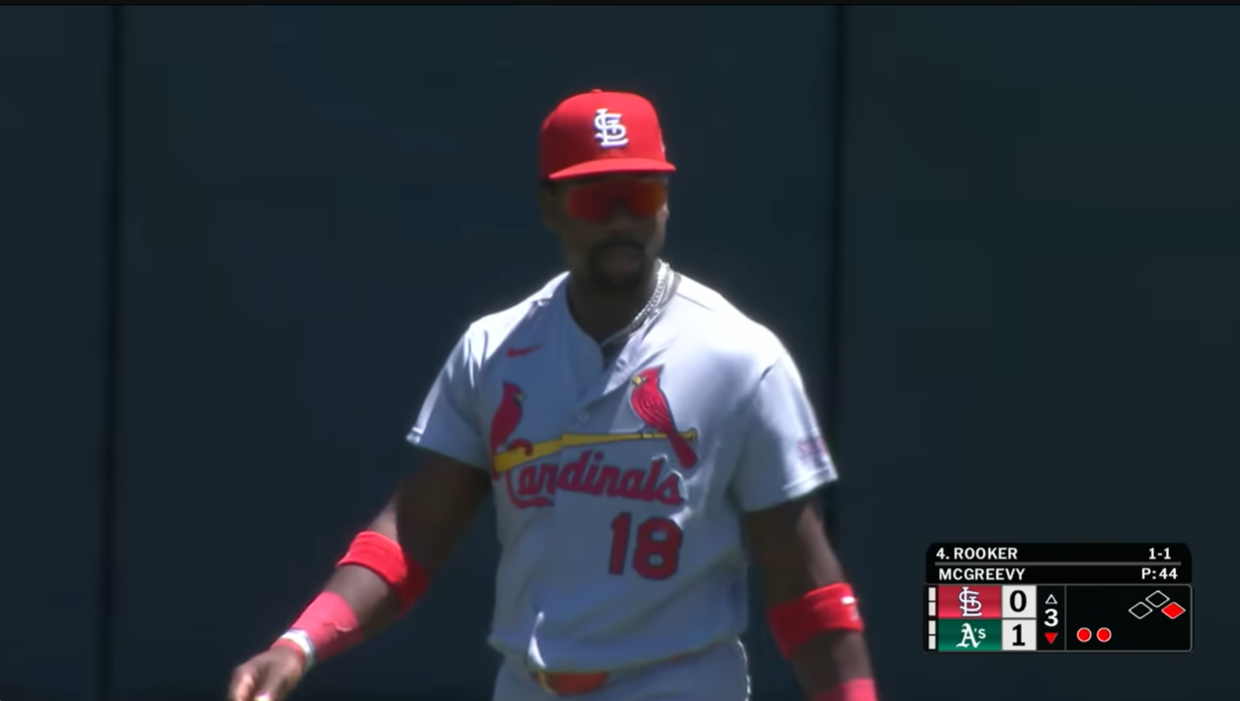
Jordan Walker turned 24 years old this week, and if the calendar feels like a formality, that is because the St. Louis Cardinals outfielder has spent much of the 2026 season making everyone forget how young he actually is. By baseball standards, he is still practically a rookie in terms of experience. By the numbers he is posting this season, he is playing like someone who has figured things out well ahead of schedule.
For a player who has carried enormous expectations since arriving in professional baseball, the 2026 season has felt like a long awaited arrival rather than a surprise.
The Goldschmidt comparison that is hard to ignore
One of the more striking ways to measure Walker’s current performance is by comparing his Statcast profile to that of Paul Goldschmidt during his 2022 season with the Cardinals a campaign in which Goldschmidt won the National League Most Valuable Player award and posted 6.8 fWAR. The two player profiles are, by several advanced metrics, remarkably similar. Spray charts, batted ball data and overall offensive production all track closely between the two seasons.
If Walker plays right field with a favorable positional adjustment and continues to add value on the bases where his numbers are already strong a projection of 7 fWAR for the full season is not unreasonable. That would place him among the most productive position players in the sport for the year.
Walker has already reached 2.1 fWAR through roughly 200 plate appearances, ranking inside the top 10 in all of baseball. He is keeping company with Aaron Judge, Yordan Alvarez, Bobby Witt Jr. and Elly De La Cruz not players typically associated with a Cardinals team still working through a rebuild.
What has actually changed
The statistical shifts underneath Walker’s performance explain a lot. His walk rate has climbed from a career average of around 7.5% to over 10% in 2026, a meaningful and sustainable improvement. His chase contact rate has jumped sharply, from 30% to 36%, meaning he is making significantly better contact on pitches outside the strike zone. At the same time, his swing and miss rate on waste pitches the kind of breaking balls designed to get hitters to swing at nothing has dropped to a career low.
The combination paints a clear picture: Walker is recognizing pitches earlier, covering more of the plate effectively and committing more fully to his swing when he decides to attack. His SquaredUp swing percentage, blast swing percentage and ideal attack angle percentage are all at career highs.
He is also using all parts of the field, a reliable indicator of a hitter who is not cheating in any one direction and is genuinely reading pitches rather than guessing.
How Walker changes the Cardinals lineup
Before Walker’s emergence, Masyn Winn was batting cleanup for St. Louis. Winn is a talented player, but using him in that role exposed a real gap in the middle of the order. Walker’s production effectively upgrades two lineup spots at once the cleanup position itself, and wherever Winn now hits lower in the order.
The top four of Jacob Wetherholt, Osvaldo Herrera, Alec Burleson and Walker gives Cardinals pitchers something they have not had in years: a genuine run of dangerous hitters without an obvious break in the sequence. The Cardinals lineup is now running a 100 wRC+ against left handed pitching, good enough for 13th in baseball a number that looked impossible to reach last offseason after the team traded away two right handed bats in Nolan Arenado and Willson Contreras.
Walker, it turns out, was the right-handed hitter St. Louis needed all along.
What this means for the rebuild
Walker’s emergence has created a more complicated timeline for the Cardinals front office. Unlike Wetherholt, who has five more years of team control after this season, Walker has just three. That window matters. If the organization cannot extend him, 2028 may be the last year he wears a Cardinals uniform, which means the acceptable length of a gradual rebuild just got shorter.
Adding Lars Nootbaar back to a healthy lineup, and potentially one more hitter from within the organization, could push this group into genuinely competitive territory. A lineup with six or seven players performing above the 50th percentile in production is one that does not collapse against dominant pitching the way the 2025 Cardinals did during a stretch that included six shutouts in two weeks.
Walker‘s improvement is not just a feel good story. It is the kind of development that changes what a franchise can reasonably expect of itself and how quickly it needs to get there.
