


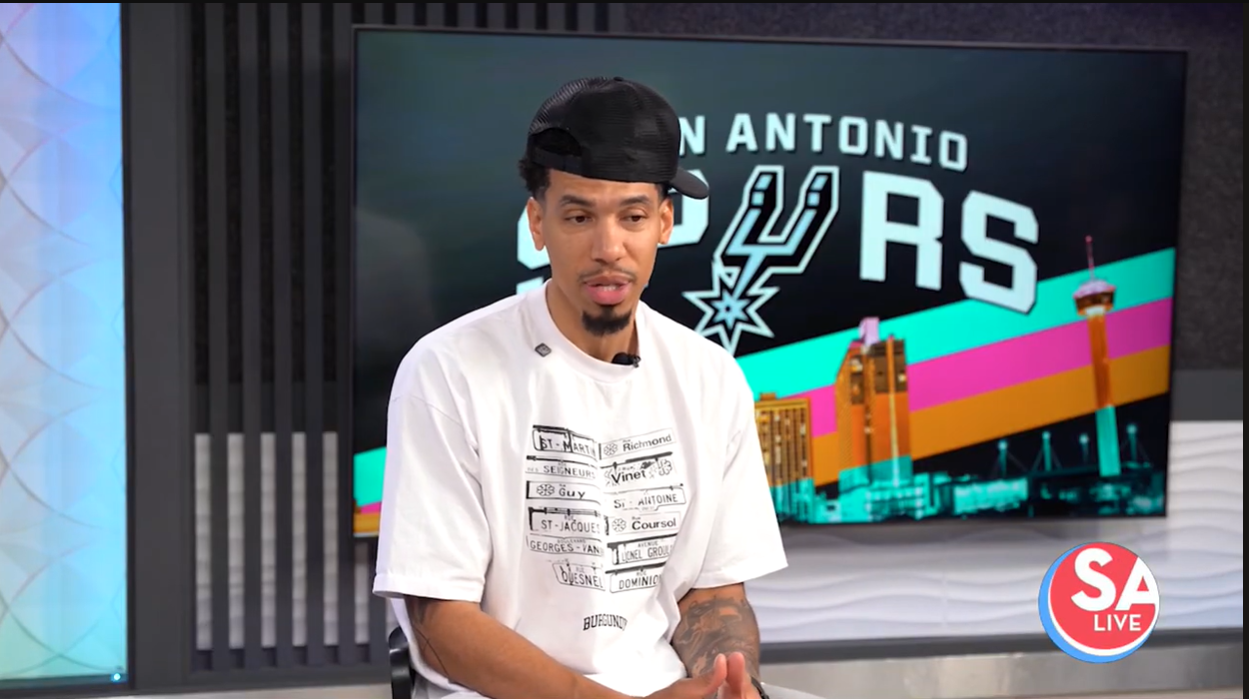
Former NBA guard Danny Green is opening up about one of the strangest chapters in basketball history and why even winning a championship could not make the experience feel normal.
The three time NBA champion recently reflected on life inside the NBA’s Orlando Bubble, the isolated environment created in 2020 to allow the season to resume amid the COVID-19 pandemic. Green, who was a member of the Los Angeles Lakers at the time, admitted that despite the league’s efforts to recreate the atmosphere of an NBA game, something important was missing.
For a player who spent years thriving in packed arenas and deep playoff runs, the Bubble often felt less like the postseason and more like a local gym.
The NBA tried to recreate game night
When the NBA suspended play in March 2020, there was uncertainty about whether the season would ever continue. Months later, the league restarted at the ESPN Wide World of Sports complex in Orlando, Florida, placing players, coaches and staff in a tightly controlled environment designed to minimize exposure to the coronavirus.
Artificial crowd noise filled the arenas. Music played throughout games. Large video boards displayed virtual fans cheering from home.
But Green said those additions never fully replaced the feeling of playing in front of thousands of people.
The veteran guard explained that he fed off the energy in the building, whether the crowd was cheering for him or against him. Without those emotional highs and lows, the atmosphere felt unusually flat and left many players searching for motivation.
Green compared the experience to playing in a fitness center with background music instead of competing on basketball’s biggest stage.
Why home court advantage disappeared
The NBA is unique among major American sports because fans sit remarkably close to the action. Courtside spectators can hear conversations, react to big plays in real time and sometimes even become part of the game when players dive for loose balls.
That intimacy creates a powerful home court advantage.
Inside the Bubble, however, every game was played in the same neutral setting. Teams no longer benefited from the energy of their home crowds, and players were forced to adapt to a completely different environment.
Green said the absence of fans had a bigger impact than many people realized. Even if players tried to ignore it, the emotional adjustment was difficult and affected performances in subtle ways.
The unusual circumstances created a learning curve across the league as stars and role players alike worked to find their rhythm in empty gyms.
LeBron James also needed time to adjust
According to Green, one player who initially struggled with the change was Lakers superstar LeBron James.
James had spent his entire career performing in front of passionate crowds. From his high school days in Akron, Ohio, through championship runs with the Miami Heat and Cleveland Cavaliers, he had become accustomed to feeding off the energy of packed arenas.
Green noticed that during the Bubble’s seeding games, James appeared to be searching for his usual spark.
Still, Green believed James ability to adapt separated him from most players.
The veteran praised his teammate for eventually adjusting to the unfamiliar circumstances and finding his form when it mattered most. Once the playoffs began, James returned to his dominant self and led the Lakers on a championship run.
His versatility and experience allowed him to overcome obstacles that many players found difficult to navigate.
The Lakers turned adversity into a title
Despite the strange conditions and emotional challenges, Green, James and the Lakers ultimately found a way to succeed.
The team entered the Bubble as one of the league’s favorites and gradually built momentum throughout the playoffs. Los Angeles defeated the Portland Trail Blazers, Houston Rockets and Denver Nuggets before meeting the Miami Heat in the NBA Finals.
The Lakers won the series in six games, capturing the franchise’s 17th championship and tying the Boston Celtics for the most titles in NBA history at the time.
For Green, the championship remains a significant achievement. Yet years later, the memories that stand out most are not the celebrations or the confetti.
Instead, he remembers how surreal it felt to compete in silence, surrounded by empty seats and artificial noise, during a period unlike anything basketball had ever experienced.
The Orlando Bubble produced one of the most memorable championships in league history. But for the players who lived through it, including Green, it was also a reminder that even the biggest moments in sports can feel unfamiliar when the crowd disappears.
