


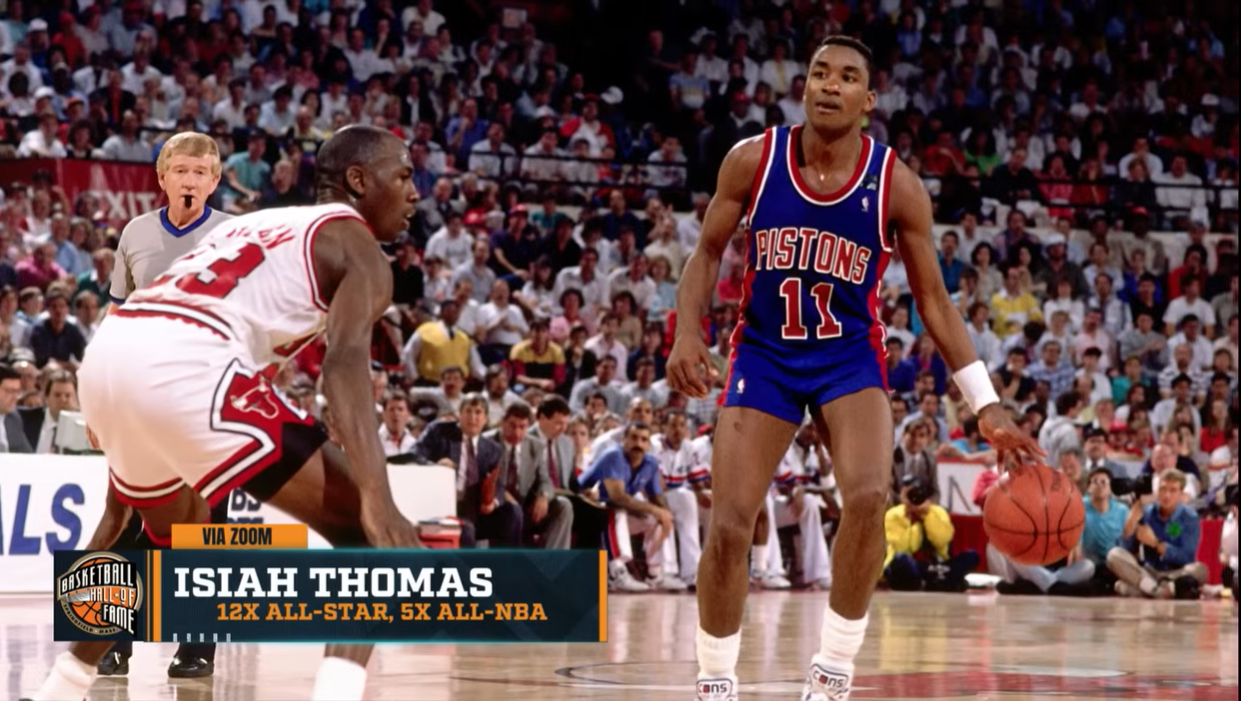
Isiah Thomas has spent the 2026 playoffs defending Jalen Brunson against the criticism that has followed the Knicks guard for most of his career, the idea that he’s simply too small to be considered among basketball’s elite. Brunson answered those doubts the most definitive way possible, by winning. He closed out the 2026 NBA Finals as a unanimous Finals MVP, with all 11 media voters naming him the recipient of the Bill Russell Trophy. That achievement came on top of unanimous MVP honors in both the NBA Cup and the Eastern Conference Finals. Despite the sweep of hardware, the conversation around the league’s true face hasn’t shifted.
Victor Wembanyama remains the player most fans and media point to as basketball’s marquee name, and that’s the disconnect Thomas can’t get past. His issue isn’t that Wembanyama belongs in the conversation, it’s that Brunson, after winning everything available to him in a single season, still isn’t part of it. For Thomas, the moment echoes something he lived through decades ago, when the league elevated Michael Jordan as its face while his own Detroit Pistons were the ones repeatedly beating him.
Thomas draws the comparison to his own era
Speaking on a recent podcast appearance, Thomas argued that Brunson’s playoff run reinforces an old truth: skill and precision can outweigh size, regardless of who’s standing across from a player. He pointed to a familiar frustration among shorter players, the tendency for questions about taller stars to follow even after a clear victory on the court.
Thomas then connected that frustration directly to his own playing days in Detroit, when the Pistons regularly got the better of Larry Bird, Magic Johnson and Jordan, yet Jordan remained the player the league chose to promote. He suggested the question of who becomes the face of the league has historically had less to do with who’s actually best and more to do with who the league wants in that position, a dynamic he believes still disadvantages smaller guards today.
The numbers behind both players cases
The statistical comparisons are hard to ignore. Detroit’s Pistons beat Chicago’s Bulls regularly during their back-to back championship run, and Thomas himself won Finals MVP in the 1989-90 season. Brunson, meanwhile, averaged 32.5 points across the 2026 Finals and closed out the deciding game with 45 points, becoming the first player in Knicks history to score more than 40 in a Finals game. He’s also just the fourth guard 6 foot 2 or shorter to win Finals MVP, joining Thomas, Tony Parker and Stephen Curry in that group.
Wembanyama’s resume carries its own weight. At 7 foot 4 with an 8 foot wingspan, he combines rim protection with guard like ball handling and shooting. During the 2025-26 regular season, he averaged 25.0 points, 11.5 rebounds and 3.08 blocks per game, and became the first unanimous Defensive Player of the Year in league history. He also reached the Finals in just his third season, a faster climb than legends like Jordan or LeBron James managed early in their careers.
Why the league keeps reaching for size
Part of the explanation may come down to scarcity. A 7 foot 4 player who can switch onto guards, shoot from deep and protect the rim is something the league has rarely, if ever, had, which makes for an easier marketing pitch than a disciplined, fundamentally sound guard. The NBA has leaned on this formula before, dating back to centers like Wilt Chamberlain and Kareem Abdul-Jabbar.
Even Wembanyama has weighed in on the dynamic, telling an NBA insider that being labeled the face of the league is something that can be shaped to a degree, though he maintained it ultimately comes down to who the best players actually are.
Tension boiled over after the Finals
The rivalry between the two stars didn’t end when the series did. Brunson directed a pointed, profanity-laced remark toward Wembanyama during the Knicks championship celebration, and Wembanyama left the floor without shaking hands after Game 5. It marked the second time this season Brunson got the better of him for a trophy, having also beaten him in the NBA Cup Final earlier in the year. The series itself featured several physical moments, including a shove on Brunson that nearly drew a flagrant foul and a contested landing under him on a late closeout attempt.
A pattern from the Jordan Rules era
Thomas’s Pistons built their identity on physical, defensive minded basketball under coach Chuck Daly, relying on intimidation and precise rotations to wear down opponents. Jordan hadn’t yet won a team title in the late 1980s, but he was already setting records, winning both MVP and Defensive Player of the Year in the 1987-88 season and averaging a near triple double the following year. Detroit’s response became known as the Jordan Rules, a defensive scheme designed to send Jordan to the floor every time he drove into the paint. Jordan spent that offseason adding muscle to withstand the punishment, a turning point on his path to his first championship.
Brunson’s case, in some ways, is even harder to dismiss than Jordan’s once was, since Jordan was already collecting individual awards before winning a single playoff series. Brunson has now won every trophy the league offers in one season and still hasn’t claimed the title Thomas believes he’s earned.
