


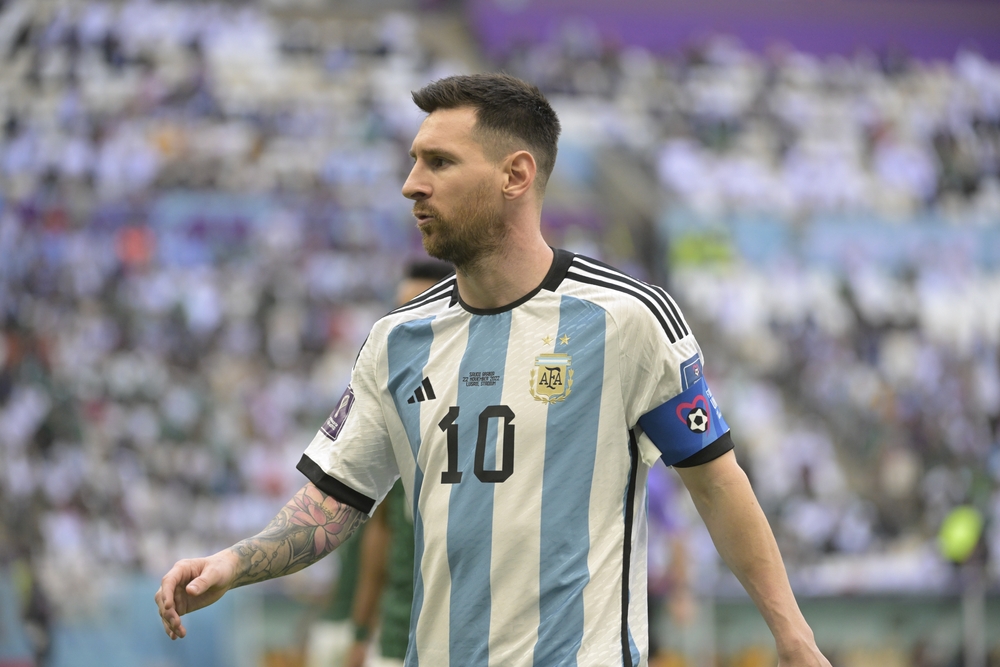
With eleven minutes remaining and Argentina trailing Egypt 2-0, the possibility arose that Lionel Messi’s remarkable World Cup career might be approaching its final moments in the round of 16. What followed instead was another demonstration of why that conclusion is almost always premature. Messi assisted the first goal with a 79th-minute header from a cross, then equalized himself four minutes later, before Argentina completed a stunning comeback to eliminate Egypt and advance to the quarterfinals.
For Mohamed Salah, the afternoon represented something different. His own performance was characteristically committed and influential, but it was not enough to prevent the exit, and at 36 years old, the defeat in Atlanta almost certainly represents the end of his World Cup story on the sport’s grandest stage.
Two careers that traveled in opposite directions
The occasion carried an irony that the history of football rarely produces so neatly. Salah first emerged from Egyptian football as a teenager with a label attached to him that was applied to promising left-footed attackers across the world during Messi’s peak years. One by one, nearly every player who carried that comparison eventually fell well short of the expectations it created. Some never recovered from the weight of it.
Salah came closer than almost any of them to justifying the comparison on his own terms, though his path to the summit of the game could not have been more different. Where Messi’s career unfolded within a Barcelona ecosystem built almost perfectly around his genius, Salah’s route included false starts, a stint that stalled under difficult circumstances at a major club, and a step backward through less prominent leagues before an extraordinary breakthrough in England delivered the sustained elite performance that had always been promised.
By the time Salah announced himself as one of the world’s best players, Messi had already accumulated a collection of individual and collective honors that no comparison could adequately capture. Yet Salah built something remarkable in its own right, through relentless self-improvement, exceptional physical maintenance, and a ruthless efficiency as an attacker that made him one of the most feared forwards of his generation.
What this World Cup meant for each of them
Their careers have diverged in international football more than anywhere else. Messi endured years of criticism with Argentina before completing one of the sport’s most celebrated redemption arcs. This tournament in the United States has produced another chapter in that ongoing story, with his team surviving a moment that seemed likely to end their title defense.
Salah’s international story has been defined by the distance between what he has given Egypt and what the results have ultimately delivered. He inspired Egypt’s qualification for the 2018 World Cup before injury prevented him from contributing during the tournament itself. He experienced defeat in two continental final appearances years apart. This tournament changed aspects of that legacy in meaningful ways, with Egypt advancing past the group stage for the first time in their history and claiming their first ever knockout stage victory, against Australia, before the Argentina defeat.
A legacy built without the defining moment
The defeat by Argentina does not erase what Salah built, though the absence of a truly transcendent international triumph remains the gap in a career that by almost every other measure is exceptional. His consistency, his records, and his status as the most influential player from the Arab world in the modern era of the sport represent a legacy that accumulates rather than concentrates into single iconic moments.
He exits the tournament having given Egypt their best World Cup run in history. He will be 37 when the next edition begins, making this likely farewell difficult to fully celebrate. He came full circle in Atlanta, facing the player whose name once preceded his own, and he could not eliminate him. But he leaves having long since escaped that comparison and become a legend entirely on his own terms.
