


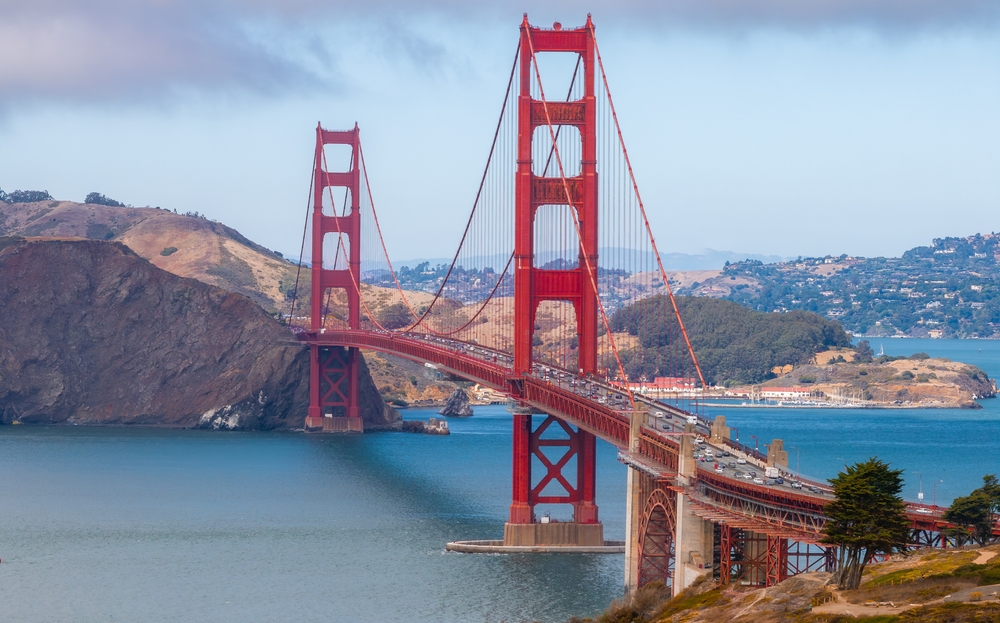
A man died and two others were injured when a fishing boat struck rocks beneath the north tower of the Golden Gate Bridge early on Sept. 17, according to authorities in Marin County.
What happened?
The 25 foot vessel hit rocks near Lime Point shortly after 6 a.m. and capsized. All three people aboard were badly hurt. Rescuers recovered them from the water, treated them at the scene and transported them to a hospital. One man, a 35 year old from San Jose, died despite extended resuscitation efforts. The conditions of the other two were not released.
Where is Lime Point?
At the base of the bridge’s north tower, on the Marin County side of the strait. The point sits directly against the shipping channel, with rock formations extending into water that carries strong tidal currents. It is a well known hazard for small craft, particularly in the low light and fog common in the hours around dawn.
Why is this stretch of water dangerous?
The Golden Gate is the sole outlet for a very large bay system, which means enormous volumes of water move through a narrow opening twice a day. Currents can exceed six knots, standing waves form where the ebb meets ocean swell, and fog reduces visibility without warning. Small boats encounter conditions here that would be unremarkable in open water but are unforgiving beside fixed rock.
What caused the Golden Gate Bridge boat crash?
That has not been determined. Authorities have not released findings on visibility, currents, mechanical condition, navigation or any other factor. Fatal marine accidents are typically investigated by the Coast Guard alongside local agencies, and conclusions take time.
Has the victim been identified?
Not by the authorities handling the case. His name has circulated through a fundraising page created by acquaintances, but neither the sheriff’s office nor the coroner has issued a formal identification. Until one comes, any name attached to this incident should be treated as unconfirmed.
Is this common?
Fatal accidents at the Golden Gate itself are uncommon, though the strait produces regular calls for assistance involving small craft, particularly recreational fishing boats operating in the early morning. The combination of current, traffic and fixed obstruction makes it one of the more demanding passages on the California coast for a vessel of this size.
What should small boat operators know?
Local mariners generally time transits of the strait to slack water rather than peak ebb, monitor current predictions rather than relying on tide tables alone, and give the tower bases and rock formations a wide margin regardless of chart depth. Fog protocols matter here more than in most coastal waters, since visibility can close in a matter of minutes.
What happens next?
The investigation continues. Any determination of cause, and any official identification of the man who died, will come from the sheriff’s office, the coroner or the Coast Guard rather than from other sources.
