


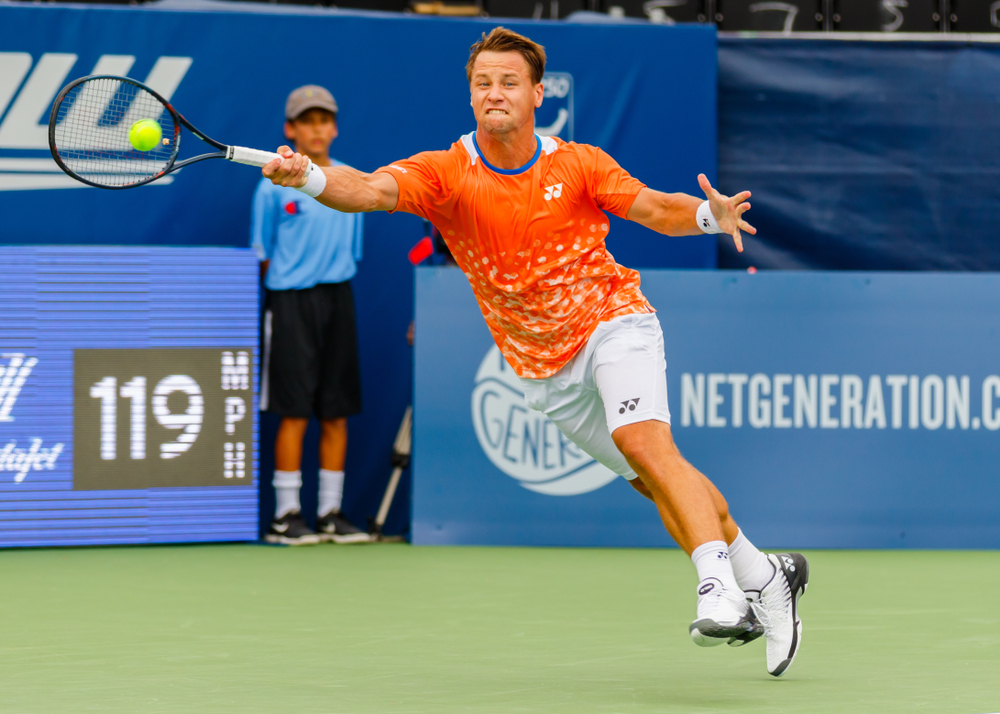
French tennis player Samuel Bensoussan has had his ban from professional tennis for match-fixing extended to three years after the Court of Arbitration for Sport ruled on the International Tennis Integrity Agency’s appeal, more than doubling the original penalty of one year and eleven months he had received for his involvement with an organized crime operation based in Belgium.
Bensoussan, 34, had originally been found to have fixed singles and doubles matches in lower-tier events on behalf of the syndicate. His peak ATP singles ranking reached 405 in 2018, placing him in the margins of the professional tour during the period when the corruption took place.
The scope of the criminal network behind the case
The scale of the syndicate’s operations revealed in the CAS verdict was substantial. The court published findings indicating that investigators had uncovered a criminal organization that corrupted at least 181 players worldwide and arranged the manipulation of at least 375 tennis matches. The figure illustrates how extensively the Belgian operation had penetrated the lower levels of professional tennis, where prize money is modest, financial pressures on players are high, and the monitoring infrastructure is less robust than at major tour events.
A criminal case in Belgium that ran parallel to the tennis disciplinary process resulted in a five-year prison sentence for the syndicate’s leader, reflecting the severity with which the Belgian courts treated the criminal enterprise at the center of the corruption network.
How the appeal process played out
Bensoussan appealed to CAS seeking to overturn his original ban entirely, arguing the penalty was unjust. The ITIA, pursuing the opposite outcome, asked CAS to increase the ban substantially, seeking a six-and-a-half-year suspension. The three CAS judges ultimately landed between those two positions, rejecting Bensoussan’s argument for overturning the ban while declining to impose the lengthy suspension the integrity agency had requested.
The ITIA had also sought repayment of the sum Bensoussan allegedly received for fixing one of the matches in 2018. CAS declined to order that repayment, representing a partial victory for Bensoussan on that specific issue even as the overall penalty increased.
What the ruling means for tennis integrity
Cases of this scale involving organized crime networks targeting lower-tier tennis players have been among the most serious challenges the sport’s integrity infrastructure has faced in recent years. The ITIA was established specifically to address such threats and has been working to develop its monitoring and investigation capabilities to identify match-fixing more quickly and pursue those involved through both sporting sanctions and criminal referrals.
The revelation that a single syndicate corrupted 181 players and fixed 375 matches illustrates the extent to which players at the margins of professional viability can become targets for criminal organizations offering financial inducements that may represent a significant portion of what those players can earn through legitimate competition. The disparity between earnings at the top of the sport and the financial reality for players ranked outside the top few hundred creates structural vulnerabilities that integrity organizations continue to work against through a combination of investigation, education, and deterrent sanctions.
Bensoussan’s three-year ban, effective from the date of the original sanction, represents the formal conclusion of his disciplinary proceedings following CAS’s ruling.
