


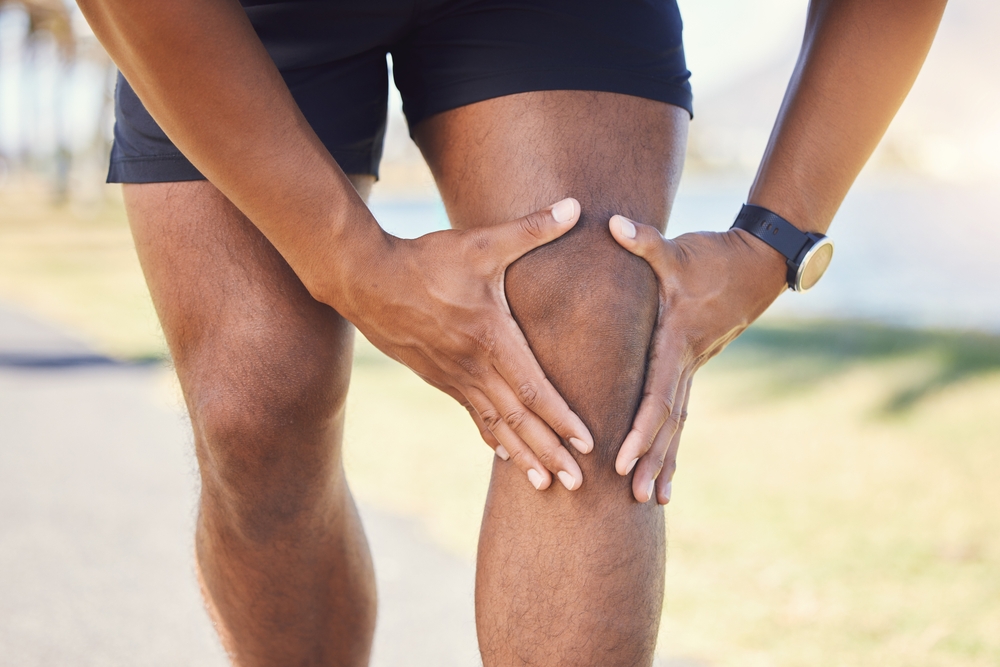
Weak glutes, tight hips and poor form are behind most workout knee pain
Knee pain after working out gets blamed on aging more than almost anything else in fitness. You hit a certain point, the thinking goes, and your knees just start to go. You accept it. You modify around it. You add knee sleeves and glucosamine to your shopping cart and quietly start avoiding exercises you used to do without thinking.
But for a significant number of people, the knees are not the actual problem. They are just the location where the problem shows up.
Knee pain during and after exercise is frequently the result of mechanical issues elsewhere in the body — weak stabilizer muscles, mobility restrictions and movement patterns that place load on the knee joint in ways it was not designed to handle consistently. Fixing those underlying issues tends to resolve the knee pain far more effectively than treating the knee itself.
What is actually causing the problem
The knee is a hinge joint that depends heavily on the structures above and below it to function correctly. When the glutes — the primary stabilizers of the hip — are weak, the hip drops or rotates inward during movement, which changes the angle at which force travels through the knee. The knee absorbs that misaligned load repeatedly, and over time that produces pain.
Tight hip flexors create a similar downstream effect. When the front of the hip cannot move through a full range of motion, the knee compensates during squatting, lunging and running movements in ways that increase stress on the joint. Tight calves and limited ankle mobility can also pull the knee out of its optimal tracking position, particularly during loaded lower body exercises.
Poor landing mechanics — the way the foot and knee absorb impact during jumping, running or step-downs — are another frequent contributor. Landing with the knee caving inward, which often happens when glute strength is insufficient, concentrates force at the inner knee structures repeatedly with every rep.
Why jumping straight into workouts makes this worse
A lot of people begin training programs, return to exercise after a break or increase their workout intensity without spending time building the stabilizer muscles that make those workouts sustainable. The larger muscles — quads, hamstrings — get trained and strengthened. The smaller stabilizers that protect the joints get left behind. The gap between overall strength and stabilizer strength grows, and the joints pay for it.
This is not an age issue. It is a sequencing issue. Stability and mobility work done before progressive loading protects the joints that would otherwise be asked to handle forces they are not prepared for.
How to actually fix it
Glute activation exercises — hip thrusts, clamshells, lateral band walks — done consistently before lower body training help re-establish the stabilizer strength that most workout programs do not build directly. Hip flexor stretching and hip mobility work address the tightness that disrupts knee tracking during movement.
Movement pattern correction matters too. Learning to squat, land and hinge with the knees tracking over the toes rather than caving inward reduces cumulative joint stress significantly. A session or two with a qualified trainer or physical therapist to assess movement patterns is worth considerably more than ongoing pain management.
When to take it more seriously
Knee pain that is sharp, sudden, accompanied by swelling or instability, or that does not improve with rest and corrective work warrants evaluation from a medical professional. Not all knee pain is mechanical, and structural issues including cartilage damage, ligament involvement or bursitis require proper diagnosis. The point is not to avoid medical care — it is to stop assuming that aching knees are an inevitable part of exercising when, for many people, they simply are not.
