


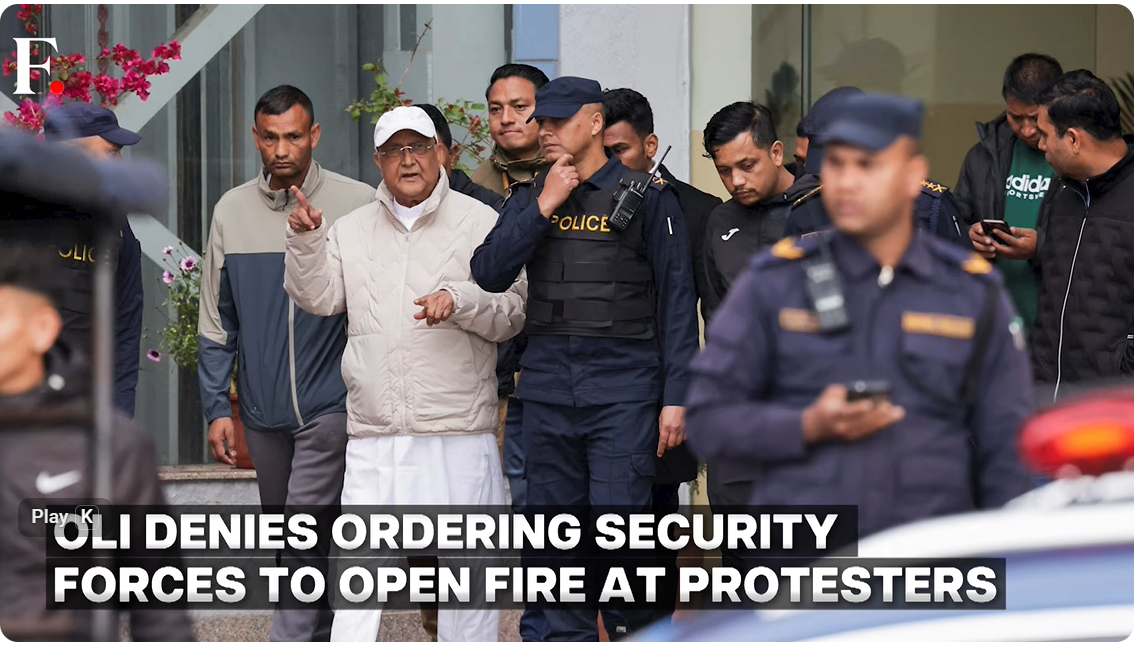
Former Prime Minister KP Sharma Oli, 74, and former home minister Ramesh Lekhak were arrested in the early hours of Saturday, March 28, in connection with the deaths of at least 76 people during the Gen Z anti-corruption protests that swept Nepal in September 2025. Both men are being held at the Kathmandu Police Office and are expected to appear in court Sunday. Oli, who has undergone two kidney transplants, was subsequently transferred to a hospital.
Police spokesperson Om Adhikari confirmed the detentions and said legal proceedings would follow their course.
What set off the protests
The crisis began on September 8, 2025, when the government moved to ban several widely used social media platforms, including YouTube, Facebook and WhatsApp. For a generation of young Nepalis already worn down by corruption, unemployment and political dysfunction, the move proved to be the final provocation.
Protests spread rapidly across Kathmandu and other major cities. Security forces responded with tear gas, rubber bullets and ultimately live ammunition. At least 76 people were killed and more than 2,000 injured over two days of unrest. Government buildings, including parliament and the Prime Minister’s Office, were set on fire. Some officials fled by military helicopter.
Oli resigned on September 9, the first sitting Nepali prime minister forced from office by mass protest in recent history. A transitional government under Sushila Karki, a retired Supreme Court judge who became Nepal’s first female prime minister, was appointed to stabilize the country and organize elections.
The panel and its findings
A government-appointed investigative panel spent the following months examining what happened and who bore responsibility. Its conclusions were pointed. The panel faulted the previous leadership for failing to prevent the use of deadly force, particularly in the early hours of the crackdown, and recommended prosecuting Oli, Lekhak and the police chief at the time. Potential penalties under those recommendations reach up to 10 years in prison, pending formal court proceedings.
Oli has denied the allegations. His legal team described the arrest as improper, arguing the former prime minister presented no meaningful flight risk and that the detention was unnecessary.
A new government, a swift first move
The arrests landed one day after Balendra Shah was sworn in as prime minister following a commanding victory in the March 5 general election. Shah, a former rapper who built a devoted following among young Nepalis before entering politics, led the Rastriya Swatantra Party to a decisive majority on a platform centered on anti-corruption and generational reform.
His newly appointed home minister, Sudan Gurung, was himself a prominent figure in the 2025 protests. Gurung announced the arrests publicly and framed them as the beginning of a justice process rather than an act of political score-settling. He was direct in stating that no one, regardless of former status, stood above the law.
Some observers and supporters of Oli have questioned whether the speed and timing of the arrests reflect genuine accountability or political calculation. Legal commentators have noted that procedural transparency in the trials ahead will determine how the action is ultimately judged, both inside Nepal and beyond its borders.
For the families of those killed in September, Saturday’s arrests represented something the protests had always demanded. Whether the courts deliver on that expectation remains to be seen.
