


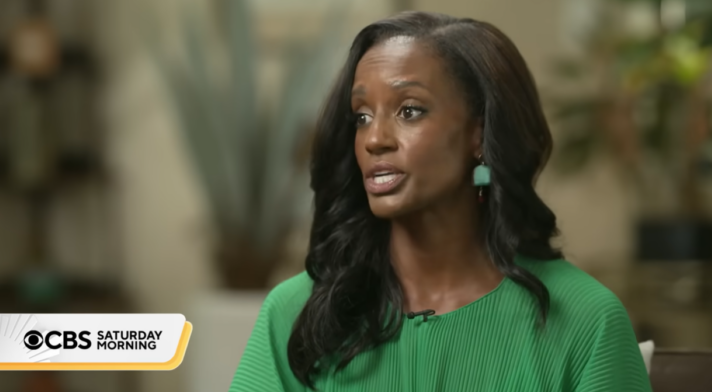
Skye P. Marshall was standing on the Golden Globes red carpet when she made a quiet but deliberate decision. She had planned to save parts of her story for a larger platform, but the moment felt right so she gave it freely, on her own terms.
The Chicago born actress understood exactly what she was offering and who it would reach. Stories like hers breaking into the entertainment industry in her 30s after years of survival jobs, military service, and corporate cubicles rarely get told at that level. For women of color still finding their footing in the industry, she wanted them to know that a nonlinear path is still a path.
From Chicago stages to Air Force service
Long before any red carpet, Marshall was a child who believed performance was simply what people did. Dance and theater filled her days so completely that the commitment felt less like a passion and more like breathing. Training became discipline, and discipline carried her forward even as practical realities started closing in.
At Hampton University, a financial aid shortfall forced her hand. She joined the U.S. Air Force out of necessity, completed her service, finished her degree, and eventually landed in New York City. What followed looked, from the outside, like success. A pharmaceutical marketing job in Manhattan, an apartment in Harlem, a social life that matched the city’s pace she had built something real.
The moment she couldn’t ignore
Two years into that life, something shifted. Marshall describes a vivid internal image that wouldn’t leave, her eight-year-old self sitting on a desk, kicking a filing cabinet with her heels, quietly furious. The shame that came with that image the sense that she had let a younger version of herself down settled into her and refused to lift.
A conversation with her mother helped her find a different kind of clarity. Rather than push the feeling away, she leaned into it, asking openly for direction and purpose. The answer came in a dream vivid and specific filled with images of her acting, attending premieres, and living a life that felt fully aligned with who she was meant to be.
The years she calls the path
Marshall left her job, used unemployment benefits to buy herself time, and moved to Los Angeles in 2009. What followed was not glamorous, but she has never described it that way. She worked as a background actor, drove for Uber, and catered high-end events she would never otherwise have attended. She studied every person she encountered with the focus of someone who knew every room was research.
She did not experience those years as a detour. Every shift, every passenger, every catered event was part of the education that would eventually inform everything she brought to a set. She was building a character library one ordinary day at a time.
Olympia Lawrence and the role that changed things
Now, as Olympia Lawrence on CBS’s Matlock, Marshall plays a junior partner at the firm Jacobson Moore ambitious, precise, navigating a divorce while positioning herself for a senior partnership. The character is layered and demanding, and Marshall built her with a specific audience in mind.
Roughly 75 percent of the people who approach her on the street about the show are Black women. She has spoken openly about what that means to her that the care she put into Olympia’s wardrobe, speech, and presence translated directly to the audience she most wanted to reach. Their reactions, she says, are the confirmation that the work landed.
The role has brought real recognition. Marshall took home a Supporting Actress win at the 2025 Celebration of Black Cinema and Television and received nominations from the Critics’ Choice Awards, the Black Reel Awards, the Gotham TV Awards, and the Astra Television Awards.
Kathy Bates, her mother, and carrying it all
Her working relationship with Matlock’s lead, Kathy Bates, has become one of the more meaningful parts of this chapter. Marshall has described the dynamic as genuinely mutual two women who need each other in the work in ways that go beyond the script.
The hardest part of this season in her life involves someone who can’t fully witness it. Marshall’s mother lives with dementia, and the distance that creates in moments meant to be shared is something Marshall has spoken about with honesty and grief. The success is real and so is what it costs to celebrate it without the person who helped her get there.
Chicago never left her
Through all of it the Air Force, the marketing job, the Uber shifts, the breakthrough Marshall has worked to hold onto every version of herself. The corporate woman, the military woman, the little girl from Chicago who thought everybody danced. She credits that inner child, the one with enough imagination to treat couch cushions like lava, with leading her to where she is now. As long as she stays true to that, she says, she knows exactly why she belongs here and she isn’t faking a thing.
