


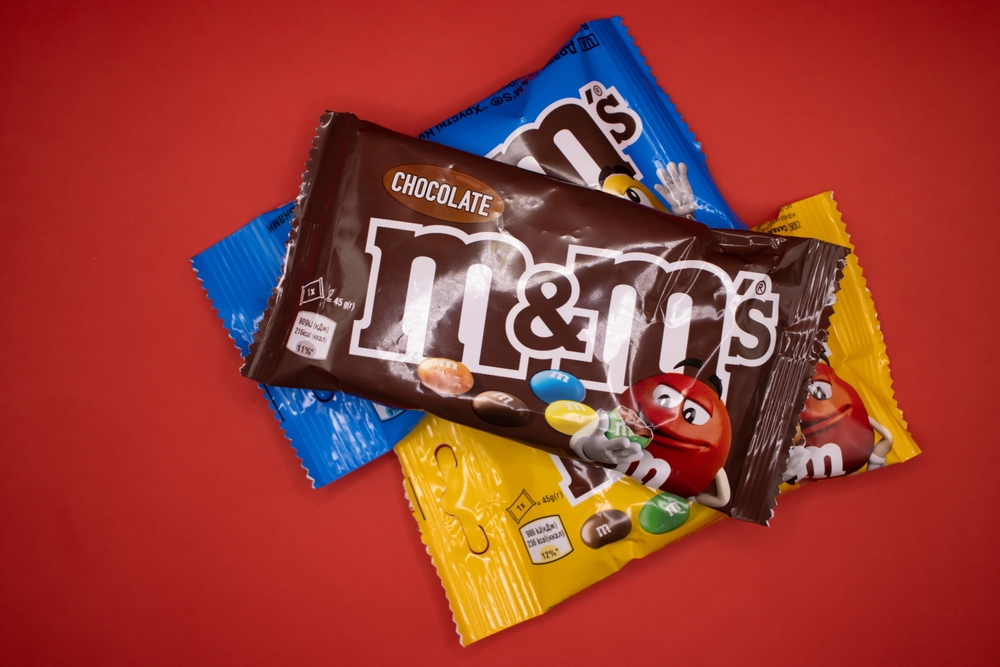
M&M’s turns 85 this summer and the celebration comes with a catch. Mars is launching a new line of the iconic candy in August made without artificial dyes, a move driven by mounting pressure from Health and Human Services Secretary Robert F. Kennedy Jr. and his Make America Healthy Again initiative. But two of the candy’s six classic colors will not be part of the launch.
Blue and brown are out, at least for now, because Mars has not found a way to replicate them using natural ingredients without causing serious problems at the manufacturing level.
What the MAHA pressure actually requires
Kennedy has been pushing food manufacturers to remove synthetic dyes from their products for months, citing research linking certain petroleum-based food colorings to behavioral issues in children and long-term cancer risks in animal studies. His office has formally revoked FDA authorization for four dyes already and has been pressing companies to phase out six more, including Blue 1, the dye responsible for M&M’s signature shade.
Mars pledged to ditch artificial dyes from its food products back in 2016 but reversed that commitment after concluding that consumers were not particularly concerned about dyes in occasional treats. The company reversed course again in 2025 after Kennedy’s office added Mars to a list of 27 corporations that had committed to removing artificial dyes from certain products.
West Virginia became the first state to sign a complete ban on major artificial dyes into law in 2025, and the federal government has set a target of phasing out six additional dyes from the U.S. food supply by the end of 2027. For Mars, that timeline created urgency around a problem it had not yet solved.
The spirulina problem
For red, orange, and yellow M&M’s, Mars found workable natural alternatives using ingredients like beetroot and turmeric. Blue proved to be an entirely different challenge.
The company selected spirulina, a blue-green algae powder often marketed as a superfood, as the most promising natural substitute for Blue 1. The ingredient can theoretically produce the right hue, but replicating M&M’s specific shade of cerulean required approximately seven times more pigment than the artificial dye it was meant to replace.
That concentration created a thick, foamy mixture that caused significant buildup inside factory pipes and eventually led to mold growth, representing a food safety risk that could not be ignored. The cleanup requirements were equally demanding, requiring hotter water, more pressure, and more time than current equipment could handle.
To address the contamination problem fully, Mars would need to upgrade more than 300 machines across its M&M’s manufacturing facilities, including new mixing tanks, paddles, and motors. The cost of that overhaul runs into the millions and is part of why the company has been searching for alternatives rather than simply committing to spirulina at scale.
The brown M&M presents a secondary problem. Its color relies heavily on the blue pigment, meaning there is no straightforward path to a natural brown without first solving the blue problem.
What the launch will look like
Mars explored several alternative configurations before settling on a four-color lineup for the August launch. The company considered a three-color mix of red, orange, and yellow but decided the palette felt too limited. Executives also experimented with purple and pink as potential additions before determining neither was a suitable replacement.
The natural-ingredient version will initially be sold exclusively through Amazon while the traditional artificially colored M&M’s remain on shelves everywhere else. The plan for now is to offer consumers a choice rather than a full replacement.
The longer-term goal is to recreate all six classic colors using natural ingredients by 2028. Whether that timeline holds depends largely on whether Mars can solve the spirulina problem without spending more on factory upgrades than the reformulation is commercially worth.
The executive overseeing the project described it as the hardest undertaking of her career. The leader of the company’s North American snacks division acknowledged the challenge of altering a product that has looked the same for decades. An 85th anniversary is supposed to be a celebration. This one comes with an asterisk.
