


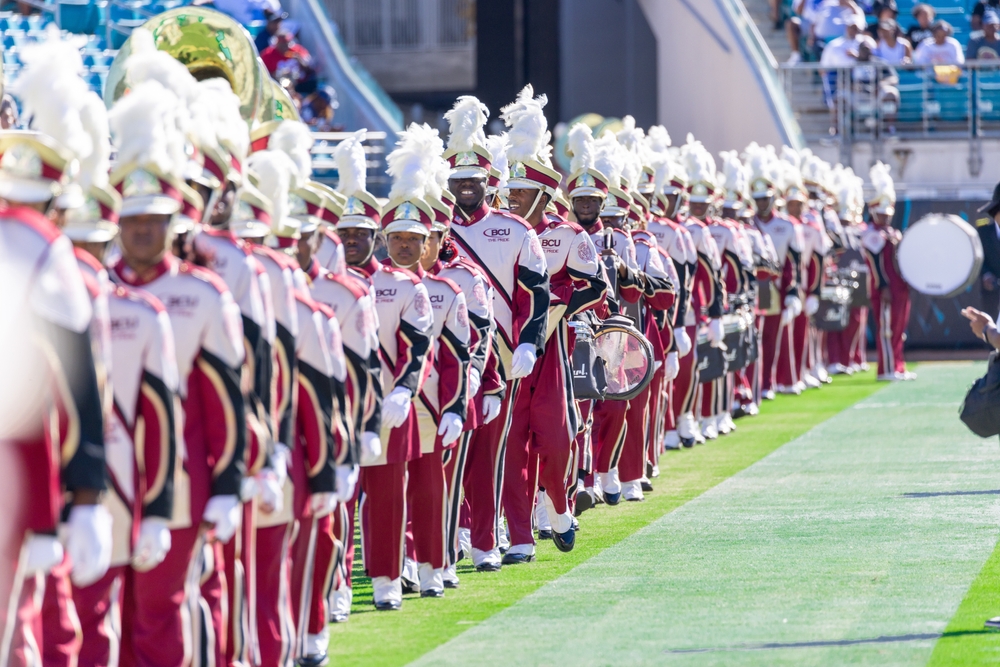
There is a moment — right before the first drumbeat drops, right before 300-plus men and women snap into formation — when the air at a Bethune-Cookman University game shifts entirely. The crowd leans in. Phones go up. And then the Bethune-Cookman Marching Wildcats, known across the country simply as The Pride, take over. No football score matters anymore. What matters is what is happening on that field.
For generations, Bethune-Cookman has been home to one of the most electrifying marching bands in the country. But The Pride is far more than a halftime act. It is a living institution — one that shapes young Black men into leaders, performers, and ambassadors of a culture that the world is still catching up to appreciate.
Bethune-Cookman and the Birth of a Legacy
The story of the Bethune-Cookman Marching Wildcats goes back to 1930, when the band formed with just 30 members. The instruments were borrowed from rival school Florida A&M University — a remarkable act of HBCU solidarity that set the tone for what the program would become. From those humble beginnings, the band grew into one of the most recognized collegiate ensembles in the nation.
Dr. Mary McLeod Bethune, the university’s legendary founder, understood early that a great HBCU needed a great band. She was right. Today, the Wildcats stand as proof that her vision was as precise as the drum lines she helped inspire.
The band now boasts over 300 members, including instrumentalists, the iconic Sophisticat Flag Corps, and the nationally celebrated 14 Karat Gold Dancers. Five drum majors — traditionally called The Five Horsemen — lead the ensemble with unmatched flair and precision. Every unit, every step, every beat carries the weight of nearly a century of Black excellence.
The Pride on the World’s Biggest Stages
Bethune-Cookman’s Marching Wildcats have performed at events most bands only dream about. From NFL games to the Super Bowl, The Pride has shown up and shown out on stages that reach millions of viewers. Their performances have been featured in BET promotions spotlighting historically Black colleges, and their reach extends far beyond any single campus in Daytona Beach, Florida.
The band also earned a place in Hollywood history. The band’s legacy was woven into the fabric of the iconic 2002 film Drumline, starring Nick Cannon and Zoe Saldana — a movie that introduced mainstream America to the intensity, artistry, and competitive fire of HBCU band culture. That film’s DNA carries Bethune-Cookman‘s fingerprints.
And then came Netflix.
Marching Orders Took Bethune-Cookman Global
In 2018, the Bethune-Cookman Marching Wildcats became the subject of Marching Orders, a 12-episode documentary series released on Netflix. The show pulled back the curtain on the grueling audition process, the brotherhood forged in rehearsal, the family traditions tied to band membership, and the sky-high expectations that come with wearing The Pride’s uniform.
Marching Orders was a cultural moment. It confirmed what HBCU fans already knew — that Bethune-Cookman’s band operates at a level of precision and passion that transcends college football. For many viewers who had never attended an HBCU, the series was a revelation. For those who had, it was validation.
The show follows members over three weeks as they fight to earn — and keep — their spots in one of the most competitive band programs in the country. Under the direction of Donovan V. Wells, a Bethune-Cookman alumnus and former Marching Wildcat himself, the stakes could not be higher. Scholarships, reputations, and family legacies are all on the line.
What Bethune-Cookman Builds in Young Black Men
The mission of the Bethune-Cookman band program goes beyond music. The program is designed to develop leadership, instill academic discipline, and create a lifelong love for the arts. Band members are required to maintain a minimum GPA, hold valid passports, and manage the demands of both academic and performance life simultaneously.
That is not a coincidence. That is a curriculum.
For young Black men especially, the Bethune-Cookman Marching Wildcats represent a path where excellence is expected and brotherhood is guaranteed. The band is a space where showing up fully — in uniform, in formation, and in character — is the standard. The Five Horsemen drum majors model that standard with every performance, leading not just the music but the men behind them.
Scholarships within the program range from partial awards to full rides, based on musical ability and the needs of the ensemble. For students from communities where college access remains a fight, that scholarship pipeline matters enormously. Bethune-Cookman uses the band as a gateway to higher education, and the results speak for themselves.
The Bethune-Cookman Standard in 2026
The landscape of HBCU band culture is more competitive than ever. Programs from Southern University, Florida A&M, North Carolina A&T, and others are pushing the boundaries of what marching bands can be. The Red Lobster Band of the Year competition has become a marquee event for HBCU band culture, drawing national attention and sparking passionate debates across social media.
Bethune-Cookman has charted its own course through that landscape — opting out of certain competitions while maintaining its identity as one of the sport’s premier institutions. The Pride does not need external validation to confirm what it already knows. A Bethune-Cookman halftime show is still one of the most anticipated events in any stadium it enters.
In 2026, the Bethune-Cookman Marching Wildcats carry forward a legacy that began nearly a century ago with borrowed instruments and an unshakeable vision. What they carry now is something no rival can replicate — a culture, a community, and a standard of excellence built by generations of Black men and women who gave everything they had to The Pride.
The drumline does not lie. Neither does the legacy.
