


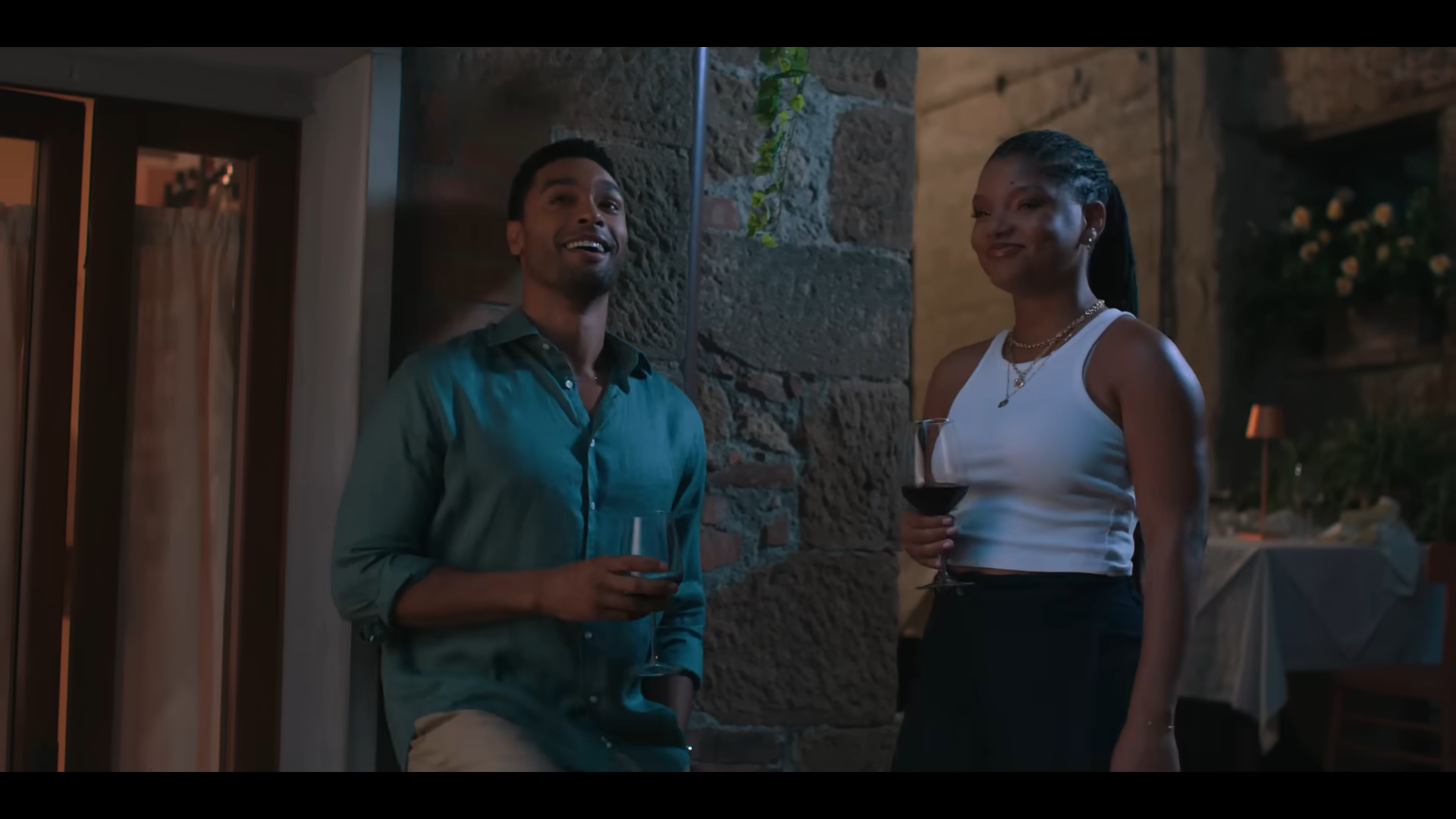
One movie is carrying a lot of weight right now. Filmmaker Nina Lee went public this week with a frustration that many in Hollywood’s creative community have quietly felt for years, sharing that studios are holding her projects in a waiting pattern until they see how the upcoming romantic comedy You, Me & Tuscany performs at the box office.
Lee, a Black filmmaker whose award-winning short film Artistic was executive produced by Lena Waithe and earned the Audience Choice Award at the Chicago International Film Festival, said two separate projects have been stalled by studio hesitation. One is an already completed rom-com that a studio has declined to purchase until it gauges audience appetite for the genre through another film entirely. The other is a romance script that is facing the same conditional hold. Both projects represent real work, real investment and a real creative vision that is now sitting in a drawer while decision-makers wait to see how someone else’s movie lands.
Her message to fans was urgent and direct. She urged her followers to buy tickets, framing the situation as one where a film she had no involvement in could reshape the entire trajectory of her career. The post spread quickly, drawing thousands of responses from people who recognized the dynamic she was describing and wanted to do something about it.
Studios are treating one film as a litmus test
The film at the center of it all is You, Me & Tuscany, a romantic comedy led by Regé-Jean Page and Halle Bailey, directed by Kat Coiro and written by Ryan Engle. The story follows Anna, played by Bailey, as she fakes a relationship with an Italian man to secure a stay in his Tuscan villa, only to fall for his charming cousin along the way. The film also stars Marco Calvani, Lorenzo de Moor, Nia Vardalos and Isabella Ferrari and is set for a theatrical release through Universal Pictures on April 10.
Lee’s post quickly resonated. More than 2,000 people reshared her message, and others began circulating information on where to purchase tickets. The response reflected a broader awareness among audiences that box office returns on Black-led films often carry consequences far beyond the individual project. It is a pattern that has played out before, where the commercial performance of one film becomes the unofficial permission slip for an entire category of storytelling, and audiences have grown increasingly aware of and frustrated by that reality.
A wider pattern playing out across Hollywood
Lee also pointed to a recent industry report highlighting a troubling regression in the hiring of women for key creative roles among Hollywood’s top productions. The findings described a meaningful pullback in women-led projects and a shrinking pipeline of opportunities for women and gender-diverse people across the industry more broadly. The data painted a picture of an industry that had made visible commitments to inclusion in recent years but was quietly reversing course when it came to the projects that actually get financed and distributed.
The combination of both realities, studios tying Black filmmakers’ futures to a single film’s performance while simultaneously pulling back on women-led projects overall, paints a picture of an industry that is consolidating risk in ways that fall disproportionately on underrepresented voices. The people most affected are rarely the ones with the leverage to push back, which is part of what made Lee’s public statement so notable.
What it means beyond one opening weekend
What makes Lee’s situation particularly striking is the logic at the center of it. A filmmaker who has already done the work, shot a film, developed a script and built a career around her craft is being asked to wait on a verdict that has nothing to do with the quality of what she has created. Her fate, at least in part, is tied to how audiences in a single April weekend respond to someone else’s movie.
That kind of conditional greenlight has long been a quiet reality for many Black filmmakers and creators working in mainstream Hollywood. What changed this week is that someone said it plainly, publicly and without apology. The box office opens April 10, and for more people than just the cast and crew of You, Me & Tuscany, the numbers will matter enormously. The film is not just selling tickets. For a generation of filmmakers waiting on the other side of that opening weekend, it is making a case.
