


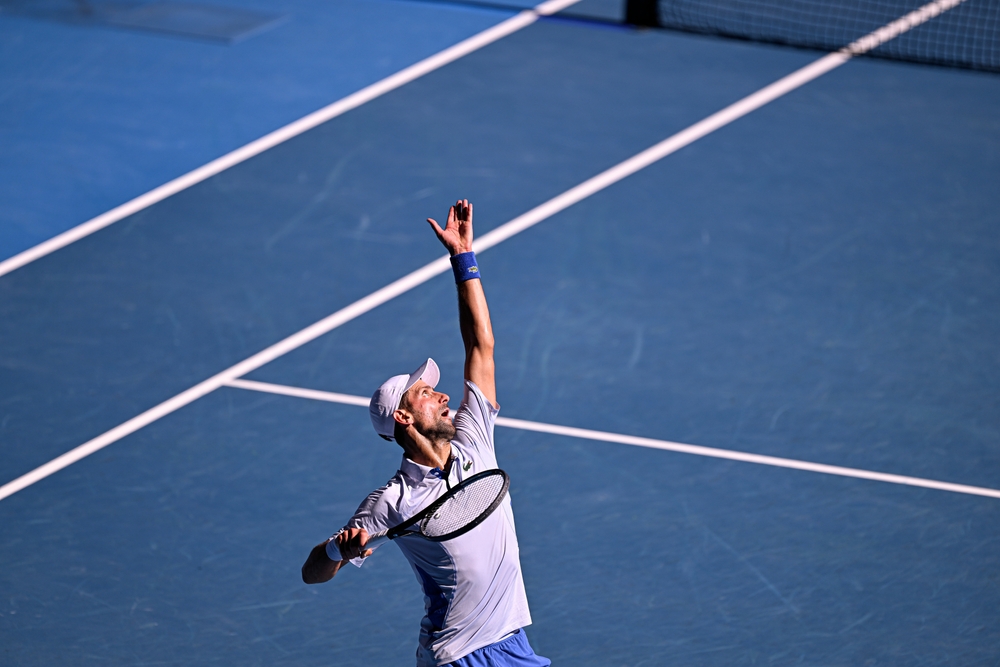
Novak Djokovic defeated third-seeded Felix Auger-Aliassime 7-6, 3-6, 6-3, 6-7, 7-6 in a match lasting five hours and fifteen minutes on Tuesday to advance to the Wimbledon semifinals, surviving what was confirmed as the longest quarterfinal in the tournament’s history just before the All England Club’s 11 p.m. curfew took effect.
The match ended on a final-set tiebreaker when Djokovic built a commanding lead and converted on his first match point, after which the 39-year-old celebrated with the crowd before performing a brief celebratory dance at the net, a gesture he has credited to his daughter’s attempts to teach him moves. He will next face defending champion Jannik Sinner on Friday in their 55th major semifinal appearance for Djokovic, a men’s all-time record.
Records accumulated across five hours
The victory extended a remarkable streak of quarterfinal appearances that has become one of the most durable records in men’s tennis. Djokovic now holds eight consecutive Wimbledon semifinal appearances, moving one ahead of Roger Federer’s men’s record for most consecutive appearances in the grass-court tournament’s final four.
The match was also his 50th five-setter at a major, breaking a tie with another player for the most in the open era. His record of 39 wins in major matches that require five sets is the most by any man in tennis history. And at 39 years old, he became the oldest man to reach a semifinal at a major since a 42-year-old player accomplished it at the 1977 Australian Open.
All of that came despite Djokovic dealing with what appeared to be a left leg issue in the first set, requiring a medical timeout during which a trainer worked on his calf. He stretched repeatedly throughout the match, particularly in the closing stages, and acknowledged after the match that he would have preferred to bypass the semifinal and go directly to the final to give his body more recovery time.
A match with controversy over the roof
The quarterfinal was not without drama beyond the scoreline. After Auger-Aliassime won the second set to level the match, tournament officials decided to close the Centre Court roof, drawing an objection from Djokovic who argued to the tournament referee that enough natural light remained to continue playing outdoors and questioned the consistency of when the roof closure rule was being applied.
He moved past the dispute and proceeded to win three of the remaining four sets, with the final tiebreaker proving decisive in a match that both players approached with the understanding that any given exchange could determine a result between two players evenly enough matched to produce a five-hour contest.
Auger-Aliassime, who is 25, acknowledged the difficulty of playing someone with Djokovic’s combination of experience, resilience, and competitive intelligence, noting that despite knowing what to expect from him, the execution remains impressive every time he does it.
What comes next
The semifinal between Djokovic and Sinner will be their third at Wimbledon in the past four years, with each man having won one of the previous meetings. Sinner defeated Djokovic in straight sets in last year’s semifinal, while Djokovic won their most recent major meeting in five sets earlier this year at the Australian Open. The contrast in playing styles, surfaces, and recent form makes the outcome genuinely unpredictable.
For Djokovic, the prize he is chasing is an eighth Wimbledon title and a 25th Grand Slam overall, a record that would stand alone in the history of the sport. He described the kind of match he had just won as one of the primary reasons he continues to play tennis at 39, framing the joy of surviving such a contest as its own reward before the larger goal.
