


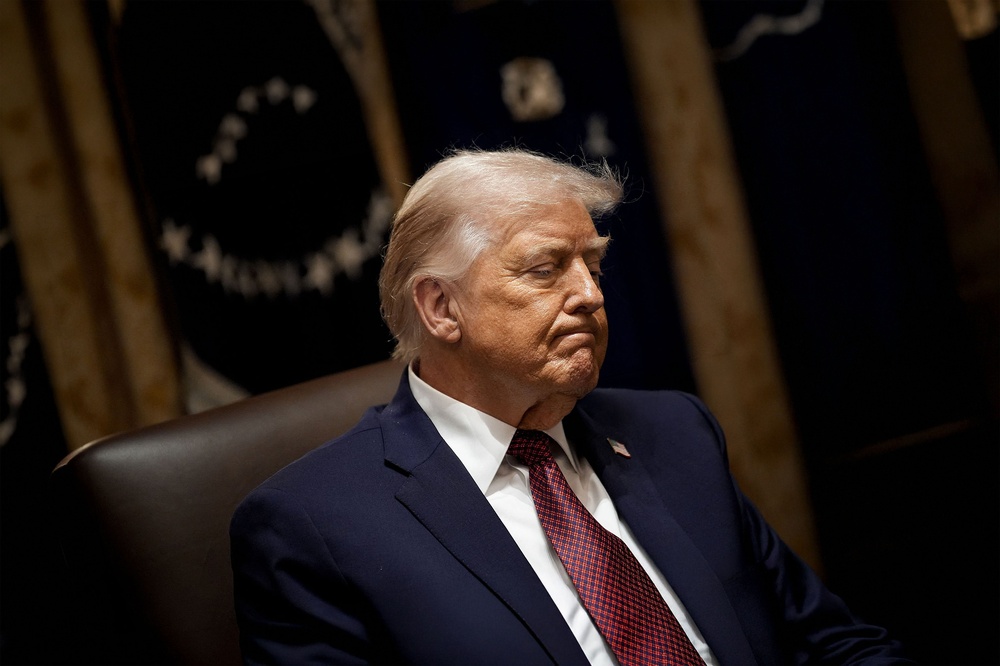
President Donald Trump has suggested renaming either the Atlantic or Pacific Ocean, adding another potential geographic name change to a series of moves involving prominent bodies of water and other landmarks.
Trump raised the idea during a campaign rally in Clarksville, Tenn., on Saturday, Oct. 10, while speaking to supporters ahead of the Nov. 3 midterm elections. He proposed two possible names, Trump Ocean or Ocean of the Americas, as he considered which ocean might receive a new title.
The suggestion follows his earlier efforts to rename the Gulf of Mexico and Lake Ontario, continuing a pattern of proposals that have drawn attention to how geographic landmarks are identified on American maps.
Trump revisits his ocean renaming idea
During the Tennessee rally, Trump returned to an idea he had initially discussed in August. He indicated that he wanted the United States to have an ocean and a major river bearing a new name, although he ruled out changing the name of the Hudson River and the Mississippi River.
The president first brought up renaming an ocean during an executive order signing ceremony on Aug. 27. His comments at the weekend rally brought the proposal back into the spotlight, with the Atlantic and Pacific emerging as the two possibilities under consideration.
Neither ocean has been officially renamed under the proposal outlined at the rally. Trump has floated the idea, but the comments did not establish a formal change to either ocean’s name.
The Atlantic Ocean borders the eastern United States, while the Pacific Ocean lies along the country’s western coastline. Both are internationally recognized geographic features whose names are used across maps, navigation systems and educational materials.
Previous changes involved the Gulf of Mexico and Lake Ontario
Trump’s latest suggestion follows two earlier efforts to change the names of major bodies of water.
In January 2025, shortly after beginning his second presidential term, Trump signed an executive order directing the federal government to use the name Gulf of America for the Gulf of Mexico. The change was part of a broader effort to revise the names used by federal agencies and on U.S. government maps.
The Gulf of Mexico borders the United States, Mexico and Cuba, making its geographic designation relevant to several countries. While the U.S. government can determine the name used in its own official records, other nations and international organizations are not required to adopt the American designation.
In August 2026, Trump also moved to rename Lake Ontario as Lake America. The proposal followed tensions between the United States and Canada over trade.
Lake Ontario is one of the five Great Lakes and sits along the U.S.-Canadian border. Its established name is used by both countries, illustrating the challenges that can arise when a geographic feature shared by multiple nations receives a proposed new designation from one government.
The lake’s location also means that a name change in American records would not automatically require Canadian authorities to use the same terminology.
What the federal government can change
The federal government has authority over the geographic names used in its own official records, including federal maps and documents. However, changing a designation in U.S. government materials does not automatically establish a universally accepted name.
International recognition is particularly important for oceans and other geographic features that extend beyond the boundaries of a single country. Other governments, international organizations and mapmakers can continue using established names in their own publications.
Consequently, even if the administration pursued a formal renaming of the Atlantic or Pacific Ocean, the result could differ across countries and mapping systems.
Other geographic names changed during Trump’s presidency
The Gulf of America and Lake America proposals are not the only examples of geographic renaming during Trump’s presidency.
The administration also restored the name Mount McKinley for the mountain in Alaska that had been officially known as Denali since 2015. The earlier change to Denali recognized the name used by Alaska Native communities, while Mount McKinley honored former President William McKinley.
The mountain’s naming history highlights how geographic designations can reflect competing traditions, historical associations and cultural perspectives.
Trump‘s latest comments leave open whether his administration will pursue another formal naming change. For now, the Atlantic and Pacific oceans retain their established names in general international usage, while the president’s proposal remains an idea he has publicly floated.
