


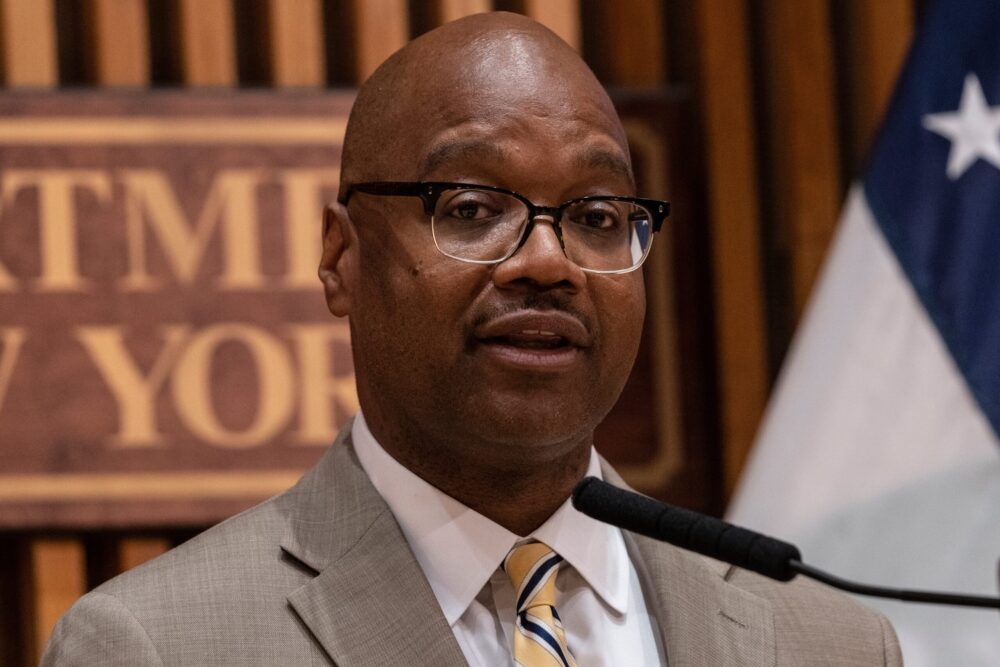
Gary Jenkins, draws from a childhood shaped by poverty and instability to lead one of New York City’s most vital organizations serving unhoused adults.
Growing up as the youngest of eight children in a single parent home in Fort Greene, Brooklyn, Gary Jenkins learned early what it meant to stretch a dollar and navigate uncertainty. Financial instability was a constant, and the world around him shaped by incarceration, substance abuse and systemic neglect made it easy to imagine only a narrow set of futures.
But Jenkins, now 59, found his way out through the guidance of two unlikely anchors: an older sister who kept a watchful eye over him and a social worker who refused to let him disappear into the statistics. Those two people helped him see a version of himself that his circumstances had not yet made visible.
That early intervention never left him. It became the engine behind a career spent giving others the same lift.
A career built on people, not paperwork
After earning his degree from SUNY Oswego, Jenkins stepped into public service as an eligibility specialist in Queens, working directly with families that looked a lot like his own. He made it a point to be more than a caseworker. He wanted the children he encountered to see in him a living example of what was possible someone who came from where they were and still found his footing.
That dedication carried him through the ranks of the New York City Department of Social Services, eventually landing him the role of commissioner. In that position, he didn’t just manage programs, he scrutinized them. One early discovery illustrated his philosophy well, shelter curfews, he found, had been set based on staff schedules rather than the needs of the people living there. He changed them. The focus, he insisted, had to return to the people being served.
Leading Urban Pathways with lived experience
In March, Jenkins stepped into his current role as CEO of Urban Pathways, a New York City nonprofit dedicated to supporting unhoused and at risk adults. The move from city government to nonprofit leadership came with a freedom he had not had before the ability to launch pilot programs and pivot quickly without layers of bureaucratic approval slowing the process.
Urban Pathways operates on a housing first model, meaning no one is turned away. The organization offers meals, showers, and pathways to both transitional and permanent housing. A Total Wellness program, staffed by licensed professionals, addresses the health needs of clients in a more holistic way.
Under Jenkins, the organization is working to expand its alcohol and drug use services. He recognizes that mental health challenges and substance use are deeply intertwined, and he believes that treating one without the other leaves people only half supported. Addressing those underlying issues, he argues, is not optional it is essential.
A memoir for the young and overlooked
Jenkins recently published a memoir, Never Give Up: A Memoir of Resilience, Purpose, and Becoming the Change, in which he tells his story directly and without softening the harder parts. The book is aimed, in particular, at young Black boys navigating the same kind of environments he once did young people who may feel like their starting point is also their ceiling.
His message is a direct one: current circumstances do not determine future outcomes.
For Jenkins, none of this work feels like a job. It feels like a responsibility one rooted in memory, in gratitude and in the belief that the same intervention that changed his life can change someone else’s too. The social worker who saw potential in a boy from Fort Greene would likely recognize what he has become: exactly the change she asked him to be.
